Introduction:
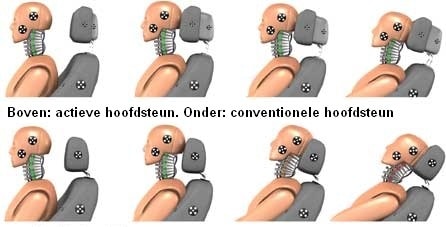
In a rear-end collision, the occupant is pushed into the seat and the head moves relative to the upper body with a very rapid motion backward and forward. Stretching of the neck muscles can result in permanent injury; whiplash. In such a collision, the active head restraint provides protection by moving forward. The occupant’s head is caught, preventing the neck from making too large a movement.
The following image shows the situation with an active head restraint (top) and without an active head restraint (bottom).
Mechanical active head restraint:
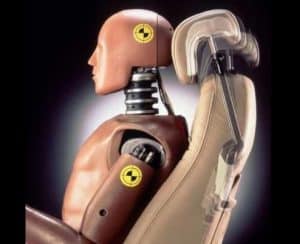
In a seat with a mechanical active head restraint, a pressure plate is installed that is pushed backward by body weight. A lever mechanism moves the head restraint upward and forward. The movement of the head restraint catches the person’s head and slows the motion.
Immediately after the collision, the pressure plate and the head restraint automatically return to their original position.
Electrical active head restraint:
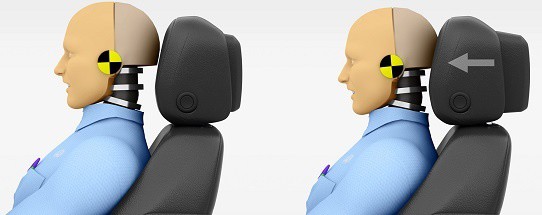
In this system, the moving mechanism is integrated only into the head restraint. The head restraint consists of two elements that are forced apart during a collision by an electromagnetic actuator. The airbag control module provides actuation of the actuator. After actuation, springs between the two elements push the cushion toward the person’s head and neck. The head restraint itself does not move during a collision. After activation, the head restraint can often be reset with special tools and diagnostic equipment. In other cases, it is necessary to replace the actuator.
Related pages: