Introduction:
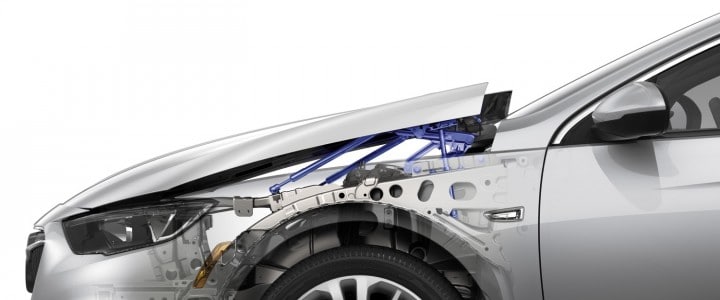
Active hood hinges are designed to protect pedestrians as much as possible from injury in the event of a collision.
The vehicle electronics ensure that the rear of the hood (windshield side) moves up a few centimeters. The pedestrian experiences a less severe impact and, thanks to this technology, is less likely to be injured. Sometimes this system is expanded with a pedestrian airbag, which inflates at the windshield.
Required sensors and actuators:
The image below shows the sensors and actuators with the legend used on a BMW 5 Series (models F10 and F11) for the active hood hinges. Below the image, the system is explained.
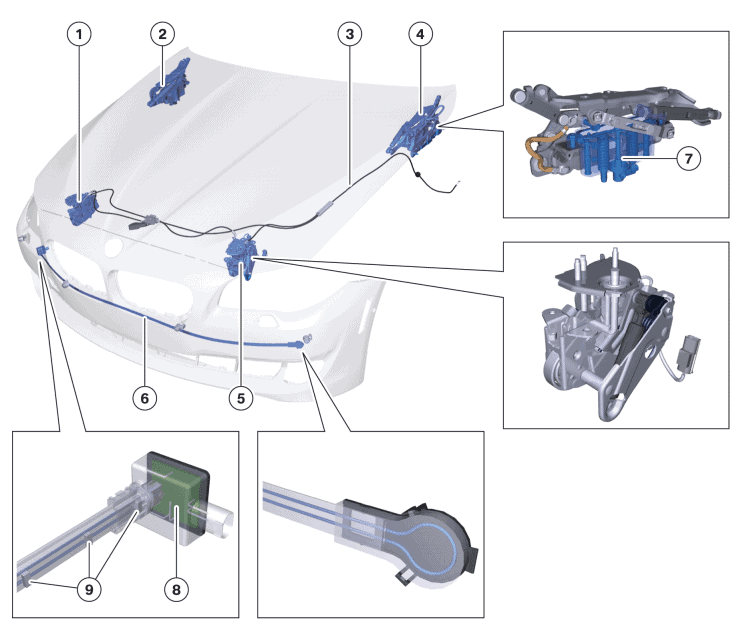
- right hood latch with actuator;
- right hood hinge with actuator;
- Bowden cable (for hood release);
- left hood hinge with actuator;
- left hood latch with actuator;
- optical fiber cable;
- pyrotechnic actuator on the left hood hinge;
- sensor;
- connecting elements.
An optical fiber cable (6) is located on the bumper beam of the body. The sensor sends an optical (light) signal through the optical fiber cable to the loop in the other bumper corner. The light signal returns to the sensor. In a minor collision, the front bumper deflects slightly. The optical fiber cable is then pinched between the front bumper and the bumper beam. Due to this pressure, the optical fiber cable breaks at the connecting elements (9). The transmitted light signal does not reach the sensor, or at least reaches it weakened, causing the connected control unit to detect a collision.
Instead of the optical fiber cable, deceleration sensors can also be used that measure both the deceleration and the deformation of the bumper.
At the moment the control unit detects that a collision has occurred, it triggers the pyrotechnic actuators of the hood hinges, and in this case also those of the hood latches. The hood rises by approximately 50 mm and often moves about 20 to 30 mm rearward.
The system is activated at speeds between (approximately) 20 and 55 km/h), depending on the manufacturer. After the pyrotechnic igniters have been triggered, a fault message appears in the vehicle display. In most cases, the hood can be closed again by pushing it down and forward at the corners in one motion. The pyrotechnic igniters must be replaced, however; they work only once. After replacement, the fault message can be cleared.
If the hinges are equipped with mechanical actuators instead of pyrotechnic igniters, no components need to be replaced.
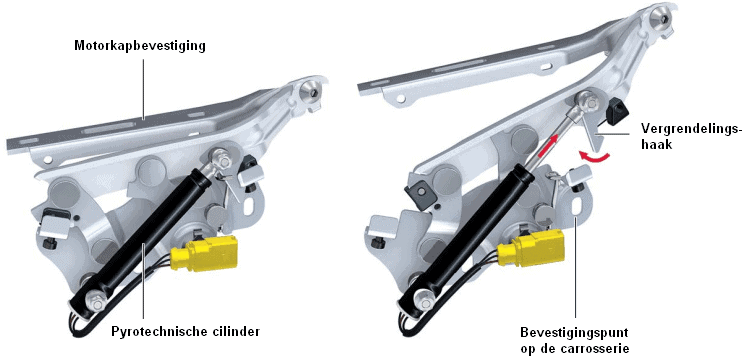
Pyrotechnic hood hinge in detail:
The image shows two situations in which the hood hinge may be in.
The hinge in the left image is intact; the hood is closed (as can be seen from the hood mounting). The pyrotechnic cylinder with the yellow connector is clearly visible.
The right image shows the activated hinge. The pyrotechnic cylinder has pushed the hinge with the hood upward.