SCR catalytic converter and AdBlue:
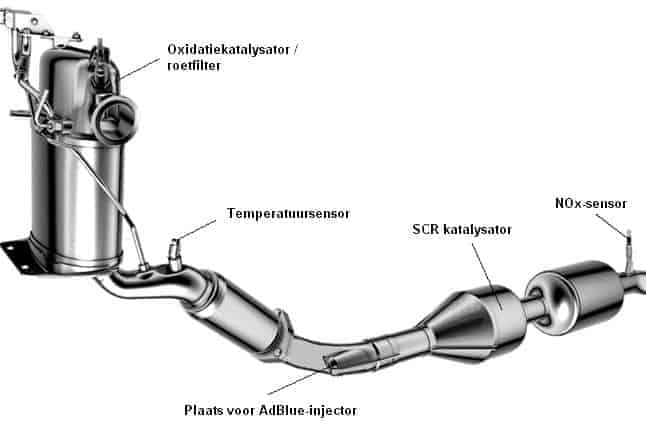
In the exhaust system of certain modern diesel engines there is a “Selective Catalytic Reduction” catalytic converter. Together with the AdBlue dosing system, this provides exhaust aftertreatment. The goal, just like with EGR, is to reduce emissions of NOx (nitrogen oxides). NOx is formed at high combustion temperatures.
Operation is as follows: the NOx in the exhaust gases is stored in the SCR catalytic converter. The SCR catalytic converter is installed in the exhaust downstream of the diesel particulate filter. When a certain amount of NOx has been stored in the catalytic converter, AdBlue is injected into the exhaust using an injector. Immediately after injection, the hydrolysis process begins; this is the splitting of a chemical compound through a reaction with water. During this hydrolysis process, the AdBlue is converted into ammonia and carbon dioxides. The ammonia and carbon dioxides then enter the SCR catalytic converter.
In the SCR catalytic converter, the ammonia reacts with the NOx (nitrogen oxides). The harmful substances in NOx are converted into the harmless substances nitrogen (N2) and water (H2O). Before the nitrogen and water are released into the outside air via the exhaust, the NOx sensor measures how much NOx is still present in the exhaust gases. This is described in the next paragraph.
By using AdBlue, diesel engines can comply with the Euro 5 and 6 standards.
The AdBlue is stored in a separate tank elsewhere in the vehicle. This can be either in the engine compartment or near the fuel tank.
Average AdBlue consumption is about 3 to 5% of diesel consumption. So AdBlue needs to be refilled less often than the vehicle needs to be refueled.
When the AdBlue tank is almost empty, an indicator light or message will appear on the dashboard. This happens several thousand kilometers before the AdBlue tank is actually empty, giving the driver time to refill the system. If the driver ignores the message and the tank is completely empty, there is a chance that the engine electronics will prevent the engine from being started. After all, if there is no AdBlue left in the tank, the vehicle no longer meets the environmental requirements. As soon as the system detects that there is AdBlue in the tank again, the engine can be started again.
Injecting AdBlue:
From the storage tank, the AdBlue is pumped by a pump to the AdBlue injector at a pressure of about 5 bar. This high pressure is needed to ensure the AdBlue can be properly atomized in the exhaust gas. The injector is controlled via the engine electronics using a PWM signal.
The engine electronics determines the amount of AdBlue to be injected. The dosing must be as accurate as possible. The hazards of incorrect dosing are as follows:
- injecting too little: not all NOx is converted.
- injecting too much: emissions of harmful ammonia because the chemical reaction in the SCR catalytic converter has not taken place sufficiently.
The NOx sensor downstream of the SCR catalytic converter measures the NOx present. If the NOx level is too high, the engine management system will ensure that a little more AdBlue is injected. Nowadays an ammonia sensor is also used. Excess ammonia is measured by this sensor, so the amount of AdBlue to be injected is reduced.
Refilling AdBlue:
AdBlue must be refilled periodically. As described in the previous paragraph, you cannot wait too long to refill when the AdBlue tank is almost empty. The driver is responsible for checking the fluid level and refilling it.
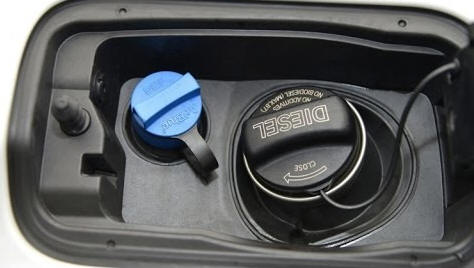
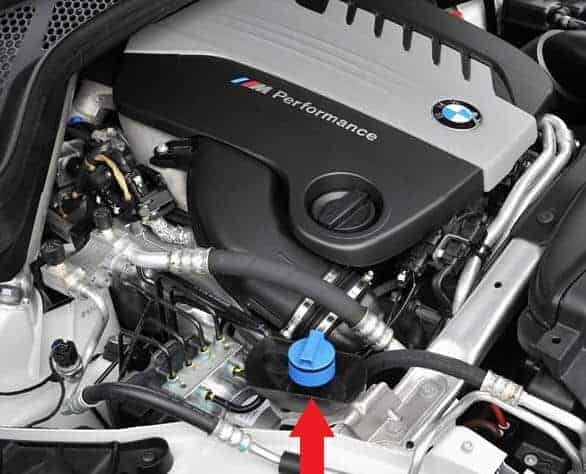
In passenger cars, the filler openings can be located in a number of places. In exceptional cases, the AdBlue filler opening is located behind the rear bumper, but usually it is behind the fuel door next to the fuel cap, or in the engine compartment. The filler opening can be recognized by the blue screw cap.
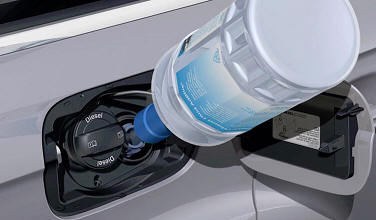
AdBlue is always in a sealed bottle. Contact between the AdBlue and outside air should be avoided as much as possible. Outside air contains moisture. When AdBlue comes into contact with moisture, it can crystallize. That is why a threaded connection between the bottle and the filler opening is possible, as can be seen in the image.
The bottle must be screwed onto the car’s filler opening. By pressing the bottle against the spring force of the screw cap, the AdBlue slowly flows through the filler opening into the car’s tank. You can refill until the bottle no longer drains; then the AdBlue level in the vehicle’s reservoir is at its maximum.