Exhaust gases petrol engine:
The exhaust gases of a petrol engine contain the following substances:
- CO2: Carbon dioxide (harmful to the environment, humans and animals at high concentrations)
- CO: Carbon monoxide (incompletely combusted gas, also harmful to health)
- CH: Hydrocarbons (unburned petrol components)
- O2: Oxygen components (that did not participate in the combustion)
- NOx: Nitrogen compounds (which are only formed at very high combustion temperatures).
The catalytic converter converts the three harmful components CO, HC and NOx into 3 harmless components: CO2, H2O and N2. The name three-way catalytic converter is derived from this.
| Harmful substance: | Adding: | Results in: |
| CO + | O2 = | CO2 |
| HC + | O2 = | CO2 + H2O |
| NOx + | CO = | N2 + CO2 |
During a cold start, enrichment takes place; there is then an excess of fuel present. During a cold start, extra CO and HC are emitted. Because during a cold start the catalytic converter has not yet reached its operating temperature, these substances cannot yet be converted. With the aid of the secondary air pump, additional air is added to the exhaust gases. Due to the extra supplied air, the temperature of the exhaust gases becomes higher and the catalytic converter warms up more quickly. The harmful substances can be converted more quickly after a cold start.
Even though manufacturers make every possible effort to reduce the harmful components in the exhaust gases, they are still present even with optimal combustion. Nevertheless, the European Union obliges manufacturers to make new engines increasingly “cleaner”. The emission standard defines the limits of the emissions. The table below shows the EU standards for a petrol engine:
| Stage | Effective | NOx | HC | NMHC | HC+NOx | CO | PM |
| Euro 1 | 1993 | – | – | – | 970 | 2720 | 140 |
| Euro 2 | 1996 | – | – | – | 500 | 2200 | – |
| Euro 3 | 2000 | 150 | 200 | – | – | 2300 | – |
| Euro 4 | 2005 | 80 | 100 | – | – | 1000 | – |
| Euro 5 | 2009 | 60 | 100 | 68 | – | 1000 | 5 |
| Euro 5b | 2011 | 60 | 100 | 68 | – | 1000 | 4.5 |
| Euro 6 | 2014 | 60 | 100 | 68 | – | 1000 | 4.5 |
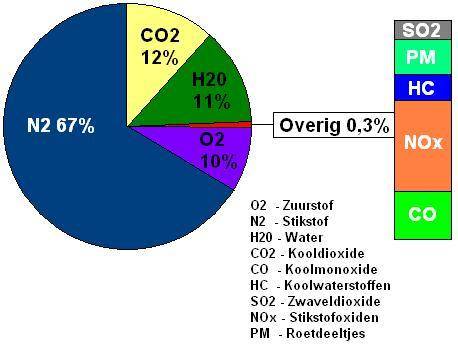
Exhaust gases of a diesel engine:
- 67% Nitrogen (N2)
- 12% Carbon dioxide (CO2)
- 11% Water (H2O)
- 10% Oxygen
- 0.3% other substances, including soot particles (PM), Hydrocarbons (HC), Nitrogen oxides (NOx), Carbon monoxide (CO)
On diesel engines, a three-way catalytic converter is also being used more and more often nowadays to convert the minimal amount of CO into CO2 and H2O.
The EU standards obviously also apply to diesel engines. Thanks to technical developments, emissions of CO2, nitrogen oxides and soot particles from modern diesel engines have decreased significantly. Since 1990, soot emissions from diesel engines have decreased by 99%. The table below shows the EU standards for a diesel engine:
| Stage | Effective | NOx | HC+NOx | CO | PM |
| Euro 1 | 1993 | – | 970 | 2720 | 140 |
| Euro 2 | 1996 | – | 700 | 1000 | 80 |
| Euro 3 | 2000 | 500 | 560 | 640 | 50 |
| Euro 4 | 2005 | 250 | 300 | 500 | 25 |
| Euro 5 | 2009 | 180 | 230 | 500 | 5 |
| Euro 5b | 2011 | 180 | 230 | 500 | 4.5 |
| Euro 6 | 2014 | 80 | 170 | 500 | 4.5 |
Four-gas analyzer:
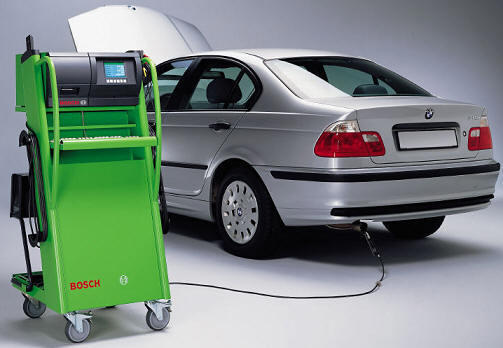
During an exhaust gas test of a car with a petrol engine, for example during the periodic vehicle inspection (APK), the values are read from the four-gas analyzer. A probe is inserted into the exhaust and the engine must run at an elevated speed. The engine must be at operating temperature. During this exhaust gas test, the following is checked:
- HC (reference value: 20 – 100 ppm)
- CO (reference value: see APK requirements)
- CO2 (reference value: 15 – 16%)
- O2 (reference value: as low as possible)
The inspector assesses these values. If these values are not within the tolerances, the car will be rejected.
When the values fall outside the tolerances, this can have many causes. The information below helps in finding the cause:
HC too high:
- lean mixture, cylinder misfire;
- rich mixture;
- oil consumption;
- ignition failure.
CO too high:
- mixture too rich;
- ignition timing (too early or too late);
- crankcase ventilation;
- tank ventilation / activated carbon filter.
CO2:
- A high CO2 content indicates that the combustion has been complete. A CO2 content that is too low is a result of a lean mixture or leakage in the exhaust.
O2:
- With incomplete combustion and/or with a leak in the exhaust, a high O2 value occurs.
| CO | CO2 | HC | O2 | Possible causes |
| H | L | H | H | Rich mixture, ignition problem |
| H | L | H | L | Engine temperature too low due to defective thermostat or temperature sensor |
| L | L | L | H | Exhaust leakage after the catalytic converter |
| L | H | L | H | Lean mixture, problem with injection system |
| H | L | GL | L | Rich mixture |
| H | H | H | H | Problem with injector and/or catalytic converter: combination of rich mixture and false air |
| L | L | H | H | Ignition problem, lean mixture, false air |
| L | H | L | L | Good combustion and properly working catalytic converter |