Function of the secondary air pump:
A petrol engine always has a rich mixture during a cold start. This means that there is an excess of fuel, so less oxygen. Because the catalytic converter is not yet at operating temperature during a cold start, it will not yet clean the exhaust gases. This means that the cold start leads to the emission of a large amount of carbon monoxide (CO) and unburned hydrocarbons (HC). The purpose of the secondary air pump is to warm up the catalytic converter more quickly.
With a secondary air pump, outside air is added into the exhaust tract. The extra air is routed into the exhaust before the catalytic converter. Adding the extra air leads to an exothermic reaction. Exothermic means that heat is generated because the present CO and HC components burn at the moment they come into contact with the extra supplied air. This increases the temperature of the exhaust gas. Due to the higher exhaust gas temperature, the catalytic converter will also heat up quickly, so that during a cold start the harmful components in the exhaust gases are reduced as quickly as possible are reduced.
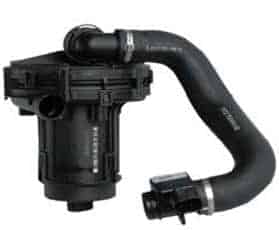
Operation of the secondary air pump:
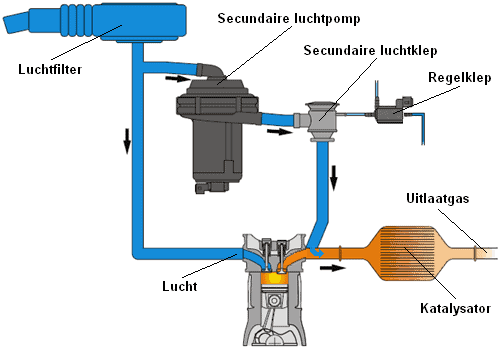
The secondary air system is located between the air filter and the exhaust. On the intake pipe from the air filter there is a branch to the secondary air pump. From the secondary air pump an air hose runs to the secondary air valve. This air valve is only open with a cold engine and an operating air pump. When the air pump is switched off, the air valve is closed, because otherwise the exhaust gases could flow to the air pump. The opening and closing of the air valve is controlled pneumatically (with vacuum) by the control valve, which is controlled by the engine ECU.
The outside air is supplied directly to the exhaust gas. In the exhaust, the exhaust gas will heat up immediately. As a result, the catalytic converter reaches its operating temperature (from 250° Celsius) within a short time. When the air pump is operating, this can be audible. The sound often resembles a vacuum cleaner. The pump often switches off again between 20 and 30 seconds after the cold start, because the catalytic converter is then already sufficiently warmed up.
The extra supplied air is detected by the lambda sensors. In the event of a malfunction in the secondary air system, such as a sticking air valve or leakage in the hoses, the lambda sensors will measure the deviation. The engine management will cause the emission warning light on the dashboard to illuminate. After all, with a fault in the secondary air system, more harmful substances are emitted. A fault in the secondary air system has no influence on the operation of the engine.
In addition to the secondary air system, the exhaust gas recirculation system (EGR) also provides for the aftertreatment of the exhaust gas.