Air conditioning not working properly:
When we receive complaints about the poor performance of the air conditioning, we try to find out exactly what the complaint involves. We also try to gather more information about when the A/C was last serviced.
- Check the outlet temperature from the opened ventilation grilles with the A/C switched on (preferably in recirculation mode or MAX mode, where recirculation is switched on automatically);
- If the air is not sufficiently cooled: check whether the A/C has gone more than four years without maintenance. In that case, check whether there is sufficient refrigerant in the system;
- Check the pressures with the air conditioning system switched on and off, and check the temperatures of the components. The following sections cover this in more detail.
System pressure in the air conditioning system:
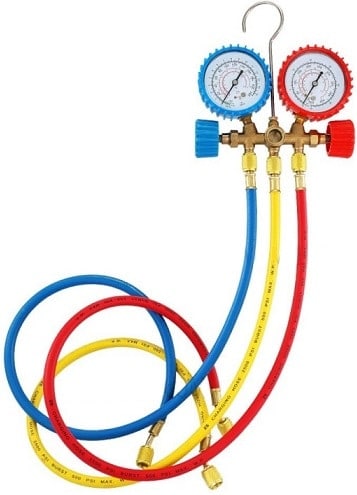
We can check the pressure in the air conditioning system with pressure gauges. The hoses must be connected to the service ports of the A/C system. When the nipples are tightened, the refrigerant will flow from the A/C into the gauges. If the system is empty, the needles will move and indicate the pressure of the system. The image below shows such a pressure tester. The pressure gauges are also present on a service station (A/C filling device).
The pressure gauge in the image contains two needles and three hoses.
- Blue is low pressure;
- Red is high pressure;
- The yellow hose on the pressure gauge is used to add nitrogen to the system for leak detection.
If the air conditioning has been switched off for some time, the gauges will indicate approximately the same pressure after connecting. After starting the engine, the low pressure will drop and the high pressure will rise. Pressure is related to temperature: when the pressure increases, the temperature also increases, and vice versa.
- The low pressure drops due to the temperature reduction of the refrigerant after it leaves the evaporator;
- The high pressure rises because the liquid refrigerant has warmed up after leaving the condenser.
The pressure will stabilise after a few minutes. The evaporator does not cool down further than a few degrees above freezing and the fan draws a constant outside air temperature through the condenser.
When the air conditioning no longer functions properly, in addition to reading out the fault memory (there may be a fault stored for a pressure sensor), we can measure the temperature, but also read the pressures with the gauges to make a diagnosis. The level of pressure tells us something about the condition of the system.
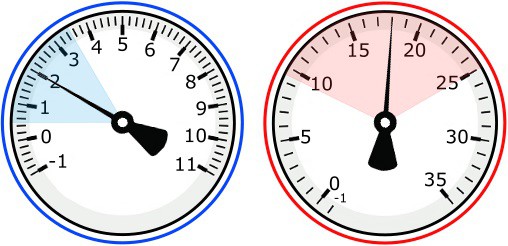
The pressures shown are what we see in a properly functioning system. The blue gauge indicates the low pressure (2 bar) and the red one the high pressure (18 bar). The pressures are highly dependent on temperature: as soon as the temperature of the outside air, evaporator, or other components changes, we see this directly reflected in the pressure.
The coloured sections on the dials indicate the working pressures:
- Low pressure: between 0.5 and 3.5 bar;
- High pressure: between 9.5 and 25 bar.
In cars we find compressors with the following types of swash plates:
- Fixed displacement: the low pressure (suction pressure) varies between 1 and 1.5 bar. The magnetic clutch switches the compressor on and off;
- Variable displacement with constant output: the swash plate is adjusted mechanically. The low pressure is constantly 2 bar, regardless of the compressor speed. A magnetic clutch provides the drive;
- Variable displacement with controlled output: the swash plate is controlled electrically. The suction pressure varies between 2 and 5 bar and depends on the ECU control. This type of compressor does not have a magnetic clutch.
Diagnosis based on system pressures:
In the previous section we saw the system pressure of a properly functioning system. In the case of a fault, we can often see this reflected in the pressures. Whether we are dealing with a leak causing too little refrigerant to be present, or an overfill during service, reading the pressures will reveal it. In this section we discuss the possible causes of too high or too low pressure in the high- or low-pressure circuit. Do pay attention to the compressor type!
Low and high pressure 0 bar
- Refrigerant pressure is 0 bar, so there is no pressure in the system. The system is empty and must be checked for leaks before refilling the system.
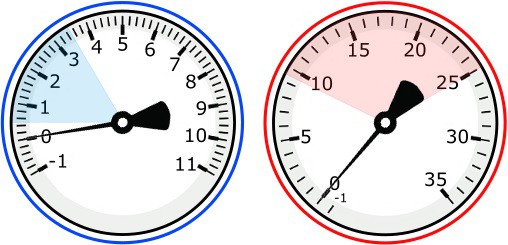
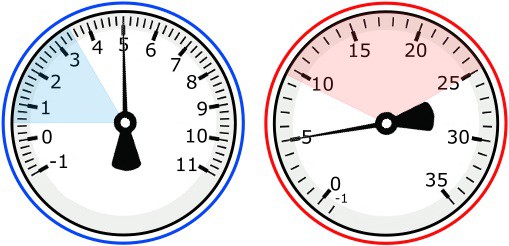
Low and high pressure equal
- The pressure does not change when the A/C is switched on or off: the A/C compressor is not functioning. The compressor probably does not engage (due to an ECU enabling condition) or the magnetic clutch is defective.
Low pressure high, high pressure normal
- Expansion valve open;
- Defective heater flap in the heater housing causing warm air from the heater to enter the evaporator. Pinch off the coolant hose to the heater radiator to see if this affects the low pressure.
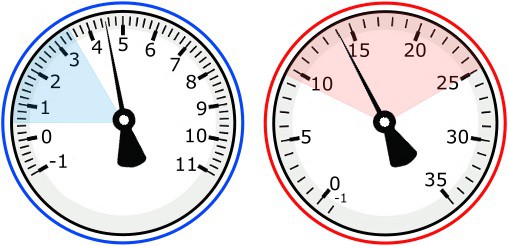
Low pressure high, high pressure high
- Too much refrigerant (measure and calculate the superheat);
- The condenser is overheating due to a restriction (perhaps visible damage?) or the cooling fan is not working;
- Too much oil in the system: the system may recently have been topped up with too much oil;
- Air in the system.
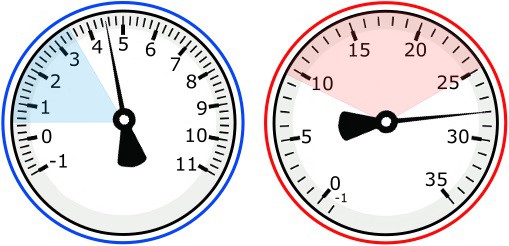
Low pressure high, high pressure low
- Expansion valve has too large an opening, or remains open;
- Compressor defective. Try to turn the compressor by hand and check the resistance;
- Control valve for variable compressor output defective.
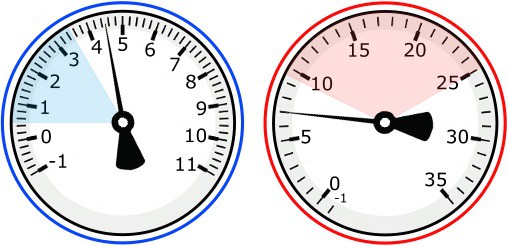
Low pressure low, high pressure low
- Too little refrigerant (measure and calculate the superheat);
- Compressor defective. Check whether the pressure is correct with the compressor switched off but shows these pressures when switched on;
- High-pressure side partially blocked (pressure must be correct when the system is switched off).
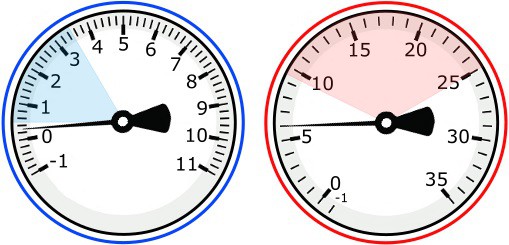
Low pressure low, high pressure normal
- There is warm air in the evaporator or the interior due to a possible problem with the recirculation mode or the heater flaps / air vents;
- The heater continues to blow warm air, possibly due to a stuck heater flap;
- The evaporator is freezing up due to a possible defect in the anti-ice switch or interior fan.
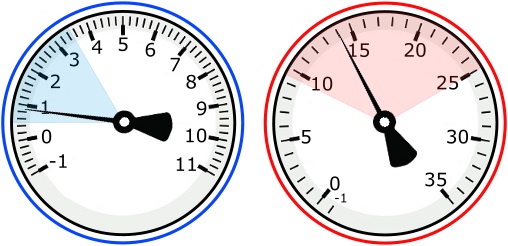
Low pressure low, high pressure high
- Too much refrigerant in combination with another problem;
- Restriction in the high-pressure side, e.g. due to a bent line as a result of a collision;
- Clogged thermostatic expansion valve, due to a mechanical defect or icing.
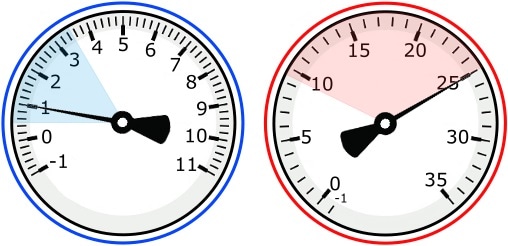
In the last pressure reading, there is a low low pressure and a high high pressure. With a restriction or blockage in the system, the low pressure can drop to 0 bar because the compressor pulls the low-pressure side into a vacuum. In this case, the low pressure may also recover slowly: after switching off the A/C, the low pressure rises noticeably slowly back to the original pressure. A possible restriction (as a result of a bent line) can be traced with a temperature measurement. The temperature measurement is discussed in the next section.
Diagnosis based on pressure and temperature (superheat and subcooling):
As described in the first section, modern A/C compressors with variable displacement and constant output adjust the pressure to the conditions. The low pressure (suction side) is constantly 2 bar, regardless of engine speed. Measuring 2 bar therefore does not tell us very much about how the system is operating. With temperature measurements, however, we can make a diagnosis.
The table below describes the specified temperatures for a properly functioning system. The temperatures are guideline values for an A/C system that has been switched on for at least 10 minutes and at room temperature. In extremely high outside air temperatures, the temperatures and pressures in the A/C system may deviate.
- A reliable diagnosis can be made using a temperature measurement;
- The compressor temperature must not exceed 90 °C: the oil may start to boil;
- A temperature difference of 30 °C between the inlet and outlet of the condenser is acceptable. A lower temperature may be due to poor flow through the condenser, causing it to work less efficiently.
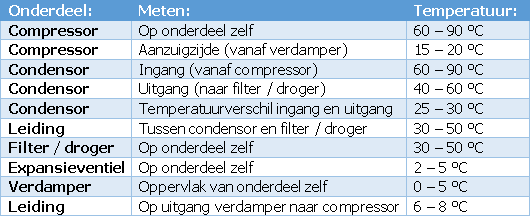
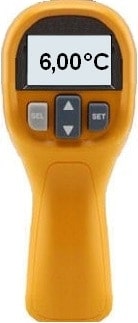
The following images show a low pressure of 2 bar, high pressure of 18 bar, and a temperature of 6 °C on the suction line after the evaporator (evaporator outlet to the compressor).
In the evaporator, the refrigerant changes from saturated vapour (vapour-liquid) to fully gaseous. The temperature of the refrigerant rises from 2–5 °C (from the expansion valve) to 6–8 °C at the outlet of the condenser.
Superheat:
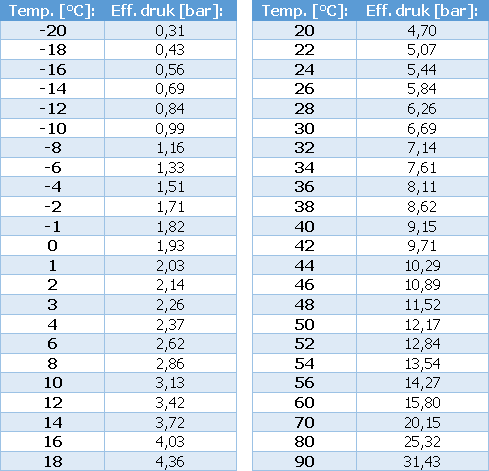
With the measured pressure and temperature we can calculate the superheat. Superheat is the difference between the suction line temperature and the evaporation temperature of the refrigerant.
- In a properly functioning system, the superheat is around 5 to 6 °C
- Superheat higher than 6 °C: the system charge is too low. When evacuating the system, for example, 200 grams will be removed from the system, while the maximum charge is 800 grams;
- Superheat lower than 5 °C: the system charge is too high. There is (far) more refrigerant in the system than specified by the manufacturer.
To calculate the superheat we need the table next to it to look up the evaporation temperature at a given pressure. In the table we see that at a pressure of 2.03 bar the refrigerant evaporates at a temperature of 1 °C.
When the air conditioning is not functioning properly, we can use this data to determine the cause. The three examples below show systems that are functioning properly and those that are not.
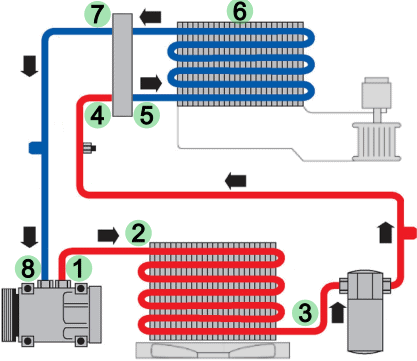
Example 1 calculating superheat for a properly functioning air conditioning system:
Pressures and temperatures with the engine switched off:
- LP: 6 bar, 20 °C (ambient temperature)
- HP: 6 bar, 20 °C (ambient temperature)
Pressures and temperatures measured with the engine running at 2000 rpm and A/C switched on for 15 min.:
- 12 bar, 85 °C
- 12 bar, 82 °C
- 12 bar, 50 °C
- 12 bar, 42 °C
- 2 bar, 1 °C
- 2 bar, 6 °C
- 2 bar, 7 °C
- 2 bar, 9 °C
Conclusion example 1:
In case of complaints about a poorly functioning air conditioning system, we can follow the five steps below to determine the condition of the air conditioning system:
- With the air conditioning switched off, both the high and low pressures are 6 bar. This is correct;
- With the air conditioning switched on, the low pressure drops to 2 bar. This pressure is regulated by the variable compressor. The high pressure depends on the condenser temperature: here we measure 12 bar.
- We measure the temperature at the outlet of the evaporator with an infrared thermometer: it is 6 °C;
- We look up the evaporation temperature of the refrigerant that corresponds to the value measured on the low-pressure line: at a pressure of 2 bar, the evaporation temperature is 1 °C;
- We calculate the superheat by subtracting the evaporation temperature from the suction line temperature: (6 – 1) = 5 °C.
In a properly functioning system, the superheat is around 5 to 6 °C, so based on this measurement we can conclude that the air conditioning system is in good condition.
Example 2 calculating superheat in a non-properly functioning air conditioning system:
Pressures and temperatures with engine switched off:
- LP: 5 bar, 20 °C (ambient temperature)
- HP: 5 bar, 20 °C (ambient temperature)
Pressures and temperatures measured with the engine running at 2000 rpm and the air conditioning switched on for 15 minutes:
- 12 bar, 98 °C
- 12 bar, 81 °C
- 12 bar, 55 °C
- 12 bar, 40 °C
- 2 bar, 5 °C
- 2 bar, 13.2 °C
- 2 bar, 14 °C
- 2 bar, 15 °C
Conclusion example 2:
With the system switched off, the high and low pressures are 5 bar. With the engine and air conditioning switched on, the low pressure drops to 2 bar and the high pressure rises to 12.0 bar. The pump switches on and the air conditioning should in principle now cool properly.
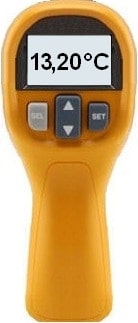
We measure a temperature of 13.2 °C with an infrared thermometer on the outlet line of the evaporator. This is significantly higher than the 6 °C in example 1.
- The low pressure is again 2 bar, so the evaporation temperature of the refrigerant is 1 °C;
- The superheat is: (13.2 – 1) = 12.2 °C.
We see a much higher temperature difference here than in the example with a properly functioning air conditioning system. As a result, the temperature difference with the passing air also becomes smaller. The interior air is therefore cooled less effectively. The passengers in the car notice this as a poorly functioning air conditioning system. The cause is a too low fill quantity. The system still operates with the amount of refrigerant present, but no longer as one may expect.
Example 3 calculating superheat in a non-properly functioning air conditioning system:
Pressures and temperatures with engine switched off:
- LP: 6 bar, 22 °C (ambient temperature)
- HP: 6 bar, 22 °C (ambient temperature)
Pressures and temperatures measured with the engine running at 2000 rpm and the air conditioning switched on for 15 minutes:
- 24 bar, 98 °C
- 24 bar, 81 °C
- 24 bar, 55 °C
- 24 bar, 40 °C
- 3.5 bar, 10 °C
- 3.5 bar, 6 °C
- 3.5 bar, 1 °C
- 3.5 bar, -2 °C
Conclusion example 3:
The pressure, and especially the temperature at the compressor outlet, are too high. The low pressure is also on the high side at all measured points. Between the evaporator and the compressor the temperature continues to drop, which shows that evaporation is still taking place. If refrigerant continues to evaporate after the TEV valve, this indicates that there is too much refrigerant in the system.
In addition to reasoning out the cause, we can also demonstrate this mathematically by calculating the superheat. At a pressure of 3.5 bar, the evaporation temperature is 13 °C. The measured temperature is 6 °C. By subtracting the evaporation temperature from the measured temperature, we can calculate the superheat: 6 °C – 13 °C = -7 °C. The superheat is therefore -7 °C. With superheat lower than 5 °C, the conclusion is: the fill quantity of the system is too high.
Subcooling:
In addition to the temperature measurement at the condenser, the subcooling can also be determined. By subcooling we mean the difference between the condensing temperature and the temperature at the outlet of the condenser. This allows us, among other things, to determine an excessively high or low fill quantity, and we can be sure that liquid is coming out of the condenser. Subcooling is usually between 5 and 15 °C.
- No subcooling means too little refrigerant;
- Too much subcooling is caused by too much refrigerant.
To determine the subcooling, we follow the steps below:
- With the system switched on, we determine the condensing temperature of the refrigerant in the outlet line at the condenser: in the table we find a condensing temperature of 50 °C at 12 bar;
- We measure a temperature of 40 °C at the condenser outlet with the thermometer;
- We calculate the subcooling as follows: subcooling = condensing temperature – temperature at condenser outlet, so (50 – 40) = 10 °C. This temperature is correct.
The software in the air conditioning ECU also determines the superheat and subcooling if the system is equipped with multiple pressure and temperature sensors. In this way, the ECU can determine that there is too little refrigerant in the system and store a fault code for it, while the pressures still appear to be reasonably good.
Related page: