Introduction:
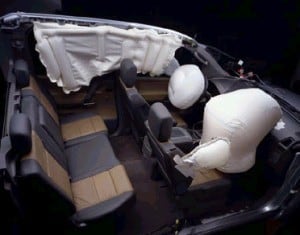
An airbag is a supplementary restraint system. Together with the seat belts, airbags must protect the occupant(s) of a car when it is involved in a collision. Virtually every modern car has one or more airbags. These are the airbags located in the steering wheel on the driver’s side and in the dashboard on the passenger side. More advanced models also have side airbags in the headliner, doors, or seats.
The airbags are activated when the vehicle experiences a deceleration greater than 12 m/s². The crash sensors register the deceleration and send this to the airbag control unit. The control unit then activates the airbags, which fully inflate within a few milliseconds.
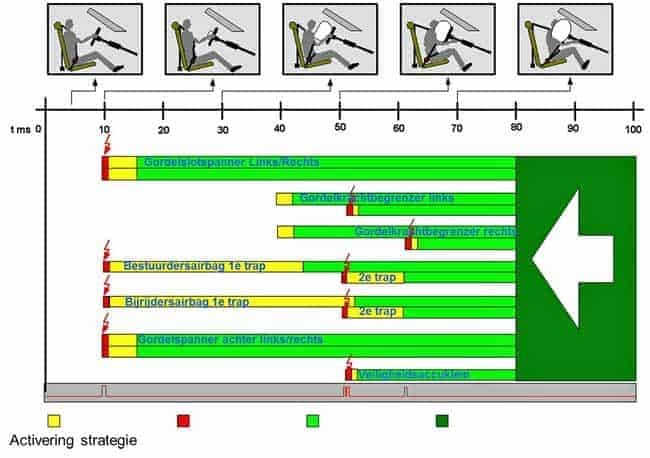
In addition to the airbags, the control unit operates more safety components to protect the occupants of the vehicle as effectively as possible. Not all components are activated at the same time. The actuation timing is programmed in the software of the control unit. Depending on the severity of the collision, the following safety components are activated:
- In a minor collision: nothing happens;
- In a somewhat more severe collision: the belt tensioners are activated. If the vehicle is equipped with seat occupancy detection, the passenger belt tensioner will only be activated when the sensor detects a person on the seat;
- In an even more severe collision: the airbag is triggered. Modern systems are equipped with a dual-stage airbag.
- With a light deceleration where the airbag is triggered, the time between the first and second stage is 100 ms.
- With a higher deceleration, the time between the first and second stage is shorter.
- The first and second stages can even take place simultaneously if the deceleration is very high.
Deceleration sensors:
The vehicle’s deceleration is measured by deceleration sensors. If the deceleration becomes much greater than the maximum braking deceleration of the car, it must be caused by a collision. When the airbag sensors measure a deceleration that is greater than 12 metres per second, these sensors send a signal to the airbag control unit. The latter will then activate the airbags. An average passenger car with good brakes has a braking deceleration between 5 and 7 metres per second; sports cars can reach a deceleration of up to approx. 8 metres per second. This means you can never reach the limit value of 12 m/s just by braking. Even at low-speed impacts against a pole or wall, this deceleration is not always reached and the airbags will therefore not be activated.
Most newer deceleration sensors are integrated into the control unit, but sometimes the sensors are also mounted separately on body parts. They respond to inertia in one direction, so it is important that the sensor is mounted correctly (so not upside down, because then the airbags will not be triggered in a collision). Deceleration sensors can be designed either electronically or electromechanically. An electronic deceleration sensor has a piezo crystal mounted inside. When a force is exerted on a piezo crystal, a voltage is generated in it. The force acting on the sensor arises from the deceleration during a collision. The level of the generated voltage depends on the severity of the impact.
The system can also be equipped with an electromechanical deceleration sensor that closes mechanically once a certain force is reached. At that moment an electrical contact is closed. The generated signal is then sent to the control unit. When both the electronic sensor with piezo crystal and the safety switch send a signal to the control unit, the control unit activates the airbags in the interior.
Airbag modules:
Each steering wheel, passenger, and side airbag has its own airbag module. When the control unit supplies the airbag modules with voltage, the airbag modules are triggered. An explosion follows, releasing a large quantity of gas that consists of 99% nitrogen. This gas fully inflates the airbag. An airbag deploys at a high speed of around 300 km/h. After the airbag has inflated, it must also deflate very quickly for safety reasons. There are large openings at the rear of the airbag modules through which the hot gas can escape.
Airbag control unit:
The airbag control unit operates the airbag modules to trigger the airbags. Another task of the airbag control unit is to activate only the airbags at locations where passengers are seated. A special sensor mat under the seat upholstery detects whether someone is sitting on the seat. If so, the airbag control unit will also trigger that airbag. If no one is sitting on the seat, that airbag will not be deployed. This significantly helps to save costs, because an airbag is not cheap. As a safety measure, the airbag warning light is activated when there is a fault in the sensor mat.
There are also dual-stage airbags that activate depending on the body weight of the person. The aforementioned sensor mat measures the weight. If it is low, stage 1 is activated. If the weight is above e.g. 100 kg, the second stage is activated. The air volume in the bag is increased in the second stage, causing the bag to inflate more.
The control unit always applies a certain low voltage to the airbag and, by checking the resistance, can determine whether the airbag is still present and in good condition. This check is performed four times per second. If an airbag is removed, the control unit will detect this, which will immediately cause the airbag warning light to come on. This can happen when the ignition is switched on at the moment that a component of the system has been removed. For safety reasons, the light will not go out again until it is reset with the diagnostic tool via the OBD system.
Driver and passenger airbag:
The driver’s airbag is located in the centre of the steering wheel. In a frontal collision, it inflates completely in a very short time. The purpose of this airbag is to cushion the forward-moving occupant. After deployment, the airbag immediately begins to deflate again, otherwise there is a risk of suffocation.
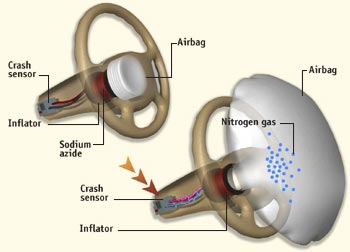
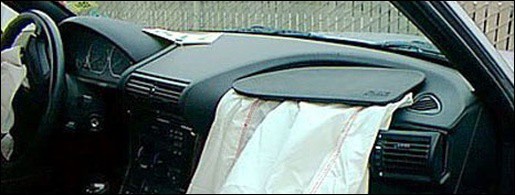
The driver’s airbag has a volume of approximately 35 litres, and the passenger airbag 65 litres. The passenger airbag has a larger volume because the dashboard is farther away from the seat.
The driver and passenger airbags are not activated in side impacts, vehicle rollovers, rear-end collisions, or when driving on rough terrain/over kerbs. These airbags only deploy in frontal collisions.
Clockspring:
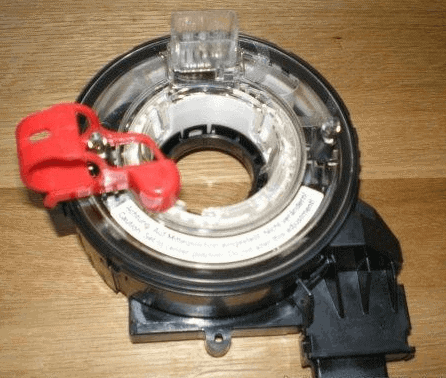
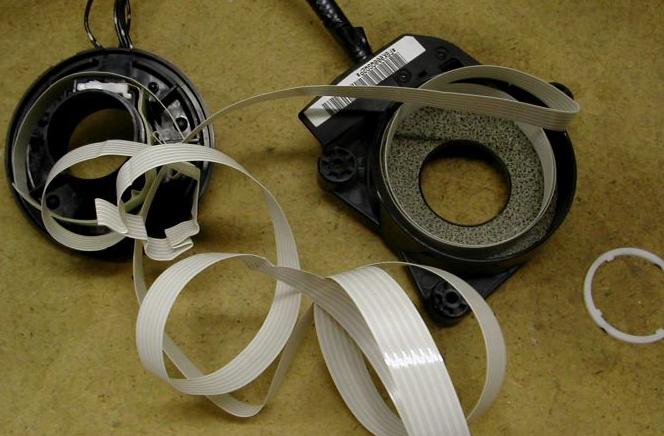
To connect the airbag in the steering wheel to the control unit, a special wire is needed. A normal wire could wear out over time due to frequent steering movements. This wire is also called a contact reel, clockspring, or spiral cable. The most common term of these three is clockspring. It is a long, wide, flat wire (or ribbon) that is wound around the steering shaft. In this way, the maximum steering lock can be reached easily. When this clockspring is removed, its position at removal must be carefully noted. If the clockspring is twisted before installation, the spring will break during steering after refitting. The airbag warning light will illuminate immediately because no voltage can be sent to the steering wheel airbag anymore. A broken clockspring must not be repaired, only replaced.
Side airbag:
Side airbags, also called door airbags or seat airbags, are designed to protect the occupants in side impacts. This airbag can be located either in the door or in the seat backrest. The trim of the door or seat will tear along a specially prepared seam.
Curtain airbag:
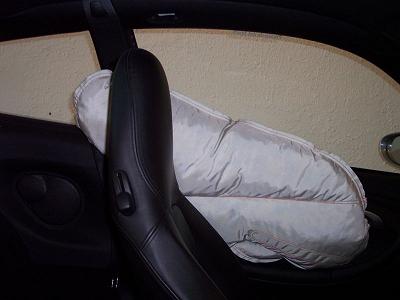
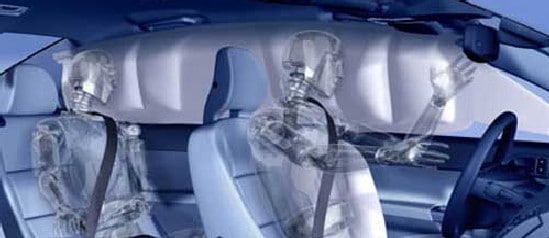
The curtain airbag is mounted up high near the headliner. In a side impact, it inflates and protects both the front and rear passengers.
Knee airbag:
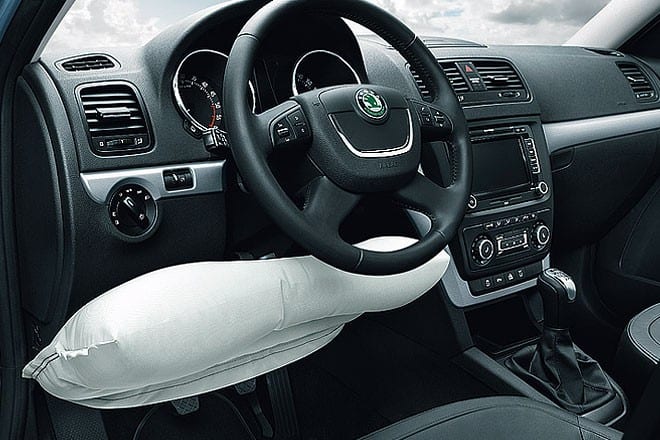
The knee airbag, as the name suggests, protects the knees in a frontal collision. Every year a lot of injuries occur because the knees hit the dashboard with great force. These strong air cushions aim to prevent that as much as possible. These airbags have been on the market for the shortest time and are not yet used on a large scale.
Belt tensioner:
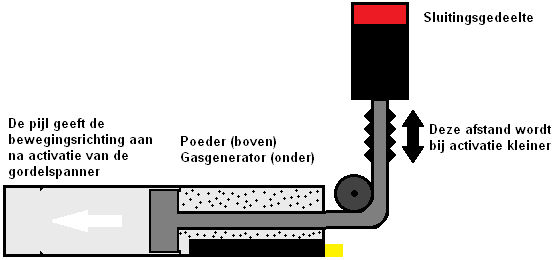
Safety systems are also often equipped with belt tensioners. The belt tensioners are also controlled by the airbag control unit. The operation of the belt tensioners with the tensioner at the buckle section and at the retractor is described on the page Gordelspanner.