Topics:
Roots Compressor:
A roots compressor (also called a supercharger) provides additional air supply to the engine. The cylinder is filled under overpressure so that, with the correct amount of injection and the correct ignition timing, higher power and torque can be obtained. The advantage of a roots compressor compared to a turbo is that it already builds up pressure at low engine speeds. A turbo first needs exhaust gases to build up pressure, which is also called turbo lag. A roots compressor is driven by a belt and does not suffer from this.
The disadvantage of this compressor is that engine power is lost because it is mechanically driven. A turbo does not have this disadvantage, which is why the ultimate power gain with a turbo is greater.
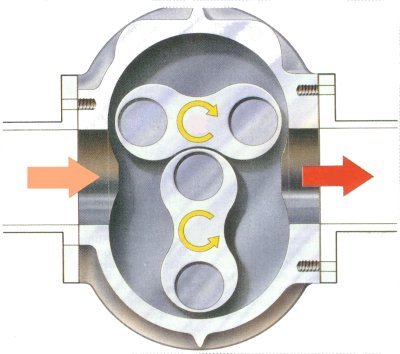
The two rotors in the picture on the right rotate in opposite directions. They do not touch each other while rotating. Because the upper rotor turns clockwise and the lower one counterclockwise, air is carried along the top and bottom of the compressor housing. This air provides the pressure charging of the engine.
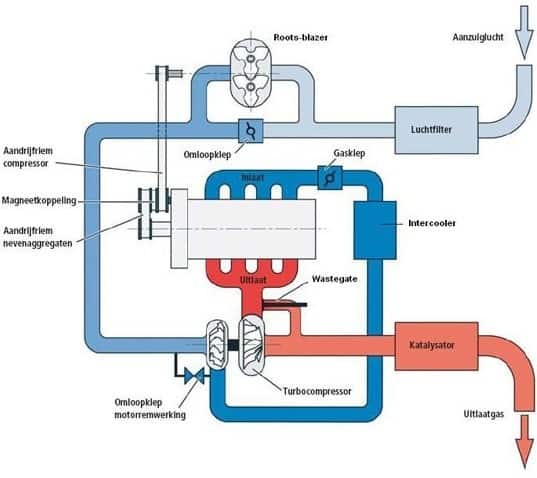
There are engines in which both a roots compressor and a turbo are used, e.g. the TSI engines from Volkswagen. (The turbo is a separate component and is described in detail on the Turbo page). Thanks to the compressor, these TSI engines have higher torque and higher power at low engine speeds. At low revs the compressor is operating, which gets the turbo going and provides cylinder filling at low engine speeds, so that the engine has enough torque below 2000 rpm. At a certain engine speed (around 2000 rpm) the compressor is switched off and the turbo builds up pressure. The turbo provides more power at high engine speeds. Due to the combination of compressor and turbo there is no longer any turbo lag.
The compressed air goes via the compressor or bypass valve to the turbo and via the turbo through the intercooler to the intake manifold.
Intercooler:
The temperature of the compressed air can become very hot (warmer than 60 degrees Celsius). For better cylinder filling and thus also for better combustion, it is necessary that the air cools down sufficiently. The intercooler takes care of this. The intercooler is a separate component and is therefore described in detail on another page; see the Intercooler page.