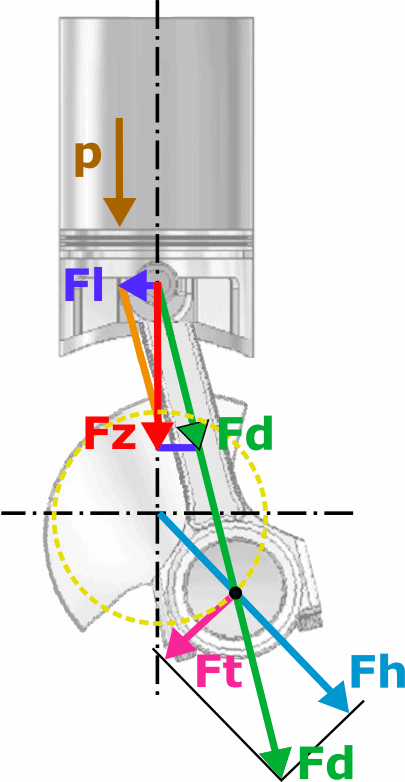
Decomposition the piston force:
Above the piston, a pressure (p) is created as a result of combustion during the power stroke. The force that is generated is transmitted by the connecting rod to the crank pin. The torque that is created (force * arm) causes the crankshaft to rotate. This is where the torque of the engine is produced.
The five images below show the forces that arise in the crank–connecting-rod mechanism when the combustion pressure pushes the piston downwards. Each enlarged image is followed by an explanation of the force interactions.
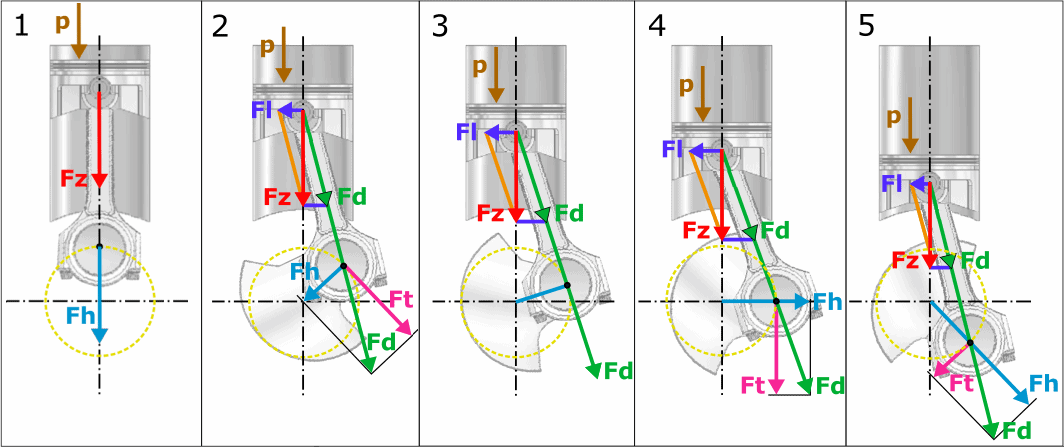
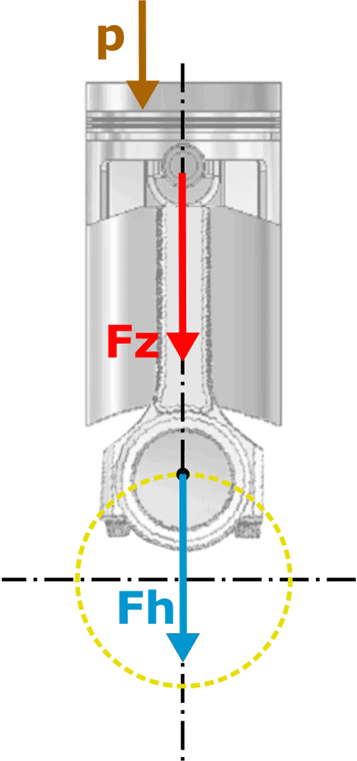
1. The combustion pressure (p) creates a force on the piston (Fz) and on the main bearing (Fh). We can determine this force using the indicator diagram.
The force Fz is transmitted to the connecting rod. In this situation, the connecting rod is positioned vertically above the crank pin and the main bearing (Fh). The actual combustion, where the pressure p is at its maximum, takes place at about 8 crankshaft degrees after TDC. The force Fz is equal to the force with which the connecting-rod and main bearings of the crankshaft are loaded. So we can write: Fz = Fh.
In this illustration we see a yellow dashed line running from the center of the crankshaft to the center of the crank pin. The midpoint of the connecting rod (black dot) circles around this.
In this situation there is no resolving of the piston force yet. However, the force on the main bearing is at its highest in this position.
Overview of the abbreviations used:
- p: combustion pressure;
- Fz: piston force;
- Fh: force on the main bearing
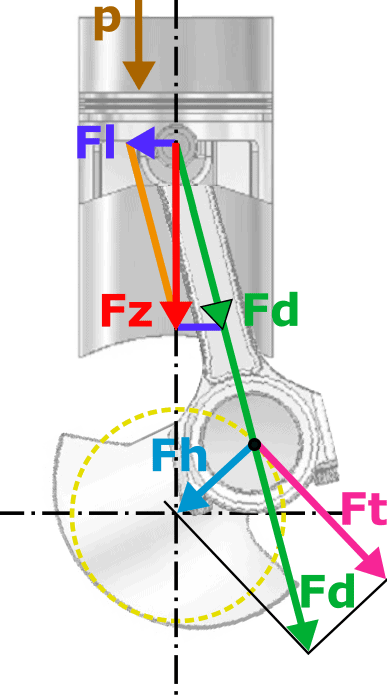
2. The force from the piston is transmitted via the connecting rod to the crank pin. In doing so, we resolve the force on the piston (Fz) into the connecting-rod force (Fd) that acts in the direction of the connecting rod.
As a result of the tilting of the connecting rod and force Fz, the piston is pressed against the cylinder wall. This force is indicated by Fl (side-thrust force). At this point the piston and cylinder experience the greatest wear.
The connecting-rod force Fd acts on the crank pin and, due to the rotation at the crank pin, is resolved into the tangential circumferential force (Ft) and the radial force on the main bearing (Fh). The radial force transfers the load via the upper connecting-rod bearing to the crankshaft.
The tangential force (Ft) depends on both the connecting-rod force and the position of the crank–connecting-rod mechanism. Because the tangential force determines the torque of the engine, the torque is constantly changing in magnitude. The mass of the flywheel ensures that these changes in torque do not immediately affect the crankshaft speed.
Overview of the abbreviations used:
- p: combustion pressure;
- Fz: piston force;
- Fd: connecting-rod force;
- Fl: side-thrust force;
- Fh: force on the main bearing;
- Ft: tangential force.
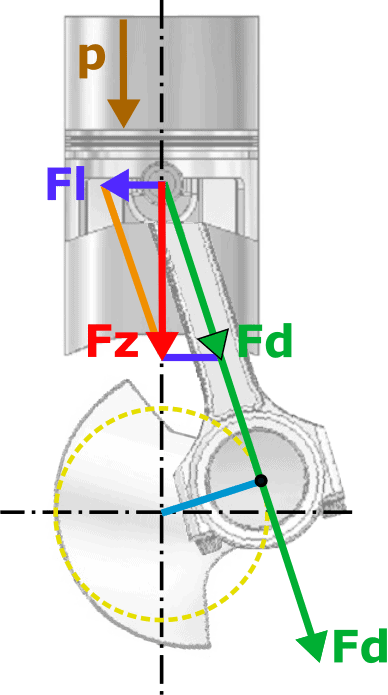
3. The center lines of the connecting rod and the crank pin are at an angle of 90 degrees to each other. The tangential force (Ft) is now equal to the connecting-rod force (Fd) and, just like the torque obtained / torque output, is at its maximum at this point. So we can write: Fd = Ft.
The main bearing is not loaded now. There is no force Fh at this moment. We can write: Fh = 0
Overview of the abbreviations used:
- p: combustion pressure;
- Fz: piston force;
- Fd: connecting-rod force;
- Fl: side-thrust force;
- Fh: force on the main bearing.
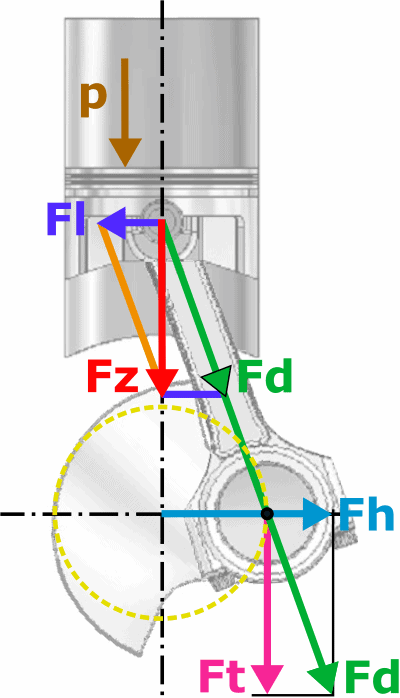
4. As the crankshaft continues to rotate, the tangential force (Ft) decreases. The tangential force is now no longer in line with the connecting-rod force.
The side-thrust force (Fl) has now increased, because the angle of the connecting rod is at its maximum.
Overview of the abbreviations used:
- p: combustion pressure;
- Fz: piston force;
- Fd: connecting-rod force;
- Fl: side-thrust force;
- Fh: force on the main bearing;
- Ft: tangential force.
5. The piston moves further towards BDC. The force on the main bearing (Fh) increases and is at its maximum when the piston has reached BDC.
The side-thrust force (Fl) has also decreased; this force becomes 0 N at the moment the piston reaches BDC.
Overview of the abbreviations used:
- p: combustion pressure;
- Fz: piston force;
- Fd: connecting-rod force;
- Fl: side-thrust force;
- Fh: force on the main bearing;
- Ft: tangential force.