Introduction:
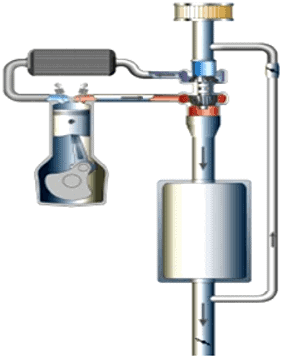
An EGR (Exhaust Gas Recirculation), also called “UGR” (Uitlaat Gas Recirculatie) in Dutch by some brands, has the task of routing a portion of the exhaust gases back to the engine. The EGR valve is used on both petrol and diesel engines. The EGR is mounted on the exhaust side of the engine block.
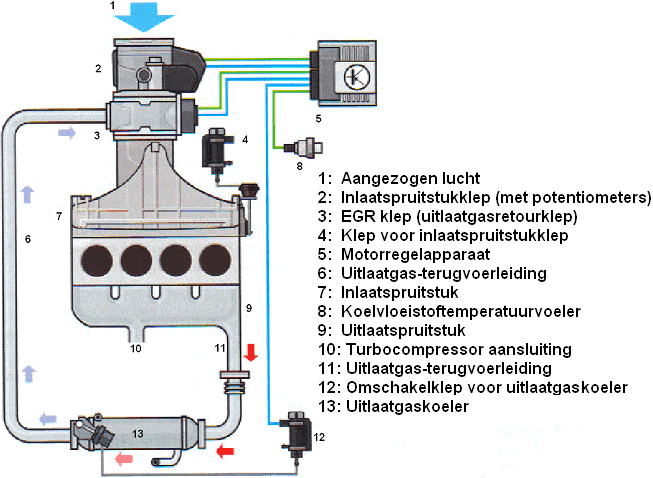
From the exhaust manifold a thick metal pipe runs to the EGR cooler. This cools the hot exhaust gases (effect of a heat exchanger). From the EGR cooler the exhaust gas goes to the EGR valve, which mixes the exhaust gases with the intake air. EGR can be implemented as a high pressure (short route) or a low pressure (long route) system. Both systems have their own advantages and disadvantages. This is described in the chapter High and low pressure EGR (further down this page).
The EGR valve and the pipes can be mounted in various locations, but the exhaust gas is always tapped as close as possible to the exhaust manifold. In the image below you can see where the components of the EGR are mounted on the engine block.
Because the EGR valve needs to be opened in multiple positions or fully closed, a stepper motor is used to actuate the valve.
Purpose of the EGR system:
By adding small amounts of exhaust gas to the fresh air in the engine’s intake tract, the oxygen content for combustion is reduced. Due to a lower oxygen ratio, a ‘less optimal’ combustion occurs. As a result, the combustion speed and combustion temperature decrease. The lower temperature of the combustion gases reduces the nitrogen oxide (NOx) content. This makes the exhaust gases cleaner, which helps meet environmental requirements.
In older engines, the EGR valve is closed when the engine is cold. In newer engines, the valve is also opened with a cold engine, so that the warm exhaust gases help heat up the engine. During acceleration, deceleration and idling the EGR is not in operation. Under part load its function is fully utilized.
Operation:
The computer controls the amount of exhaust gas that may be routed back to the engine based on the following data:
- Engine load (the EGR only works under part load; at full load the valve is closed).
- Engine speed (at too low or too high an RPM the valve is closed).
- Intake air temperature.
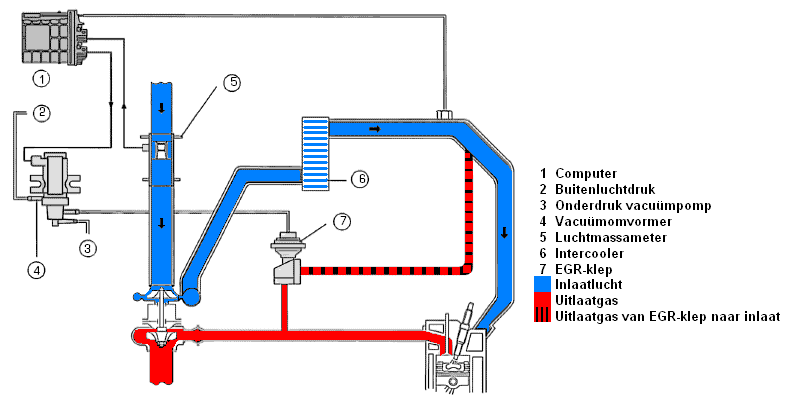
With this data, the computer actuates the solenoid valve with a certain duty cycle. If the difference is minimal, the vacuum converter is controlled in such a way that the EGR valve is not activated. In this rest position, the solenoid valve passes the ambient air pressure to the EGR valve. However, if the amount of inducted air is greater than the required amount, the solenoid valve is actuated so that the vacuum from the vacuum pump is also applied to the EGR valve. With the help of the solenoid valve, the vacuum from the vacuum pump to the EGR valve is thus regulated. The EGR valve is opened just enough so that the difference between the required and inducted air remains as small as possible.
High and low pressure EGR:
The exhaust gas recirculation system can be divided into two systems, namely high pressure EGR and low pressure EGR. The difference lies in the point where the exhaust gases are tapped from the exhaust. Below, the operation, advantages and disadvantages of both systems are described.
High pressure EGR (short route):
The exhaust gases are routed back to the engine before the turbo. Between the exhaust manifold and the turbo there is an EGR pipe. Often there is a cooler on this pipe to reduce the exhaust gas temperature. The EGR valve is located at the end of this pipe. When the EGR valve opens, the exhaust gases in the pipe mix with the intake air that is supplied from the intercooler to the engine intake.
Advantages of high pressure EGR:
- EGR can be adapted very quickly to the dynamic engine condition.
- During a cold start the EGR will help raise the temperature in the combustion chamber as quickly as possible (standard on diesel engines of the EURO III generation and later).
Disadvantages:
- Contamination of the intake tract due to soot formation.
- Exhaust gas must be cooled more than when using a low pressure EGR system.
- The exhaust gas flow is not fully utilized to drive the turbo’s turbine; part of the gas is tapped off before the turbo.
Low pressure EGR (long route):
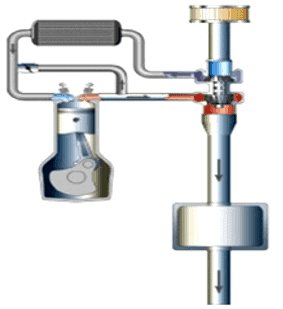
The exhaust gases are only routed back to the engine intake after the particulate filter. Usually the outlet of the EGR valve is connected to the inlet of the compressor (as in the image), but sometimes it is connected between the intercooler and the intake manifold. The disadvantage is that the recirculated exhaust gas has too low a pressure and velocity. To solve this, an additional valve is installed in the exhaust (after the EGR tapping point). When this extra valve closes, the pressure between the turbo and the valve increases. Due to the increased pressure, the exhaust gases will be routed through the tapping point to the EGR valve.
Advantages of low pressure EGR:
- All exhaust gas has already been utilized in the turbo’s turbine.
- Exhaust gas temperature is low (without using an EGR cooler) compared to high pressure EGR.
- EGR gas is cleaner because, among other things, the particulate filter has already performed exhaust gas aftertreatment, so there is less engine contamination due to soot formation.
Disadvantages:
- The addition of exhaust gas to the intake air (according to the dynamic engine condition) occurs more slowly, because the EGR has to travel a longer route.
- The EGR valve is located further away from the intake valves.
Disadvantages and possible malfunctions:
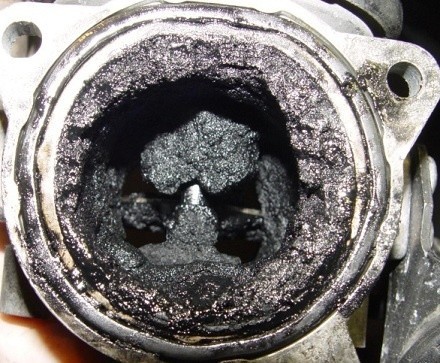
The EGR valve does not benefit engine performance. Due to the use of the EGR valve, performance can decrease and fuel consumption can increase. Internal contamination will also increase significantly (see image). The dirt cakes on everywhere and in this way contaminates the intake manifold and the engine’s intake valves as well. Especially with a calm driving style, these contaminants remain behind in the engine.
The only advantage of EGR is that the exhaust gases are cleaner; NOx emissions decrease. On older diesel engines, the EGR valves could easily be blocked off with a blanking plate. The manufacturers of new cars ensure by means of sensors and other methods that it is no longer possible to shut off or trick the EGR, because pressures are measured at various points in the line. Therefore, in newer cars, a software modification in the engine management system will also have to be carried out. This is often part of the new software during chiptuning.
It may happen that the EGR valve remains unintentionally open while it is not being actuated. Too much exhaust gas is then routed to the engine. With a diagnostic tool we can recognize this by:
- an excessively (persistently) high intake air temperature due to the exhaust gases (see the page about the temperature sensors);
- a value that is too low from the mass air flow sensor: a large percentage of the incoming air consists of air originating from the EGR instead of from the air filter.
EGR cooler:
The temperature of the exhaust gases is about 300 degrees under part load (at constant speed on the motorway) and more than 700 degrees at full load. However, the colder the air supplied to the intake, the better the engine performs. Cold air contains more oxygen. Warm air is more expanded and therefore contains less oxygen. Yet hot exhaust gases are routed back into the engine.
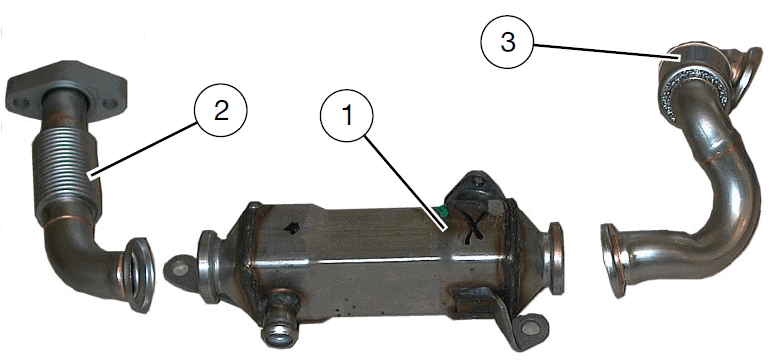
There is often an EGR cooler between the EGR valve and the engine intake. This works as a heat exchanger. Coolant flows through the EGR cooler (in fixed channels, so it does not come into direct contact with the exhaust gases). The coolant absorbs the heat from the exhaust gases. The coolant becomes warmer and the exhaust gases cool down. The EGR cooler lowers the temperature as far as possible, preferably close to 100 degrees.
More information about this heat exchange technology can be found in the chapter heat exchanger.
Besides EGR, a secondary air pump is also used in petrol engines for exhaust gas aftertreatment, and in diesel engines the SCR (Selective Catalytic Reduction) catalyst with AdBlue dosing system is used.