Introduction:
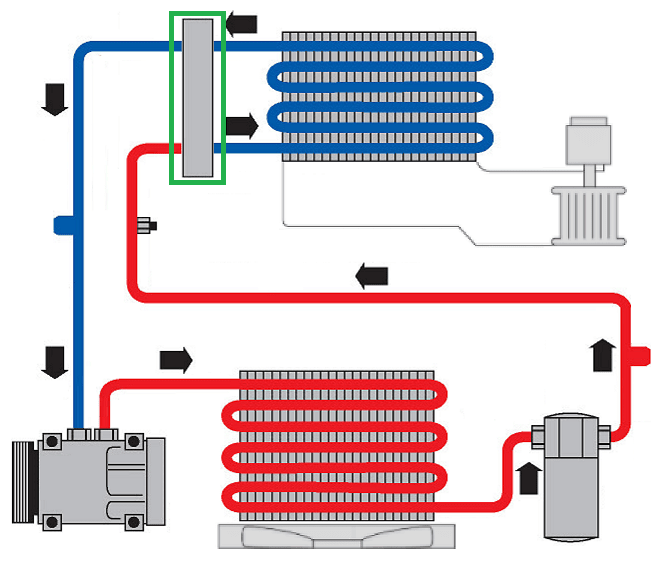
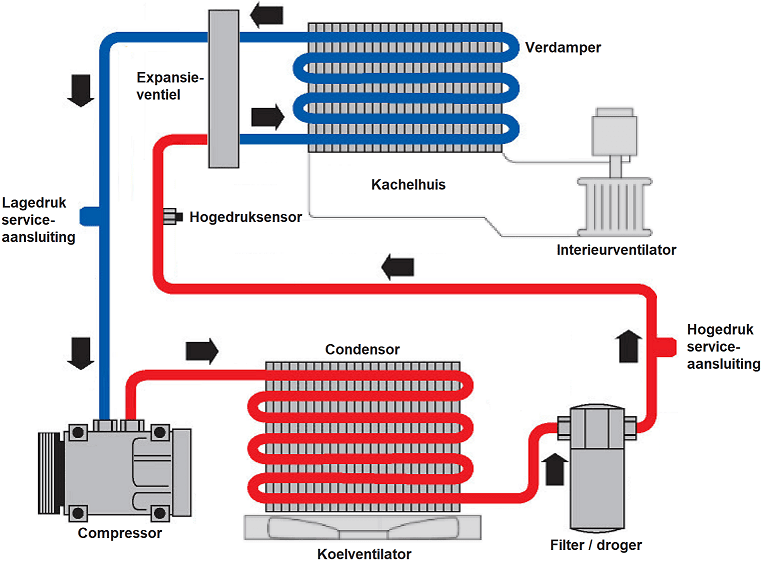
An expansion valve is an essential component of air conditioning systems. It functions as a restriction in the line between the dryer/filter element and the evaporator, resulting in a transition from high to low pressure. In the image below, the expansion valve (designed as a block valve) is outlined in green.
After the refrigerant has passed the filter/dryer element from the compressor, it reaches the expansion valve at a pressure of approximately 15 bar and a temperature of about 45 degrees Celsius. From the expansion valve, the refrigerant enters the evaporator. As the refrigerant flows through the restriction of the expansion valve, it undergoes a significant pressure drop. When the pressure decreases, the boiling point of the refrigerant also drops. The refrigerant starts to evaporate and changes from liquid to gaseous form. In this phase change from liquid to vapor, the refrigerant absorbs heat from the surroundings. This extracted heat is taken from the passing air flowing through the evaporator, resulting in cooling of the air. This cooled air is directed into the interior, resulting in the cooled and dehumidified air produced by an air conditioning system.
There are different types of expansion valves, namely the capillary expansion valve and the thermostatic expansion valve (TEV), which is also often called a “block valve”. These are described below.
Capillary:
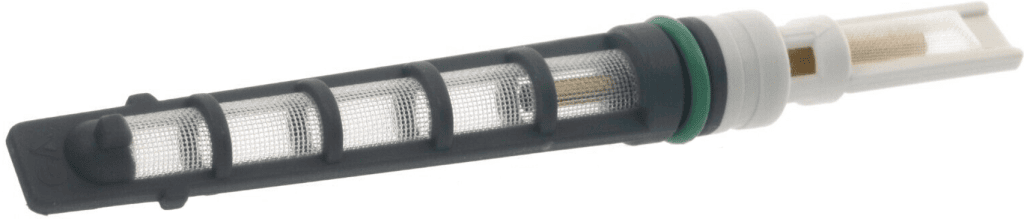
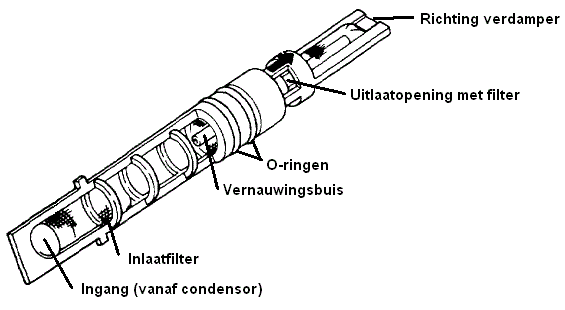
In air conditioning systems you sometimes encounter a simple type of expansion valve, called a capillary or orifice. In newer vehicles, expansion valves are usually no longer equipped with a capillary, but with a thermostatic (controlled) expansion valve.
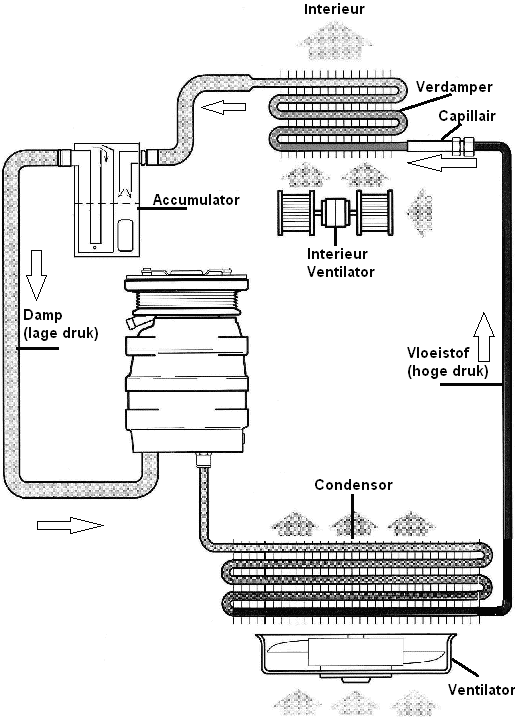
In an A/C system with a capillary, the cooling capacity cannot be finely adjusted. If the pressure becomes too high or the evaporator becomes too cold, the A/C compressor usually switches off.
The outside of the capillary expansion valve is usually made of plastic and there is a special tube inside. There are filters before and after this tube. The capillary causes a sudden drop in pressure, which quickly lowers the boiling temperature of the refrigerant and changes it from liquid to gas. How the capillary is constructed determines how much the pressure drops, and this affects the temperature at which the refrigerant enters the evaporator. The capillary can be found in different sizes, and if you install one with different dimensions, the cooling capacity of the system changes. If less evaporation takes place in the evaporator, this usually means less cooling.
In A/C systems with a capillary, we also usually find an accumulator in the low-pressure section. This prevents liquid from being drawn in by the compressor, because the capillary has a fixed opening. The accumulator also has other important tasks, such as filtering, removing moisture (drying) and storing refrigerant. The refrigerant enters the accumulator from the evaporator as gas, still containing some liquid droplets. A separation screen in the accumulator ensures that the liquid particles sink down along the side. A desiccant removes moisture from the refrigerant. In addition, the vapor at the top is drawn in by the compressor through a small opening of about 1 millimeter, carrying a little oil with it.
In A/C systems with a capillary, the following malfunctions can occur:
- Blockage: If the capillary becomes blocked due to contaminants in the refrigerant, this can reduce the cooling capacity;
- Incorrect dimensions: In certain cases it may be necessary to replace the capillary with one of different dimensions in order to adjust the cooling capacity of the system. This may be required in case of system modifications or if the original specifications do not meet the required performance, such as a freezing evaporator or insufficient cooling.
- System-related problems: If the air conditioning system continuously exhibits performance issues and other components have been checked and are in good condition, the capillary may be a possible cause. The capillary may be damaged in a way that is not easily visible.
Thermostatic Expansion Valve (TEV):
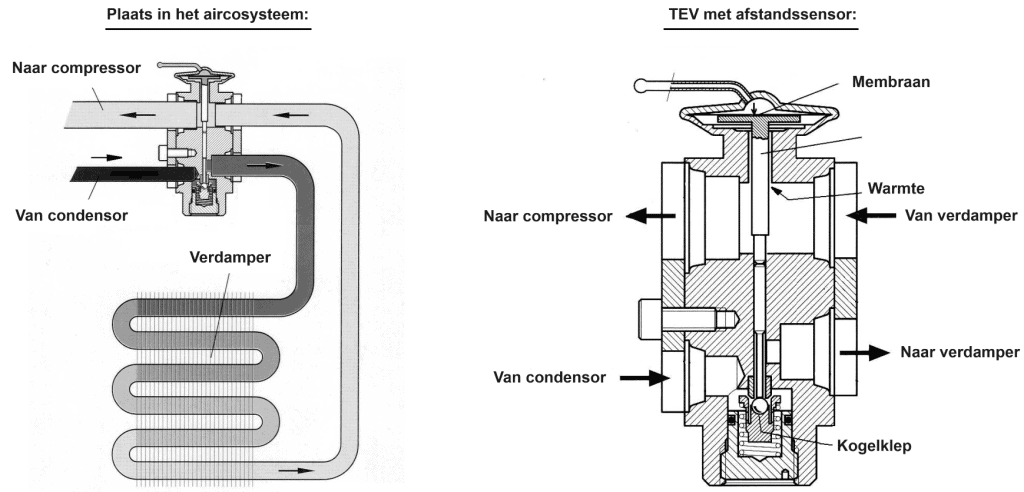
An air conditioning system that we usually find in modern vehicles is a system with a thermostatically controlled expansion valve, abbreviated as TEV. The thermostatic expansion valve replaces the system with a capillary and is essentially a restriction whose opening size is controlled by the temperature of the gas flowing out of the evaporator.
There are different designs. In addition to replacing the capillary, the filter/dryer element is also different. The filter/dryer is located here directly after the condenser and deals with the refrigerant in liquid form. The temperature is measured after the evaporator. If the evaporator temperature becomes too high because too little refrigerant flows through it, the opening is enlarged, allowing more refrigerant to enter the evaporator and the temperature drops again. The thermostatic expansion valve keeps the temperature (and pressure) constant within certain limits. This also means that we can be sure that the refrigerant is drawn in by the compressor in vapor form, so no accumulator needs to be used in the low-pressure section anymore.
The thermostatic expansion valve can be divided into three types:
- Expansion valve with remote bulb control with internal or external pressure equalization.
- Block valve with internal or external diaphragm.
- Electronically controlled expansion valve.
Thermostatic expansion valve with remote bulb and internal pressure equalization:
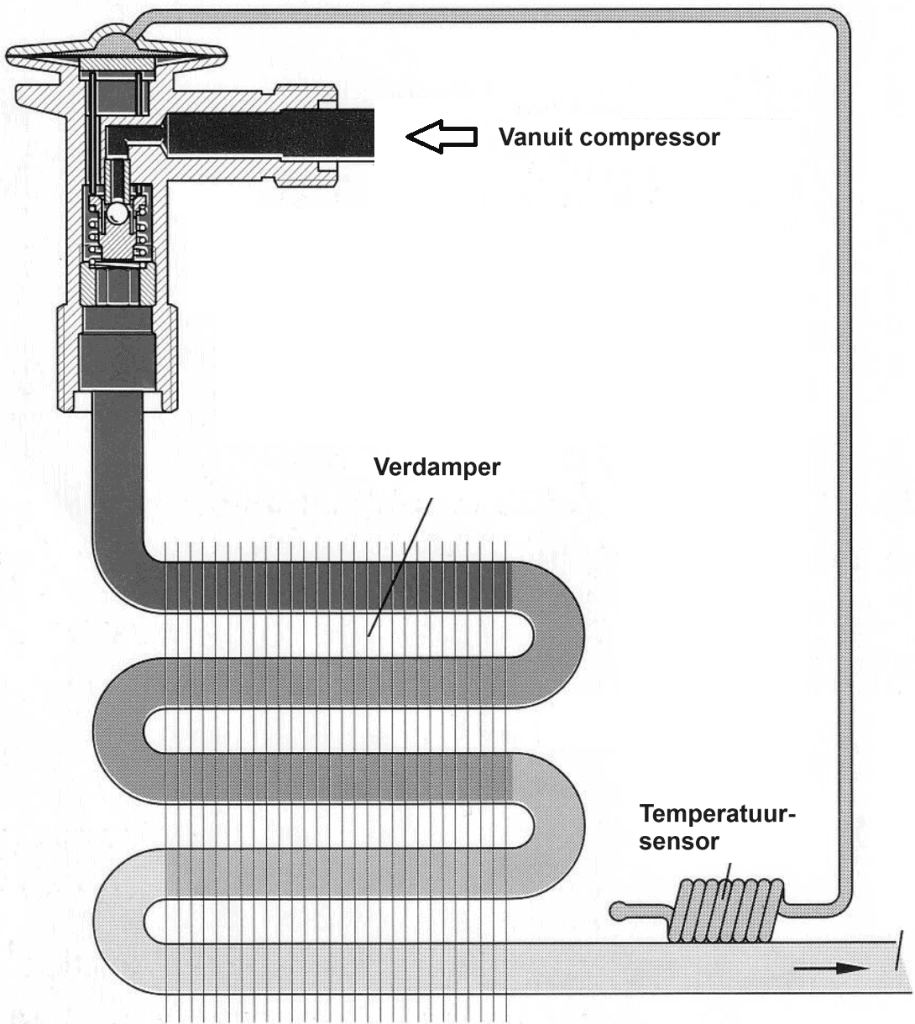
The thermostatic expansion valve consists of two parts, namely the measuring section and the sensor or bulb, which is connected to the actual expansion valve. The measuring section is filled with gas and is located at the outlet of the evaporator. When the temperature at the outlet of the evaporator rises because too little refrigerant is passing through, the gas expands and the pressure increases. The pin then pushes the ball off its seat, allowing more refrigerant to flow into the evaporator and the outlet temperature to drop again. The ball is released as soon as the force on the diaphragm from the sensor becomes greater than the sum of the spring force and the pressure force of the refrigerant at the inlet side of the evaporator. When the temperature after the evaporator becomes too low, the opposite happens. The spring force pushes the ball back onto the seat, the opening narrows and the flow of refrigerant is reduced. The TEV valve therefore keeps the temperature of the refrigerant constant. The thermostatic expansion valve measures the temperature and converts it into pressure. The pressure control activates the valve.
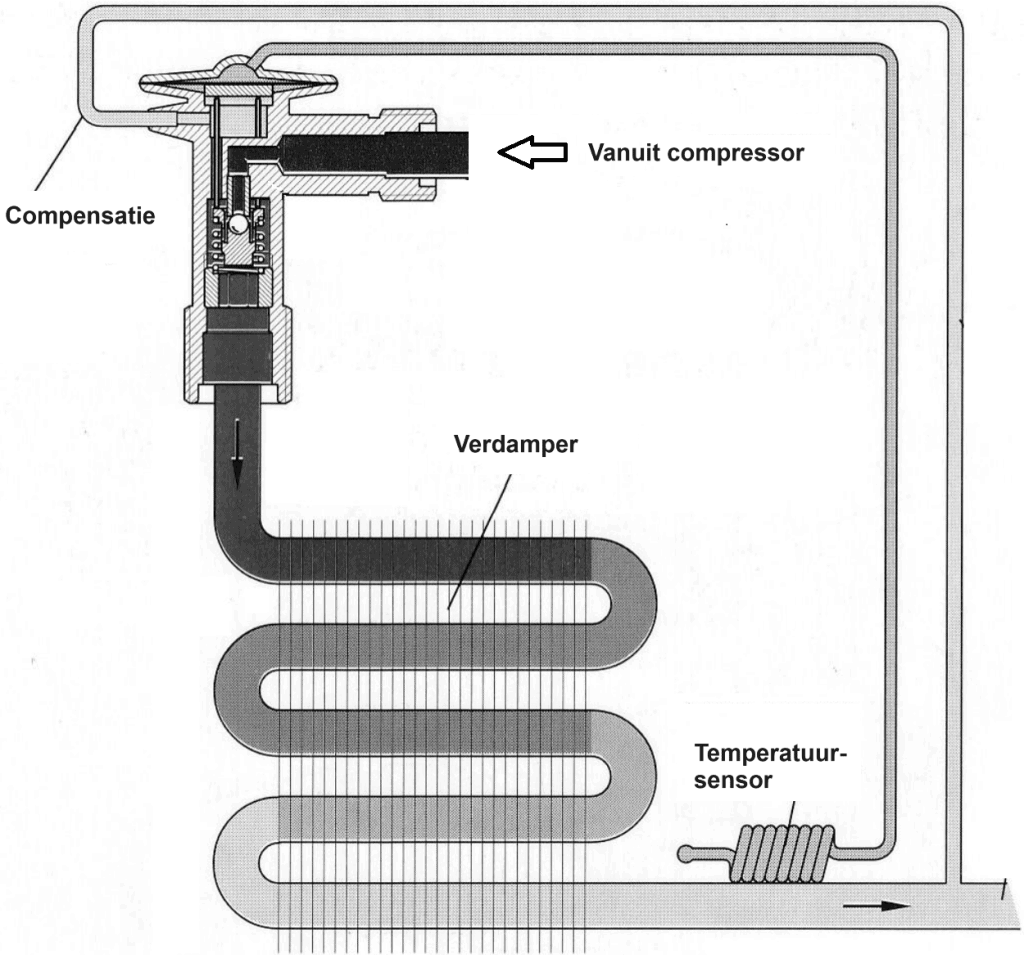
Thermostatic expansion valve with remote bulb and external pressure equalization:
Pressure equalization is related to the pressure under the diaphragm. If the space under the diaphragm is connected to the inlet side of the evaporator, we do not take into account the pressure drop that occurs in the evaporator. After all, the temperature is measured at the outlet side of the evaporator, while the regulation takes place at the inlet side. When the pressure drop exceeds 0.2 bar, it is recommended to use an expansion valve with external pressure equalization. If the space under the diaphragm is connected to the outlet side of the evaporator, the pressure drop is compensated. External pressure equalization is usually applied in larger systems.
Block valve with external control diaphragm
The block valve is installed at the inlet and outlet line of the evaporator. The inlet line is located next to the outlet line at the evaporator. At the bottom of the block valve, the refrigerant in liquid form enters from the filter/dryer (condenser) and passes the ball valve on its way to the evaporator. Above the diaphragm there is a fixed amount of gaseous refrigerant. This gas will assume the temperature of the gas coming out of the evaporator. If the temperature rises, the increase in pressure will push the pin downwards, resulting in a larger flow opening in the supply line. This allows more refrigerant to enter the evaporator, causing the temperature to drop. In the opposite situation, the ball valve will close, allowing less refrigerant into the evaporator and the temperature will rise.
Block valve with internal control diaphragm:
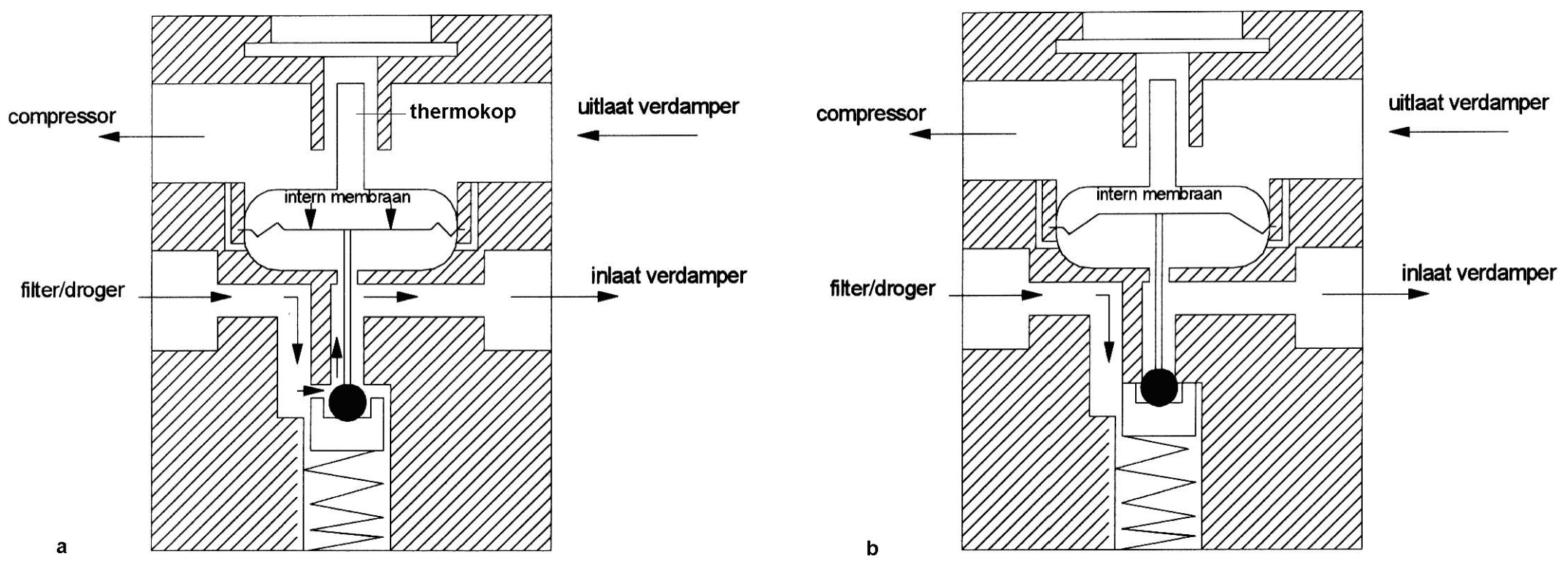
In the block valve with an internal control diaphragm, there is a thermal bulb containing refrigerant at the outlet side of the evaporator. The refrigerant in the thermal bulb takes on the temperature of the refrigerant leaving the evaporator. At a high temperature, the refrigerant expands, causing the diaphragm of the capsule to push the rod down and increase the opening of the ball valve. Conversely, a lower temperature will cause the diaphragm to move upwards, making the opening smaller. These two situations are shown in the images below.
Electronically controlled thermostatic expansion valve:
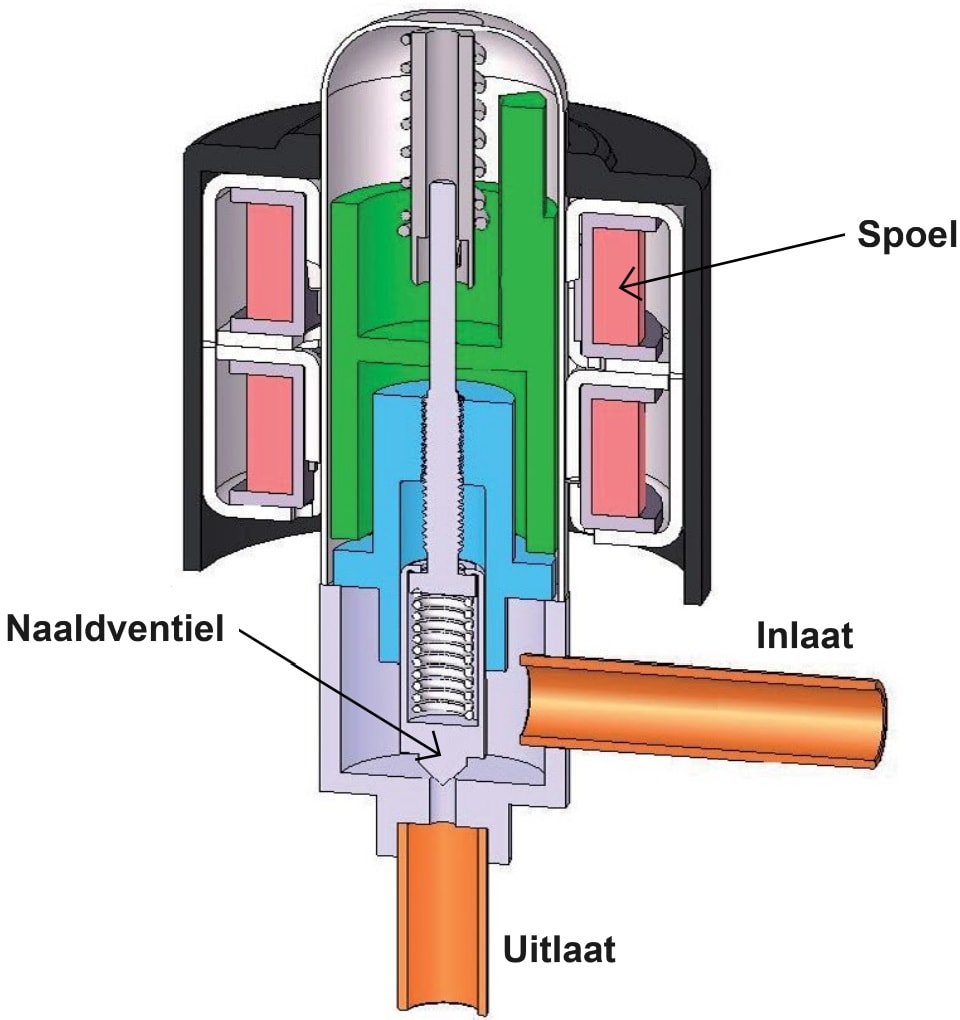
Using the climate control ECU, the Electronically controlled Expansion Valve (abbreviated as EEV) can be actuated. A stepper motor can be used for this. This stepper motor allows the needle to increase or decrease the opening in small steps. Depending on the desired temperature in the interior, the ECU can very quickly control the capacity by using the electrically driven A/C compressor and the expansion valve.
Possible malfunctions:
In the workshop, we encounter problems with the expansion valve. Most often, problems arise due to contamination, causing the expansion valve to become blocked or remain open.
- The valve is blocked:
Blockage is caused by contaminants in the refrigerant. As a result of the blockage, too little refrigerant enters the evaporator, leading to an increasing pressure with the risk of the compressor overheating. - The valve remains open:
Because the valve remains open, too much refrigerant can enter the compressor. At the moment that not all refrigerant in the evaporator has yet changed to gas, there is a risk that a (too large) amount of liquid refrigerant will enter the compressor, causing the compressor to suffer liquid slugging.
Contamination is easy to prevent: replace the filter/dryer periodically.
Related page: