Introduction:
An intercooler is an air cooler. An intercooler is used when a turbocharger or a supercharger is fitted to the car. The air coming from that turbocharger or supercharger is sent under pressure to the engine intake (see the chapters turbo and supercharger).
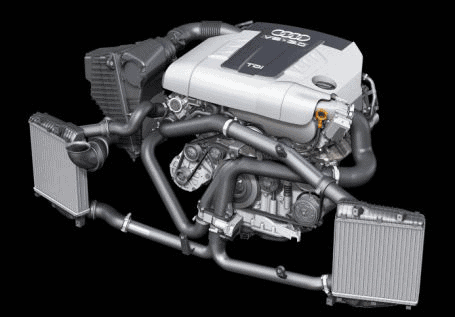
In the image you can see an Audi engine with two intercoolers mounted at the front. These intercoolers are often not directly visible, because they are mounted behind the grilles in the front bumper. Some cars have one smaller, or one large, elongated intercooler.
Temperature of the compressed air:
This air can become very hot, up to 150 degrees Celsius. The temperature increase is caused by the compression (the squeezing together) of the air. In warm air the molecules have expanded and, in proportion, there is less oxygen present per cm3 than in cold air. For combustion, warm air is therefore very disadvantageous. When the air is colder, the air volume is smaller. The volume increases with heat, resulting in less net air delivery. By cooling the air, the volume decreases and the volumetric efficiency increases. Better volumetric efficiency results in better combustion and therefore more power.
Operation of the intercooler:
The task of the intercooler is to cool down this compressed air. The compressed air comes from the turbo, passes through the intercooler, and then goes to the intake section of the engine. The compressed air is blown through the small channels of the intercooler via the pipes at the side. Because the intercooler is mounted at the front of the car, the airflow while driving passes through the intercooler. The compressed air transfers its heat through the small channels to this airflow. As a result, this compressed air cools down by dozens of degrees.
The principle is similar to that of the radiator, where the airflow while driving cools the coolant. The intercooler is somewhat similar. The difference is that no coolant flows through it, but compressed air flows through it.
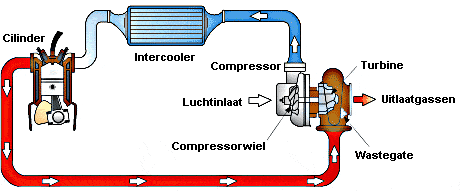
The image shows the path the air takes; from the exhaust side of the cylinder the air moves to the turbo. The exhaust gases drive the turbine wheel, causing it and the compressor wheel to rotate. With the compressor wheel, the turbo draws in air from the air filter to the air intake and compresses it. The air compressed by the turbo is directed to the intercooler, where it cools down sufficiently before being fed to the intake side of the cylinder again.