Incandescent lamp:
The invention of the incandescent lamp is often attributed to Thomas Alva Edison. However, there were other people who contributed to the development of a means to generate light with electricity. In 1801, Humphry Davy was already experimenting with a glowing platinum wire, which immediately burned out though. In 1854, Heinrich Göbel succeeded in making the first real incandescent lamp. His lamp consisted of a carbonized bamboo fiber in an eau-de-cologne bottle from which the air had been evacuated.
He was able to evacuate the bottle by filling it with mercury and then letting it drain. Because of the vacuum, the bamboo fiber could not burn. Göbel’s lamp burned for 400 hours. Edison applied for a 25‑year patent on a similar type of lamp. Göbel started a lawsuit over this and was proven right in 1893. However, he died in the same year.
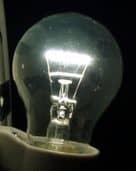
An incandescent lamp is a glass lamp in which light is produced by means of a glowing filament. When voltage is applied, a current flows through the filament, causing it to heat up and emit light. In the past, a filament was made of carbon, but nowadays it is made of tungsten. The glass of an incandescent lamp is quite strong, even though it is thinner than a sheet of paper. This is possible thanks to the shape in which the glass is blown. The electrical resistance of a tungsten filament in a cold state is no more than a few dozen Ohms and, directly after applying the voltage, increases under the influence of the generated heat to several hundred to thousands of Ohms. When switching on an incandescent lamp, this causes an inrush current, which is often the reason the filament burns out if it already contained a thin spot.
The filament does not simply burn through while glowing. That is because there is no or very little oxygen present in the glass bulb containing the filament; instead, it is filled with argon or another noble gas. In open air, the filament of an average lamp would burn out within a few seconds after applying a voltage. In a burning incandescent lamp, the filament material evaporates very gradually due to the heating and condenses on the inside of the glass bulb. This can be recognized by the dark color that older lamps acquire on the inside of the glass. Once a dark haze is present on the inside, the lamp is best replaced immediately. When replacing one lamp, it is therefore wise to also check the condition of the other lamps.
Halogen lamp:
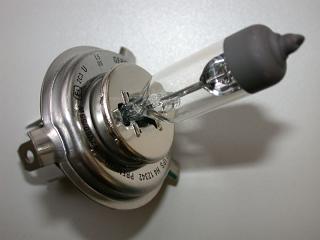
A halogen lamp becomes extremely hot. The temperature can rise to 250 degrees. The lamp therefore has heat‑resistant glass. In the lamp, a small amount of halogen (e.g. iodine, bromine, chlorine or fluorine) is added under high pressure, which becomes gaseous due to the heat. In the colder parts of the lamp, the halogen bonds with the evaporated material of the filament. This gaseous compound breaks down again into halogen and metal when it comes close to the very hot filament. The metal then condenses back onto the filament, extending its service life.
The advantages of this lamp are that it is small and the light is easy to focus.
More information about the headlamp and the light beam can be found on the headlamp page.
Xenon lamp:
A xenon lamp (also called a gas‑discharge lamp) has a higher light output than a standard halogen lamp. This lighting technology has been in use for a longer time already. Not in the automotive sector, but for lighting football stadiums. With xenon lighting it is possible to approximate the intensity and color of daylight.
Advantages of xenon:
- Xenon lighting in the car is brighter and spreads better than standard halogen lighting.
- Thanks to the enormous light output of xenon lighting, it is possible to mount the headlamps in a smaller housing. With a smaller surface, it is already possible to create the same or a higher light output. This has the advantage for the car manufacturer of being able to optimize aerodynamics and it also provides more freedom in design.
- Consumes 30% less energy.
Disadvantage of xenon: - It dazzles oncoming traffic more easily than halogen lighting, especially when the headlamp does not have a suitable lens for xenon lighting.
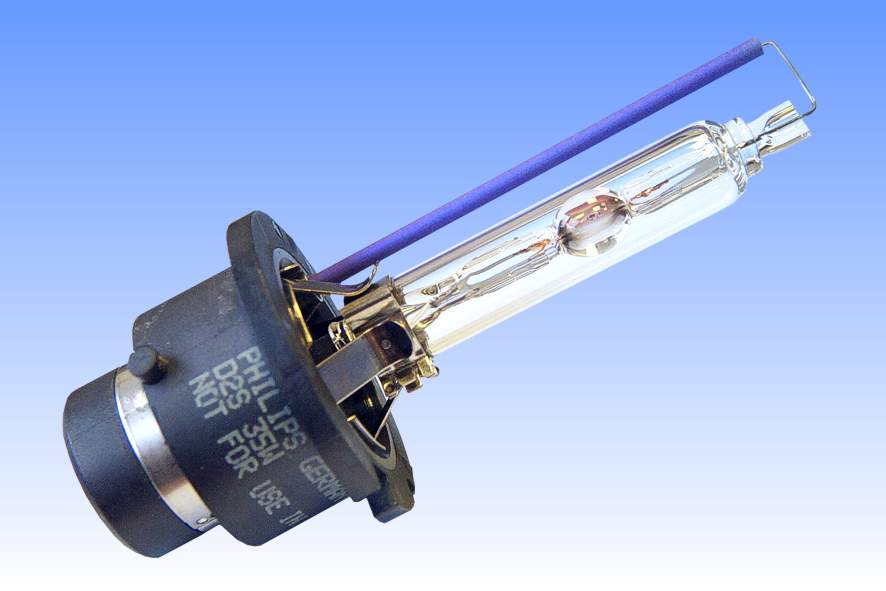
As mentioned earlier, the higher light output makes it possible to use a smaller reflector and headlamp. Because xenon lamps convert electrical energy into light with a higher efficiency, much less heat is generated than with standard halogen lighting.
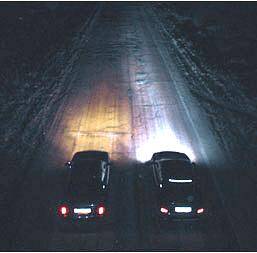
The service life of xenon lamps is also longer than that of halogen lamps. The average service life of a xenon lamp is generally about 2000 hours. That corresponds to the average service life of a car.
The ECE regulation stipulates that vehicles equipped with xenon lighting must also be fitted with a leveling system. The leveling system (automatic leveling control) prevents dazzling of oncoming traffic. On the rear axle, an angle‑of‑rotation sensor is mounted that registers the pitching of the vehicle. The recorded data are processed in a control unit, which in turn tilts the headlamp unit up or down.
To prevent the formation of stray light, which is light that falls outside the intended light beam, as much as possible, it is necessary that the headlamp lenses remain clean. Therefore, a washing system for the headlamp lenses is mandatory on cars with xenon lighting. A pump builds up a water pressure of approx. 3.5 bar, after which 2 arms extend from the bodywork and spray the headlamp lenses clean. After spraying, the arms are retracted into the bodywork again.
More information about the headlamp can be found on the headlamp page.
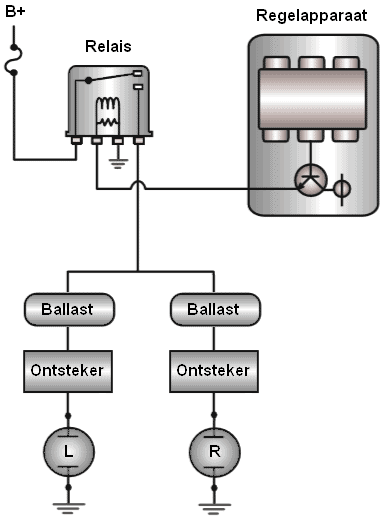
Xenon lamps do not have filaments, whereas halogen lamps do. Instead, a discharge tube surrounded by quartz glass is used. The lamp is filled with noble gases and metal halides and is ignited by means of two electrodes between which an arc is formed. The arc is created by supplying a brief ignition pulse between 20,000 and 30,000 Volts. After that, a constant voltage of about 85 Volts ensures that the lamp continues to burn.
To generate and limit these high voltages, a control gear unit is used: the igniter. The igniter provides the high switch‑on voltage. The ballast (shown separately from the igniter in the illustration) is often mounted together with the igniter in one housing. The ballast controls the maximum current through the lamp. If no ballast were used, the lamp would receive too high a current and would fail.