Rolling circumference calculator:
Fitting tyres with an incorrect size on the car will cause an error on the speedometer. Exactly how big this deviation is can be calculated with the calculator below. When using a phone, it is best to rotate it to “landscape mode” to show the entire table on the screen.
The table shows two tyre sizes by default: 205/55R16 and 225/40R18. These sizes can be changed to the sizes you want to compare.
At the bottom, the speeds of both tyre sizes are compared: if tyre 1 rotates at speed x, then tyre 2 rotates at speed y.
Because we initially compare the tyre sizes statically, the deflection can remain at the preselected 0% and 0 mm. The result will then be n/a.
The explanation of the static and dynamic height and circumference (with a load >0) is given in the following paragraphs. In the static comparison, the RFT (RunFlat Tyre) has no influence on the calculation. The deflection of a RunFlat tyre only plays a role when we look at the dynamic properties.
Tyre height and rolling circumference explained:
Using the calculator, the tyre height and rolling circumference can be calculated. This is ideal when looking for another tyre size (for example from 16 to 18 inch) that fits the car without affecting the accuracy of the speedometer.
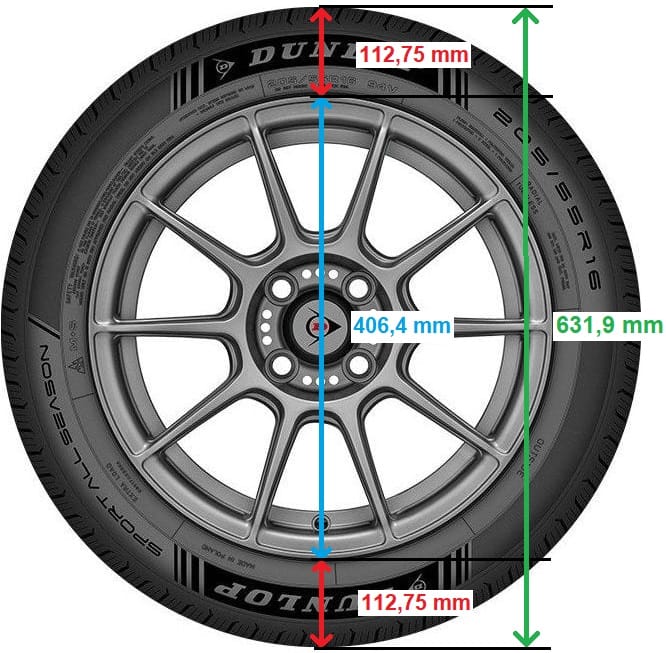
The tyre in the example shows the markings: 205/55 R16:
- 205 = tread width in mm
- 55 = tyre height from road surface to underside of the rim = 55% of 205 (0.55 x 205 = 112.75 mm)
- 16 = rim diameter in inches (1 inch = 25.4 mm, so 16 inch x 25.4 mm = 406.4 mm)
Enter these three values into the calculator to calculate the tyre height and static rolling circumference in an unloaded state. The tyre height is twice the height in millimetres plus the rim diameter in mm. In the example above this gives: 112.75 + 112.75 + 406.4 = 631.9 mm (or 63.19 cm). With this calculator you can easily calculate the tyre heights of different tyre sizes and the difference in circumference and speed.
The two tyre sizes shown by default in the table, 205/55 R16 and 225/40 R18, have a very small difference in height and circumference. As a result, the speed difference on the speedometer is also minimal. This means that when size 205/55 R16 is prescribed by the manufacturer, wheels with tyre size 225/40 R18 can also be fitted. The only question then is whether the wider tyres will rub in the wheel arches. If this happens when steering, it can cause a lot of tyre wear and is a reason for rejection during the vehicle inspection (APK). In that case, wheel spacers offer a solution.
More information about the tyres can be found on the wheels and tyres page.
Static rolling circumference:
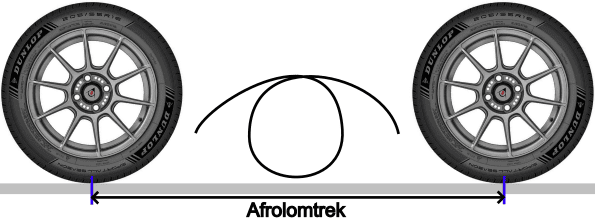
The static rolling circumference is the distance a wheel covers after one complete rotation when it is rolled over the ground without load, so without the weight of the vehicle resting on it. There is then no deformation due to deflection or any other type of load.
When, for example, a tyre size 205/55 R16 is fitted from the factory and someone wants to fit larger rims and tyres, a number of things must be taken into account. The offset (ET value) must be correct, the tyres must not rub against the shock absorber, wheel arch or control arms, and the static rolling circumference must not differ too much from the other tyre size. The static rolling circumference can be calculated with this calculator. As described above, for the static rolling circumference we assume a deflection of 0% and 0 mm. Below are the calculations to determine the static rolling circumference of a wheel.
- Tyre size: 205/55 R16
- Calculation of the sidewall height: 205 × (55/100) = 112.75 mm
- Calculation of the total diameter of the tyre: The total diameter of the tyre is the sum of the rim diameter and twice the sidewall height:
– Total diameter = (rim diameter in inches × 25.4) + 2 × sidewall height
– The rim diameter in millimetres is: 16 × 25.4 = 406.4 mm
– So the total diameter is: 406.4 + 2 × 112.75 = 631.9 mm - Calculation of the static rolling circumference: The circumference of the tyre is calculated using the formula for the circumference of a circle:
Rolling circumference = π × total diameter
Rolling circumference = π × 631.9
Rolling circumference = 1984.76 mm ≈ 1.98 metres
The tyre size 205/55 R16 has a static rolling circumference of approximately 1.98 m. If you mark a line on the sidewall of the tyre and on the road surface with chalk and rotate the wheel one full turn, and then make another mark on the road surface at the height of the line on the sidewall, the distance between these lines is 1.98 metres. This distance determines the speed displayed on the car’s speedometer.
We now compare tyre size 225/40 R18 and see that the rolling circumference is now 2.00 m. This difference is minimal, which makes this tyre size suitable for the car (provided it does not rub anywhere). However, when size 225/45 R18 is calculated, a static rolling circumference of 2.07 m can be seen. Compared to the 205/55 R16 this is too much difference, which means a lower speed would be indicated on the speedometer (the wheel takes longer to make a full revolution). This tyre size is therefore not recommended to fit.
The owner’s manual or, for example, Autoweek.nl can be used to look up which tyre sizes are prescribed for the car. With this calculator various tyre sizes can be compared with each other.
Dynamic rolling circumference:
The dynamic rolling circumference of a tyre is the distance the tyre travels during one full revolution under normal operating conditions. In this case, the tyre is under load from the vehicle and in contact with the road surface. Due to tyre deformation, there is a difference between the static and dynamic rolling circumference. In practice, the dynamic rolling circumference is almost always smaller than the static rolling circumference.
In practice, this difference can have noticeable consequences. When two tyres on the same axle have different tyre pressures, differences in tyre height and rolling circumference arise. This can lead to the vehicle pulling to one side or a steering wheel that is not straight. If all tyres have the same, but too low tyre pressure, the vehicle will not pull to one side, but the speed display may deviate due to the changed rolling circumference.
In the calculator, the dynamic rolling circumference is only calculated when the deflection is greater than 0. The deflection can be entered as a percentage or as an absolute value in millimetres. For a realistic approach it is important to enter only one of the two. When both a percentage and a value in millimetres are entered, they are added together, which makes the result less realistic.
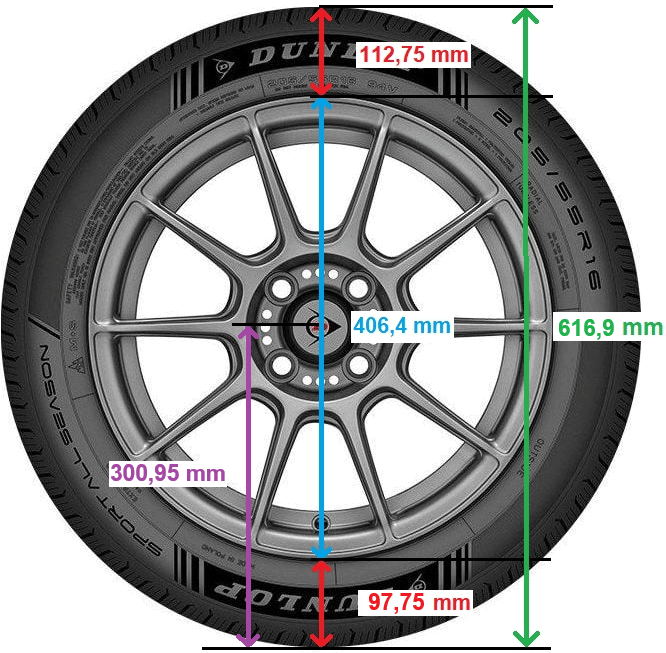
In this example we assume a tyre size 205/55R16. The static wheel diameter is 631.9 mm. Under load the tyre deflects 15 mm at the bottom. As a result, the total wheel diameter decreases:
- Static condition: 631.9 mm
- Deflection: 15.0 mm
- Dynamic condition: 616.9 mm
The dynamic rolling circumference is then calculated with:
- Rolling circumference = π × dynamic diameter
- Rolling circumference = π × 616.9 ≈ 1938 mm (≈ 1.94 m)
For comparison: the static rolling circumference is approximately 1.98 m. This difference explains why load and tyre pressure influence the speed indicated by the speedometer. In this example, a speed of 100 km/h results in a deviation of approximately 2.37 km/h due to the deflection of 15 mm.
Deflection as a percentage and the k-factor:
When the deflection is entered as a percentage, the calculation becomes more theoretical. It cannot simply be assumed that with, for example, 10% deflection the full sidewall height decreases by 10%. The sidewall height is measured from bead to tread, but the part of the sidewall near the rim flange hardly deflects.
The sidewall is also stiffer at the transition to the shoulder. In a simplified approach, it can be assumed that approximately 25 mm of the sidewall height hardly or does not deflect. With a tyre size 205/55R16 with a static sidewall height of 112.75 mm and a static wheel diameter of 631.9 mm, the dynamic height at 10% deflection can be calculated as follows:
- Dynamic height = static wheel height − ((static sidewall height − 25) × (percentage deflection / 100)) − deflection in mm
- Dynamic height = 631.9 − ((112.75 − 25) * (10 / 100)) − 0
- Dynamic height = 623 mm
With this dynamic height of 623 mm the rolling circumference can then be calculated again. When, instead of a percentage, an absolute deflection in millimetres is entered, only the last part of the formula changes. With a deflection of 30 mm and 0% percentage deflection, the following applies:
- Dynamic height = 631.9 − ((112.75 − 25) * (0 / 100)) − 30
- Dynamic height = 601.9 mm
To make this calculation with the deflection percentage more realistic, the calculator uses a k-factor. The k-factor determines which part of the sidewall height is actually deformable. With low profile tyres the sidewall is stiffer and the k-factor is lower. With tyres with a higher profile the sidewall is more flexible and the k-factor is higher. Suppose a k-factor of 0.70 is used for this tyre (appropriate for a mid-profile tyre), then the deformable sidewall height is calculated with:
- Deformable sidewall height = sidewall height * k
- Deformable sidewall height = 112.75 * 0.70
- Deformable sidewall height = 78.9 mm
Only this part of the sidewall height is used in calculating the percentage deflection. At 10% deflection this results in:
- Compression due to percentage deflection = 78.9 * (10 / 100)
- Compression due to percentage deflection = 7.9 mm
The dynamic wheel diameter then becomes:
- Dynamic height = 631.9 − 7.9 = 624.0 mm
The total compression due to deflection consists of two parts: a percentage deflection applied to the deformable sidewall height and an absolute deflection in millimetres:
- Compression = (deformable sidewall height * (percentage deflection / 100)) + deflection in mm
When entering an absolute deflection in millimetres, a directly observed or estimated deformation is entered. In that case the k-factor is not applied. For the most realistic possible approach it is important to enter only one of the two values (percentage or millimetres). When both are used, they are added together and the result may deviate from practice.
Runflat (RFT)
In the calculator, RFT can also be selected. A runflat tyre has a stiffer sidewall construction and deflects less under the same load than a standard tyre. Therefore, the calculated deflection for an RFT tyre is multiplied by a factor of 0.8:
- Deflection RFT = deflection * 0.8
As a result, the dynamic diameter and rolling circumference become slightly larger than with a non-runflat tyre under the same conditions.
Conclusion:
When comparing different tyre sizes in the rolling circumference calculator, static data is used in practice. Although a wider tyre or rim affects the weight distribution over the road surface and thus also the amount of tyre deflection, these differences are so small in most situations that they can be neglected when comparing tyre sizes.
Entering dynamic data, such as a percentage or an absolute deflection in millimetres, however, gives a more realistic picture of the actual situation under load. When entering the deflection percentage, the k-factor is also taken into account, which makes the data even more realistic. This data shows how tyre deformation affects the dynamic rolling circumference and thus the speed indicated by the speedometer.
Related page: