Topic:
Drift angle:
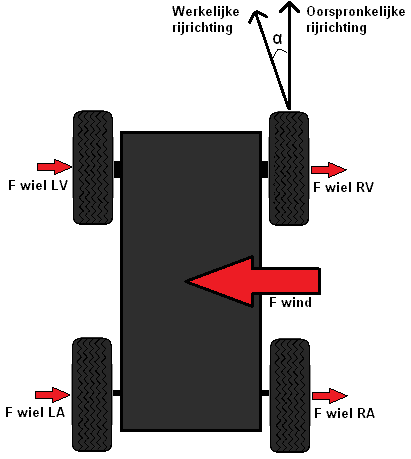
The sidewall of the tyre is always flexible. The advantage of this is that this part deforms when encountering obstacles on the road surface. The disadvantage is that during steering, the sidewall causes reduced stability. The tread wants to follow the steered driving direction, but the wheel itself will, due to the lateral force, point in a slightly different direction. The slip angle is the angle between the original and the actual direction of travel. This is clearly visible in the image below.
The original direction of travel is straight ahead. There is no steering input. The large red arrow with “F wind” indicates the crosswind; this pushes against the car. The sidewalls of the tyres deform due to the lateral force.
Because of this deformation, the direction of travel of the car changes. Under the influence of the crosswind, it follows the arrow of the actual direction of travel. This means the driver has to countersteer in order to maintain the original direction of travel. A larger F wind results in a larger angle between the Actual and Original direction of travel. The angle between them is therefore called the slip angle.
Here are two situations:
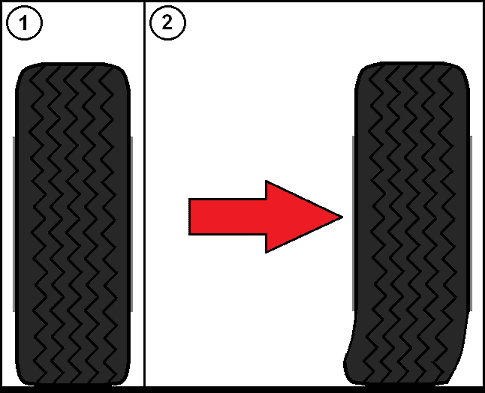
- The wheel in the normal (rolling) situation.
- A lateral force is acting on the wheel. The lateral force pushes against the hub and the centre of the rim, as now in the direction of the arrow. The tread remains “stuck” to the road surface. The sidewall of the tyre provides the flexibility between the tread and the rest of the tyre. The height of the sidewall and the tyre pressure have a major influence on the deformation of the sidewall.
It is now of course understandable that a soft sidewall does not benefit the car’s driving characteristics. The higher the sidewall (and the lower the tyre pressure), the more it deforms. The tyre size 195/65R15 has a tall sidewall and the size 225/40R18 a fairly flat sidewall. The tyres have the same rolling circumference, so they are comparable. The 15″ tyre will lean over more in corners than the 18″. That makes the 18″ a suitable tyre for a sportier driving style. There is also more feel between the steering wheel and the road surface. The disadvantage of the flatter, stiffer sidewall is that comfort decreases, because the car then becomes stiffer. The sidewall is simply too flat to still provide as good a cushioning effect as the 15″.