Introduction:
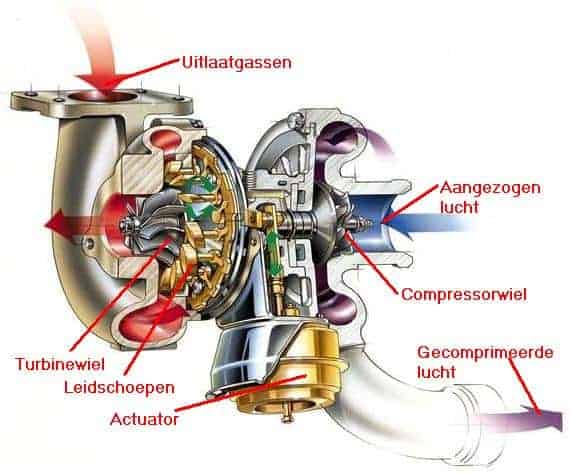
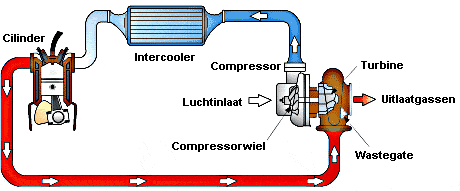
The exhaust gases leaving the cylinders are routed via the exhaust manifold to the turbo. Due to the pressure and energy of these exhaust gases, the turbine wheel starts to rotate. After the exhaust gases have transferred energy to the turbine wheel, they exit the turbo and continue to flow towards the exhaust system.
The turbine wheel is connected to the compressor wheel via a shaft. When the turbine wheel rotates, it drives the compressor wheel. The compressor wheel draws in air via the intake on the side of the turbo, where the air filter is located. This air is compressed and, under pressure, fed via the turbo hose to the intercooler.
By applying a turbo, more air enters the cylinders during the intake stroke than with a naturally aspirated engine. In a naturally aspirated engine, air is only drawn in because the piston moves downwards.
In a turbocharged engine, the air is actively forced into the cylinders under pressure. Because more air is present in the cylinders, more fuel can be injected as well. This releases more energy during combustion, resulting in a higher engine power output.
The boost pressure is measured by the boost pressure sensor (MAP sensor). This sensor sends a signal to the ECU. Based on this signal, the ECU controls the boost pressure, for example by actuating the wastegate or variable turbine geometry.
The turbo is placed as close as possible after the exhaust manifold. Sometimes the exhaust manifold and the turbo therefore form one unit. Directly after leaving the combustion chamber, the exhaust gases still have a high gas velocity. This minimizes energy losses before the exhaust gases reach the turbine wheel. It limits pressure loss and ensures efficient drive of the turbine wheel. Due to the short distance between the cylinders and the turbine wheel, the volume of the exhaust tract is small, causing the turbo to respond faster to changes in engine load. The turbo shaft can therefore spool up more quickly, reducing turbo lag.
The temperature of the air compressed by the turbo can rise sharply, often to above 60 degrees Celsius. For proper combustion it is important that this air is cooled. This increases the air density, making more oxygen available for combustion.
The intercooler cools the compressed intake air before it enters the engine. The intercooler is a separate component and is therefore discussed in detail on a separate page; see the page Intercooler.
Multiple turbochargers:
The term “twin-turbo” indicates the presence of two turbochargers. These two turbos can be mounted side by side on one cylinder bank, or one turbo per cylinder bank. This gives the driver the advantage of higher torque at low engine speeds, better performance at high revs and a smoother engine character. At low revs, the air is supplied to the engine by a small turbo, and at higher revs the larger turbo becomes effective. The larger turbo has more turbo lag, because it needs more air to get going, but that is compensated by the small turbo.
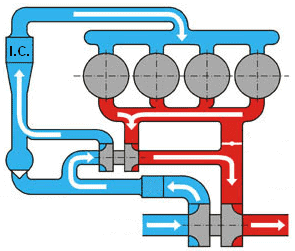
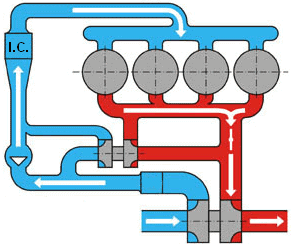
The four images below describe the situations in which both turbos operate, or when only one of the two operates. The four circles represent the cylinders, the red and blue parts are the exhaust gases and intake air. The intercooler is indicated by “I.C.”.
Low engine speed and low engine load:
At engine speeds below 1800 rpm there is only a small exhaust gas volume flow. With this small volume, the small turbo can be used. The valve between the exhaust manifold and the large turbo is closed. The exhaust gas is therefore only transferred from the small to the large turbo. This already brings the large turbo up to speed. This is a series configuration, because both turbos are being used.
Medium engine speed and moderate load:
Between 1800 and 3000 rpm, the valve between the exhaust manifold and the large turbo opens. At this moment, both turbos are driven directly by exhaust gases from the engine. Here too, this is a series configuration, because both turbos are being used.
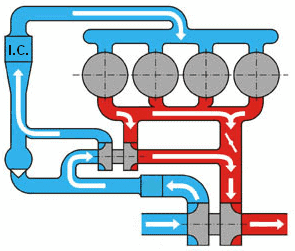
High engine speed and high load:
Above 3000 rpm, the exhaust gas volume flow becomes too great for the small turbo. The turbo is deactivated to prevent the so‑called “choke line” from being crossed (see the chapter on compressor characteristic further down the page). The wastegate of the small turbo is opened, so that all exhaust gas fed to the turbo is routed past the turbo. The exhaust gas then does not reach the turbine wheel.
The large turbo, on the other hand, is fully supplied with exhaust gas. The valve remains open so that the large turbo can reach a high speed and thereby move a large amount of intake air to the intake manifold.
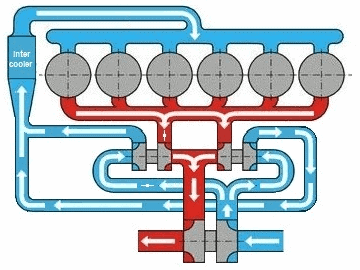
Nowadays, “tri-turbo” engines are also being produced. These engines have three turbochargers fitted so that a maximum volumetric efficiency can be achieved in every rev range. BMW applies tri-turbo technology in, among others, the M550d. The two small turbos use variable geometry, making them suitable for both low and high engine speeds. Depending on the rpm, the turbo is adjusted for better response. The large turbo uses a wastegate.
Below, two situations are described indicating which turbo is active at which moment.
Low engine speed and low load:
Only one of the two small turbos is driven. Due to the small size of the turbo, it spools up quickly. The small turbo routes the exhaust gas to the large turbo. This already brings the large turbo up to speed.
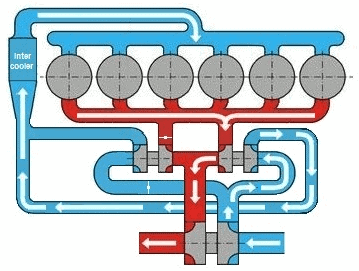
Medium and high engine speed and load:
Both small turbos are driven. The two small turbos drive the large turbo. This achieves the maximum boost pressure at all medium and high engine speeds.
Boost control with the wastegate:
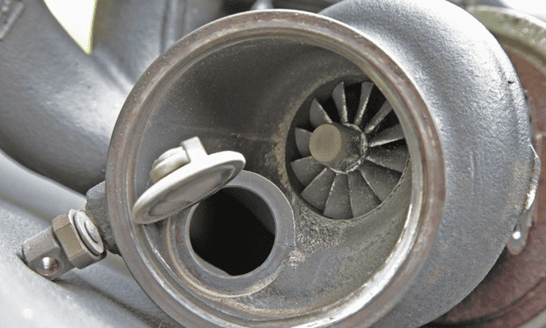
On virtually every turbo without variable vanes, a wastegate is fitted. The wastegate ensures that the pressure and speed of the turbo do not become too high. It does so by routing part of the exhaust gases past the turbine wheel, so that these gases do not contribute to driving the turbo. When the turbo still has to build up pressure, for example during acceleration, the wastegate is closed. All exhaust gases leaving the cylinders during the exhaust stroke then flow through the turbine wheel. This allows the turbo to spool up quickly and build the desired boost pressure.
At idle, little or no boost pressure is required. In this situation, the wastegate is (partially) open. Part of the exhaust gases is then routed directly to the exhaust system without flowing through the turbo. The energy of these exhaust gases is not used to drive the turbo. This is where the wastegate gets its name; the English word “waste” means loss. The wastegate can also open at higher engine speeds and loads. As soon as the turbine wheel and thus the compressor wheel reach a certain speed or a maximum boost pressure, any further increase must be prevented. By partially opening the wastegate, part of the exhaust gases is diverted. In this way, the turbo speed and boost pressure remain within safe limits.
The degree to which the wastegate opens is controlled by the ECU. For this, the ECU uses, among other things, the signal from the boost pressure sensor. By varying the opening angle of the wastegate, the boost pressure can be controlled precisely.
The figure below shows the boost pressure control with the wastegate actuator. The vacuum pump (2) supplies vacuum to both the brake booster (4) and the wastegate actuator on the turbo (7). The one-way valve (5) ensures that the airflow can only go in one direction: vacuum can be drawn from the wastegate, but as soon as the vacuum on the brake-booster side partially disappears, for example after repeated (pumping) braking and the vacuum pump has not yet generated sufficient vacuum, this has no influence on the boost pressure control. The explanation of the boost pressure control continues below the figure.
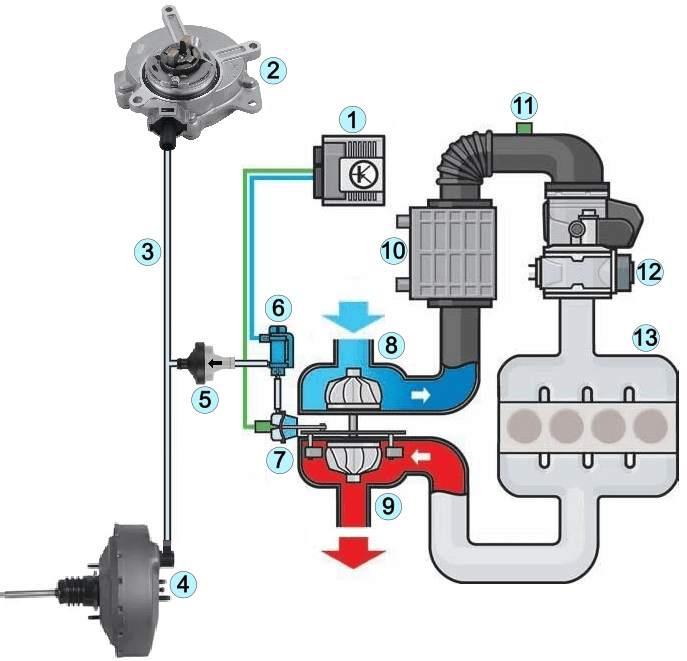
Legend:
- Engine control unit (ECU)
- Vacuum pump on the camshaft
- Vacuum line
- Brake booster
- One-way valve
- PWM-controlled boost control valve (N75)
- Wastegate actuator on the turbo
- Turbo inlet (compressor side)
- Turbo outlet (turbine side)
- Intercooler
- Boost pressure and temperature sensor
- Throttle body
- Intake manifold of the combustion engine
The PWM-controlled boost control valve (N75) regulates the amount of vacuum that is admitted to the wastegate actuator on the turbo (7). The operating conditions of the engine determine the wastegate opening angle:
- during acceleration at low rpm, the wastegate is fully closed to bring the turbine shaft up to speed as quickly as possible;
- when higher boost pressure is reached, measured by the boost pressure sensor (11), the wastegate opens partially or fully to limit the boost pressure.
The wastegate is a normally open valve: without actuation it is open and the turbine wheel does not build up pressure. The exhaust gases leave the turbo via the wastegate to the exhaust and do not drive the turbine wheel. Only when vacuum has been generated and the boost control valve (6) gradually admits the vacuum, does the wastegate close against the spring force.
With a vacuum pump, the negative pressure to the wastegate can be checked. When the engine idles for a few seconds and the pressure on the vacuum line is measured, the pressure is around 100 to 250 millibars (-0.1 to -0.25 bar).
Suppose a fault is present in the boost pressure control and we measure a pressure around the atmospheric pressure of 1 bar, then insufficient vacuum has been generated. We can connect the pressure gauge at several points to investigate whether the vacuum pump is not working properly, the one-way valve is defective (blocking), there is an air leak in the vacuum line, or the boost control valve (N75) is not working correctly.
Twin-scroll turbo:
When exhaust gases from multiple cylinders come together in the exhaust manifold, interference problems can arise. The pressure waves from different cylinders can then disturb each other, causing energy to be lost before the exhaust gases reach the turbine wheel.
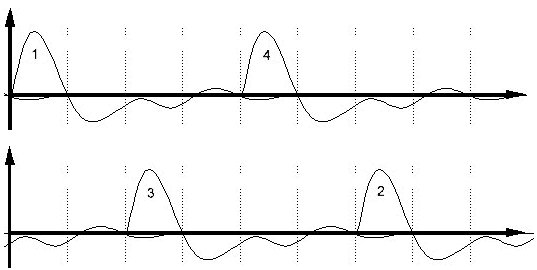
With a twin-scroll turbo, the exhaust gases are separated and routed to the turbo via two separate channels. This means that the exhaust gases from certain cylinders do not come into direct contact with each other in the exhaust manifold, but reach the turbine wheel separated from each other. In this way, the pressure pulses are better preserved and the turbine wheel is driven more efficiently. Using a twin-scroll turbo provides quicker throttle response and higher efficiency of the turbo. In the figure below you can see that the exhaust gases from cylinders 1 and 4 form one channel together and those from cylinders 2 and 3 form the other channel. In this way, interference between the pressure waves is minimized as much as possible.
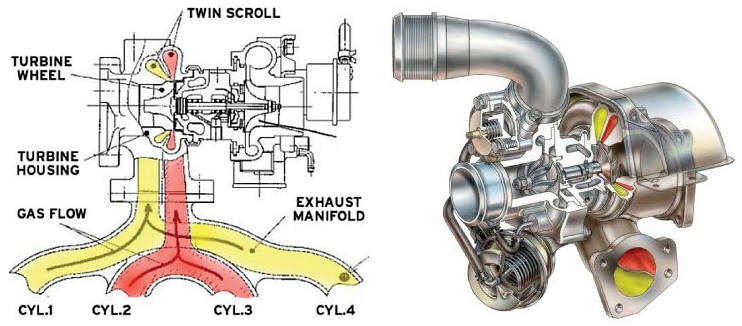
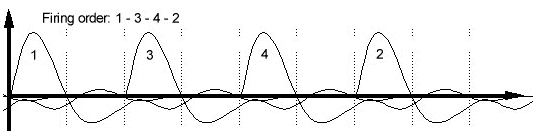
With a conventional turbo, the exhaust gases come into contact with each other in the exhaust manifold. We call this “interference”. The figure below shows the pressure pulses that arise in the exhaust manifold from one cylinder.
Because there is valve overlap, during the transition from the exhaust stroke to the intake stroke both the intake and exhaust valves are open, temporary negative pressures can occur in the cylinder. This pressure can be lower than atmospheric pressure. During valve overlap, the exhaust gases help to draw fresh intake air into the combustion chamber and expel remaining exhaust gases. This phenomenon is also called scavenging. Due to this better scavenging, the combustion chamber is filled with more fresh air and thus more oxygen. As a result, the volumetric efficiency of the engine increases.
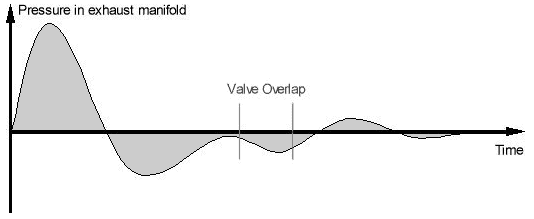
When we look at the pressures in the exhaust manifold of a four-cylinder engine, we see a lot of interference occurring. The pressure pulses of the different cylinders influence each other. Each positive pressure pulse is partially flattened by negative pressure waves that arise as a result of valve overlap. This interference causes the effective energy of the exhaust gas pulses to decrease. As a result, the turbine wheel is driven less powerfully, which has an adverse effect on turbo spool-up time. This enlarges the turbo lag, i.e. the response time needed to build up sufficient boost pressure.
Using a twin-scroll turbo improves the response time of the turbo, because the exhaust gases from cylinders 1 and 4 and from cylinders 2 and 3 are separated from each other. This keeps the exhaust gas pulses better preserved and they are less affected by negative pressure waves from other cylinders. The pulses that reach the turbine wheel are therefore stronger and more energetic.
Because the exhaust gas pulses are utilized more effectively, the designer can choose to increase the valve overlap. This allows for better scavenging of the cylinders, so that more fresh air is drawn in. The result is higher volumetric efficiency and a faster turbo response.
Variable geometry turbo (VGT):
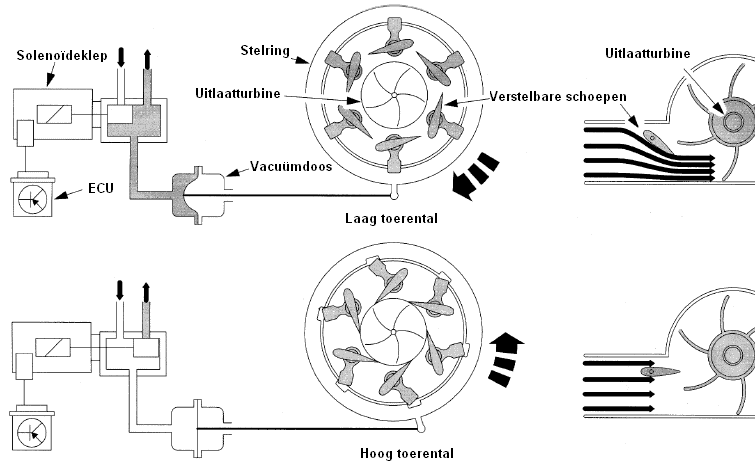
A turbo with a wastegate can suffer from turbo lag. Only when the engine reaches a certain speed is there enough exhaust gas energy available to spool the turbo up quickly. At low engine speeds, the exhaust gas pressure is often too low to drive the turbo effectively. A variable geometry turbo has no wastegate, but is equipped with adjustable vanes in the turbine housing. These vanes can change position by means of an adjustment ring. The adjustment ring is usually rotated using vacuum. The required amount of vacuum is determined by the ECU based on engine load and engine speed and is controlled via a solenoid valve.
By changing the position of the vanes, the flow of the exhaust gases can be directed. At low engine speeds, the vanes are more closed. This reduces the passage cross-section and increases the exhaust gas velocity, causing the turbine wheel to spin faster despite the lower exhaust gas pressure. This significantly reduces turbo lag. At higher engine speeds, the vanes open further. This allows a larger quantity of exhaust gas to flow through the turbo without the turbo spinning too fast. In this way, suitable boost pressure can be built up at both low and high engine speeds. The engine already has sufficient boost pressure at low speeds, while at high speeds overloading of the turbo is prevented.
Dump valve:
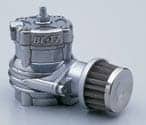
The dump valve is also called a blow-off valve. The dump valve is mounted in the intake tract between the turbo and the intake side of the engine. Through this tract, the compressed air from the turbo is supplied to the engine. During acceleration, the turbo in a passenger car can reach speeds of up to about 200,000 revolutions per minute, at which the maximum boost pressure is built up.
When the accelerator pedal is suddenly released, the throttle closes. At that moment, however, the turbo is still spinning at high speed and continues to supply air. This creates an overpressure in the intake tract before the throttle. Without a dump valve, this overpressure would flow back towards the compressor, strongly braking the compressor wheel. This phenomenon is called compressor surge and causes the turbo speed to drop rapidly.
The dump valve prevents this by venting part of the compressed air when the accelerator pedal is released. This removes the overpressure from the intake system and prevents the air from pushing back against the compressor wheel. As a result, the turbo maintains its speed better, so that boost pressure is available again more quickly when accelerating again. As soon as the overpressure has been relieved, the dump valve closes again.
Contrary to what is often thought, a dump valve does not increase engine power. The function of the dump valve is to protect the turbo and improve throttle response. The characteristic blow-off sound that is audible when releasing the accelerator during acceleration is caused by the dump valve opening.
Compressor map (surge & choke line)
When designing an engine, the size of the turbo must be taken into account. Matching the size of the turbo to the engine is called “matching”.
- With an excessively large turbo, there will be a large turbo lag. The turbo spools up slowly because the turbine housing and turbine wheel are too large for the small amount of exhaust gas at low engine speeds. Only at higher speeds is there sufficient exhaust gas energy available to bring the turbo up to speed and provide high boost pressure.
- With an excessively small turbo, turbo lag is small or virtually absent. The turbine wheel spools up quickly even with a small amount of exhaust gas. As a result, a relatively high boost pressure is already built up at low engine speeds. The disadvantage of a too small turbo is that at higher speeds the amount of exhaust gas becomes too large for the turbo. The turbo can no longer process this amount of energy.
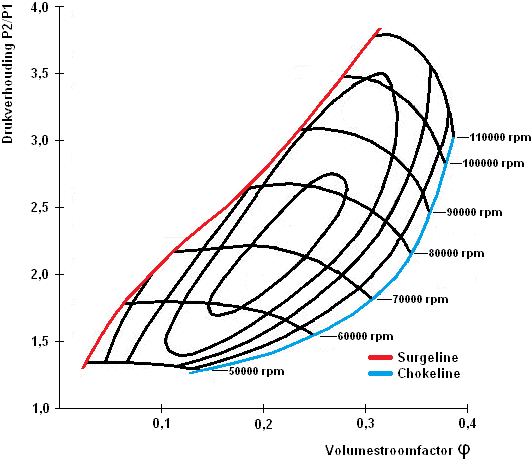
In that case, the wastegate has to open earlier to route part of the exhaust gases around the turbine. This prevents the turbo from reaching excessively high speeds. The word “waste” means “loss”. That applies here because the exhaust gases that are routed via the wastegate do not contribute to driving the turbo and therefore do not produce useful power. The size of the turbo is therefore very important in engine design. Each turbo has a specific compressor map. This compressor map can be used to assess whether a turbo is suitable for a particular engine. The figure below shows an example of a compressor map.
The pressure ratio P2/P1, shown on the y-axis, is the ratio between the pressure before the compressor (P1) and the pressure after the compressor (P2).
- P1 is the compressor inlet pressure. This is usually the ambient pressure or the pressure after the air filter.
- P2 is the compressor outlet pressure, i.e. the pressure with which the drawn-in air is directed towards the engine.
The pressure ratio is dimensionless. A pressure ratio of 2.0 means that the pressure after the compressor is twice as high as the pressure before the compressor. This pressure ratio has no direct relation to the pressure before or after the turbine wheel on the exhaust side of the turbo. The volume flow factor φ, shown on the x-axis, indicates the amount of air flowing through the compressor. Further to the right in the graph, the airflow through the turbo increases.
The curved lines in the graph are speed lines of the turbo shaft.
Each line represents a constant speed of the compressor wheel, for example 50,000 rpm, 70,000 rpm or 100,000 rpm. At a certain speed, such a line shows which combinations of volume flow and pressure ratio are possible.
In the figure, the red line is the surge line and the blue line is the choke line. The surge line, also called the pumping limit, indicates the boundary at which the compressor starts to operate unstably. In this region the pressure ratio is high while the volume flow is low. The engine demands little air, but the compressor still tries to build up a high pressure. As a result, the air can no longer flow stably through the compressor.
If the compressor operates beyond the surge line, the airflow decreases sharply or even temporarily comes to a standstill. The pressure then builds up again and the air starts to flow once more. This process repeats continuously. This unstable airflow causes pressure fluctuations and pulsations in the intake tract. This phenomenon is called “surging” or “pumping” of the compressor, hence the name surge line.
The back-and-forth flowing air creates high mechanical and thermal loads. This can damage or break off the compressor wheel blades and overload the turbo bearings.
The choke line is another limit that the compressor must not exceed. When the choke line is exceeded, the compressor wheel runs at very high speed and the compressor can no longer process additional air. The flow becomes ‘choked’. The limitation is determined by the geometry of the compressor wheel and the compressor housing. Additional speed then does not result in more air, but does cause a sharply increasing mechanical load and lower efficiency. Operating in the choke region leads to power loss of the engine and an increased risk of overloading the turbo.
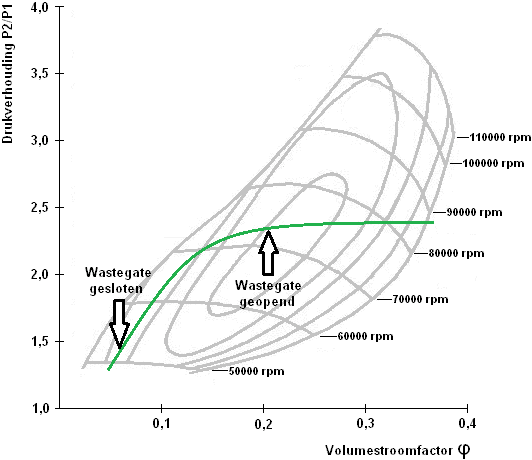
The figure shows the compressor map of a turbo on an engine operating at part load. At part load, the aim is to achieve the lowest possible specific fuel consumption. This lowest specific fuel consumption is found at operating points that are located near the most efficient region of the compressor. This region is represented by the smallest efficiency islands in the compressor map.
The engine management controls the boost pressure in such a way that the compressor operating point is located in a favourable efficiency region. In the figure, this is shown by the green line: it represents the progression of the compressor operating point as air demand increases.
At the beginning of the line, the wastegate is closed. This causes all exhaust gas to flow through the turbine wheel and the boost pressure to rise. As the desired boost pressure is reached, the engine management system partially opens the wastegate to route part of the exhaust gases around the turbine and prevent the boost pressure from increasing further. The turbo shaft speed in this operating range lies between approximately 80,000 and 90,000 revolutions per minute, as can be read from the speed lines in the compressor map.
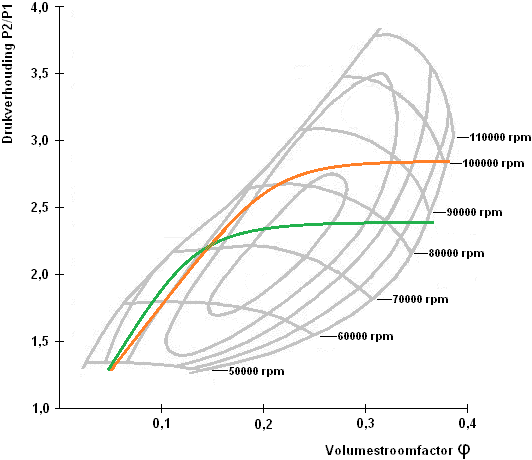
When driving in the mountains, the geographical altitude is higher and the air pressure is lower and thinner. This affects the operation of the turbo because the pressure before the compressor decreases. As a result, the drawn-in air contains less oxygen per unit of volume. To still achieve the same absolute boost pressure in the intake manifold, the compressor must provide a higher pressure ratio. This means that both the pressure ratio P2/P1 and the compressor speed must increase. This situation is shown in the figure.
The green line represents the part-load situation when driving at sea level. The orange line represents the part-load situation when driving in the mountains. Due to the lower air pressure at altitude, the compressor operating point shifts to a higher pressure ratio and a higher speed. In this example, the compressor speed rises to about 100,000 revolutions per minute.
Because of the higher compressor speed, the temperature of the compressed intake air supplied to the engine also increases. The intercooler therefore has to dissipate more heat in order to limit the intake air temperature. In addition, a difference in fuel consumption is visible. When driving in the mountains, fuel consumption increases. This is caused by the higher pressure ratio P2/P1, the higher turbo speed and the lower overall efficiency of the compressor under this operating condition.
Combination of turbo and supercharger:
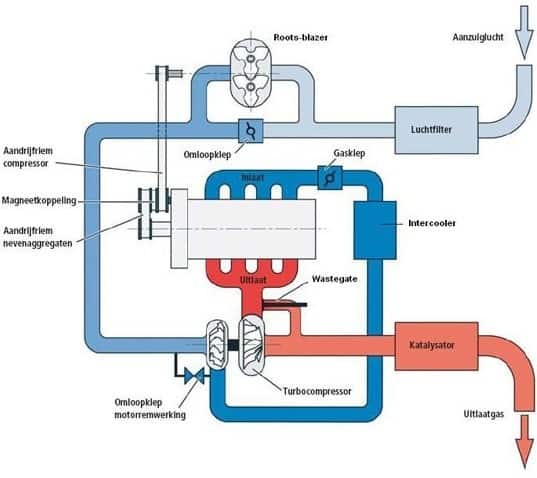
More and more often, car manufacturers choose to equip an engine with both a turbo and a mechanical supercharger. The turbo is usually larger and equipped with a wastegate. The supercharger is used to reduce or eliminate turbo lag. At low engine speeds, the supercharger immediately provides boost pressure and helps the turbo spool up faster. At higher engine speeds, the turbo takes over all boost pressure and the supercharger is switched off or bypassed.
The drawn-in air is first compressed by the supercharger. Depending on the operating condition, the air then flows directly to the turbo via a bypass valve or the supercharger is bypassed. The air is then further compressed by the turbo, cooled in the intercooler and then routed to the intake manifold. Click here for more information about the Roots supercharger.
Electric turbo:
A conventional exhaust-gas turbo suffers from turbo lag at low engine speeds because sufficient exhaust gas energy is needed to drive the turbine wheel. A mechanical supercharger does not have this disadvantage and can provide boost pressure from idle. A combination of both systems therefore seems ideal. However, a mechanical Roots supercharger must be driven by the crankshaft, which consumes additional engine power and reduces efficiency.
To reduce turbo lag without extra mechanical losses, car manufacturers are experimenting with electric turbos or combinations of multiple turbos. With an electric turbo, the compressor wheel is driven by an electric motor instead of by exhaust gases. The electric turbo is controlled by the ECU. Within about 250 milliseconds, the compressor wheel can reach a speed of approximately 70,000 revolutions per minute. This allows boost pressure to be built up immediately at low engine speeds. The compressed intake air is then routed to the compressor of the exhaust-gas turbo.
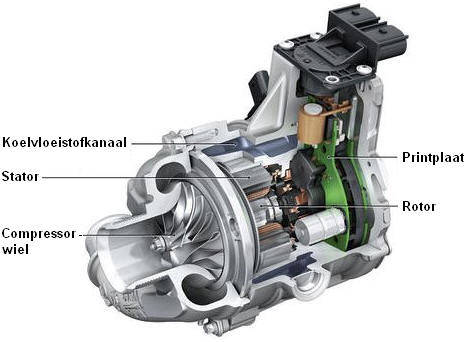
As soon as sufficient exhaust gas energy is available, the exhaust-gas turbo takes over the pressure build-up and the electric turbo is switched off or becomes less active. In this way, turbo lag is greatly reduced, while the energy loss of a mechanically driven supercharger is avoided. Thanks to the use of an electric turbo, the engine responds more quickly to the accelerator pedal. At higher engine speeds, where the exhaust-gas turbo can independently provide full boost pressure, the electric turbo is completely switched off.