Arc flash introduction:
Lithium-ion batteries in electric cars are made up of individual cells. Each cell has a voltage that depends on the state of charge. A fully charged cell is about 4.2 volts and at a low state of charge about 3 volts. The cells are connected to each other both in series (higher voltage) and in parallel (higher capacity). The voltage of an HV battery pack can therefore range between 200 and 1000 volts, and as a result arc flash currents of thousands of amps can occur. When working on HV systems, arc flash must be taken into account when working energized.
In HV systems, an arc flash can occur when a short circuit is created with tools, insulation is damaged, or when conductors touch each other while working energized. An arc flash is an electrical discharge through the air between two conductors with a voltage difference. Normally, air is an insulator, but when the electric field strength is high enough, the air becomes ionized. As a result, the air temporarily becomes conductive and current can flow through it. An arc flash causes:
- A bright flash of light;
- A very high temperature (can be higher than 10,000 °C) with heat radiating to the surroundings;
- Vaporization of insulation and copper;
- A pressure wave due to rapid expansion of the heated air, which can fling metal particles outward.
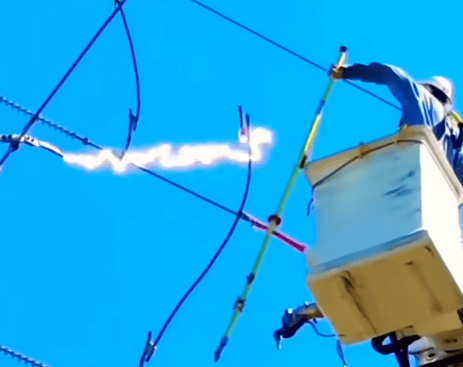
A short circuit or arc flash can cause serious injury. The severity of the injury or damage depends on the system voltage, the available short-circuit current, the duration of the arc flash, and the distance to the arc flash.
The video below shows an experiment in which electrical conductors are separated by air, but where a sufficiently high source voltage causes the air gap to create an electrical short circuit between the conductors, resulting in an arc flash.
At the start of the work, in the event of a risk of contact or arc-flash hazard, precautionary measures must be taken and protective equipment must be used. If, during work on the HV system, there is a risk of an arc flash and it is not clear in advance how large that risk is, NEN 9140 states that an arc-flash calculation must be carried out if:
- the analysis has shown that there is an arc-flash hazard for which the incident energy is not yet known;
- there is no upstream protection present (in the form of a fuse or circuit breaker);
- the fuse is more than 630 A at a voltage of more than 60 volts DC.
The incident energy (IE) is the amount of heat energy per unit area (cal/cm²) released by an arc flash at a certain distance from the working point. The higher the incident energy, the heavier the required arc-flash protection.
- IE < 1.2 cal/cm²: it is unlikely that second-degree burns will occur during an arc-flash incident. No arc-rated PPE is required in addition to the usual PPE;
- IE 1.2 – 8 cal/cm²: if the incident energy cannot be sufficiently reduced, it is recommended to use arc-rated PPE (such as a face shield) and to apply additional safety procedures in the workplace;
- IE > 8 cal/cm²: up to about 8 cal/cm², many guidelines refer to a “moderate” risk. Above this level, the severity of burns increases sharply, so thicker and often fully enclosing protection (PPE) is needed.
- As IE increases, it should always be considered to reduce safety risks, for example by disassembling parts of the battery pack and thereby reducing the voltage.
An arc-flash calculation determines the magnitude of the short-circuit current, how long the arc flash can last, and how much incident energy is released at the working distance. Based on the calculation outcome, the ev-wv determines whether working energized is justified, which personal protective measures are required, and whether additional measures are needed.
Arc flash calculation: calculating the incident energy (1):
When work is carried out on an HV system that is energized, an arc-flash calculation must be performed beforehand on the basis of the data below to determine the risk and the required protective measures.
| Gegevens: | |
|---|---|
| Capaciteit | 5000 mAh |
| Nominale spanning cel | 3,6 volt |
| Spanning volledig geladen cel | 4,0 volt |
| Inwendige weerstand cel | 0,02 ohm |
| Cellen in serie | 200 cellen |
| Cellen parallel | 20 |
| Serviceplug | Deelt de batterij in tweeën (daarom factor 0,5) |
| Tarc | 2,0 seconden |
| D | 50 cm |
| Symbolen en betekenissen: | |
|---|---|
| Ibf | Botte kortsluitstroom in A |
| Iarc | Vlamboogstroom in A (Iarc = 0,5 * Ibf) |
| IE | Vlamboogenergie op werkafstand in cal/cm^2 |
| Vsys | Systeemspanning in V |
| Tarc | Vlamboogduur in s |
| D | Werkafstand in cm |
In the four steps below, the incident energy is calculated (according to J. Fontaine and C. McCluer) on the basis of the data above. Tarc and D are given.
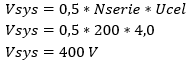
1. Calculate the system voltage (Vsys) by multiplying the number of series-connected cells (Nserie) by the cell voltage (Ucel). When the service plug splits the battery pack in two, we multiply everything by 0.5:
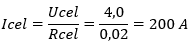
2. Calculate the short-circuit current per cell (Icel). The short-circuit current per cell is the maximum current that a single battery cell can deliver when the positive and negative terminals are connected directly to each other:
3. Calculate the bolted fault current (Ibf). The bolted fault current is the maximum current that can flow when the positive and negative of a battery are connected directly to each other without additional resistance:
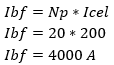
4. Calculate the incident energy (IE). The incident energy is the amount of heat energy released by an arc flash at a certain distance from the working point:
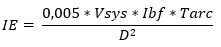

The incident energy determines whether there is a chance of burns, how severe those burns can be, and which personal protective equipment (PPE) is needed. A commonly used limit value is 1.2 cal/cm^2. Above this value, a person’s unprotected skin can sustain a second-degree burn.
The higher the voltage, current, or fault duration, the higher the incident energy. The greater the distance, the lower the incident energy.
Arc flash calculation: calculating the incident energy (2):
In the previous calculation, the working distance was 50 cm. In this example, the working distance is reduced to 10 cm and the incident energy is calculated again.
| Gegevens: | |
|---|---|
| Capaciteit | 5000 mAh |
| Nominale spanning cel | 3,6 volt |
| Spanning volledig geladen cel | 4,0 volt |
| Inwendige weerstand cel | 0,02 ohm |
| Cellen in serie | 200 cellen |
| Cellen parallel | 20 |
| Serviceplug | Deelt de batterij in tweeën (daarom factor 0,5) |
| Tarc | 2,0 seconden |
| D | 10 cm |
| Symbolen en betekenissen: | |
|---|---|
| Ibf | Botte kortsluitstroom in A |
| Iarc | Vlamboogstroom in A (Iarc = 0,5 * Ibf) |
| IE | Vlamboogenergie op werkafstand in cal/cm^2 |
| Vsys | Systeemspanning in V |
| Tarc | Vlamboogduur in s |
| D | Werkafstand in cm |
Vsys, Icel and Ibf do not change because the battery data are the same. We enter the working distance in the incident energy formula:

The incident energy is inversely proportional to the square of the distance to the arc flash. This means that when the working distance becomes smaller, the energy per square centimeter increases sharply. If the distance goes from 50 cm to 10 cm (five times smaller), the incident energy becomes 25 times as large (from 6.4 to 160 cal/cm^2).
Arc flash calculation: calculating a safe working distance:
If the incident energy may be a maximum of 1.2 cal/cm², the minimum safe working distance can be calculated. We do this with the data in the table below. The first three calculations (Vsys, Icel, Ibf) remain the same; only the input data are different. In calculation 4, the working distance D is determined using the known IE.
| Gegevens: | |
|---|---|
| Capaciteit | 4500 mAh |
| Nominale spanning cel | 3,6 volt |
| Spanning volledig geladen cel | 4,0 volt |
| Inwendige weerstand cel | 0,01 ohm |
| Cellen in serie | 100 cellen |
| Cellen parallel | 10 |
| Serviceplug | Deelt de batterij in tweeën (daarom factor 0,5) |
| Tarc | 2,0 seconden |
| IE | 1,2 cal/cm^2 |
| Symbolen en betekenissen: | |
|---|---|
| Ibf | Botte kortsluitstroom in A |
| Iarc | Vlamboogstroom in A (Iarc = 0,5 * Ibf) |
| IE | Vlamboogenergie op werkafstand in cal/cm^2 |
| Vsys | Systeemspanning in V |
| Tarc | Vlamboogduur in s |
| D | Werkafstand in cm |
1. Calculate the system voltage (Vsys):
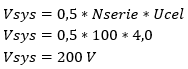
2. Calculate the short-circuit current per cell (Icel):
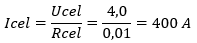
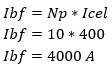
3. Calculate the bolted fault current (Ibf):
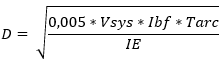
4. Calculate the working distance D. The value 1.2 cal/cm² is often used as a threshold at which unprotected skin can sustain a second-degree burn. By entering this threshold value for incident energy (IE) in the denominator of the formula, the distance can be determined at which the energy does not exceed this safe value.

Related pages: