Calculating axle load using FBD:
The axle loads of a vehicle can be calculated with a schematic drawing and the vehicle data. Using an FBD (Free Body Diagram – in Dutch: VLS, Vrij Lichaam Schema), a vehicle can be drawn with the relevant forces (see image below). The conditions for an FBD are that the road surface is not drawn. Even if the vehicle is on a hill, the vehicle may not be drawn at an angle, but a horizontal force with a direction must be drawn in the FBD.
The advantage of working with an FBD is that unnecessary elements are omitted. When, for example, the internal moments or axle load of a trailer are to be calculated, it is useful to draw only the trailer instead of a car with trailer. By drawing only what is needed, you avoid making mistakes (by including too many horizontal/vertical forces in the calculation that do not belong there).
First, the weight acting on the vehicle must be calculated using gravitational acceleration. Gravity depends on the place on Earth where the vehicle is located. In the Netherlands, gravitational acceleration is 9.81 m/s².
The vehicle mass must be multiplied by gravity. That gives: 1500 x 9.81 = 14,715 N (the unit of force is Newton). Note that gravitational acceleration is sometimes also called gravitational acceleration (again), gravitational constant or fall speed. The value 9.81 is sometimes rounded to 9.8 or very roughly to 10. This is easier for mental arithmetic (1500 / 10 is easier to calculate in your head than 1500 / 9.81) but the final answer is certainly not accurate. Therefore always use 9.81 m/s², unless the question (for example in an exam) explicitly states otherwise.
The total force with which the vehicle is pressed onto the road surface is therefore 14,715 Newton. This force is distributed over both axles of the car.
The front axle load is often higher because the engine is located there. This can be seen in the image from the position of the centre of gravity, which is in front of the midpoint. The centre of gravity is an imaginary pivot point. If this centre of gravity were exactly in the middle, the axle load on both axles would be equal (vehicle mass divided by 2). Because the distances of the wheels, the position of the centre of gravity and the total vehicle mass are known, the axle loads at the front and rear can be calculated.
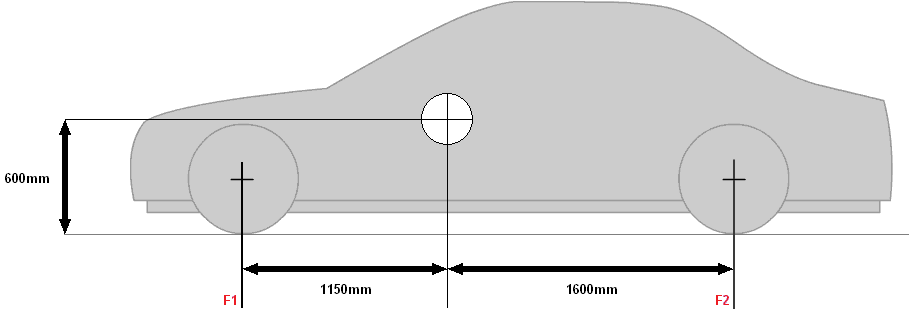
Vehicle mass: 1500 kg
Weight: 14,715 N
Height road surface – pivot point: 60 cm
Distance F1 – pivot point: 115 cm
Distance pivot point – F2: 160 cm
Distance F1 – F2: 115 + 160 = 275 cm (this is the wheelbase)
Calculating rear axle load (F2):
14715 x 1.15 – F2 x 2.75 = 0
16922 – F2 x 2.75 = 0
F2 = 16922 / 2.75
F2 = 6154 N
The calculation is worked out in detail below:
- To calculate F1 and F2, one of them must be calculated first. We choose to calculate F2 first.
We take F1 as the pivot point. Everything clockwise is positive and everything counterclockwise is negative. That means that the forces pointing downwards are positive, and the force F2, pointing upwards, is negative. We fill in the first part of the formula.
14715 x 1.15 – F2 x 2.75 = 0
(Always fill in this last 0 as standard, because further in the calculation the numbers on the left and right of the ” = ” sign are swapped.) - Force x arm: The weight of 14715 is multiplied by the distance of 1.15:
14715 x 1.15 = 16922 - We now fill this back into the formula:
16922 – F2 x 2.75 = 0 - Move 16922 to the other side where the 0 is:
F2 x 2.75 = 16922 - Divide both sides by 2.75 to remove it from the left of the = sign:
F2 = 16922 / 2.75 - That results in:
F2 = 6154 N.
Difference between weight and mass:
Remember that weight is not the same as mass. The weight at F2 in the previous calculation is 6154 Newton. A mass is always in kilograms. It must therefore always be divided by the gravitational acceleration of 9.81. (6154 / 9.81 = 627.3 kg) Think of the curb weight of the vehicle that is stated on the registration certificate. That is always in kg. To make the above explanation clear: in space there is no gravity. Everything floats there, no matter how heavy it is. Everything does indeed have a weight; when you throw a carton of milk at something, or a stone, this will have a different impact. The carton of milk will not easily damage something if it hits e.g. a wall, but the stone will definitely cause damage. That is because the force with which the object comes to a stop is greater for the stone than for the carton of milk. This proves that weight is also present and important in space, but mass is not. Mass comes from the gravitational pull of the Earth. So the weight of the car is not 1200 kg, but the mass is 1200 kg. Many mistakes are often made with this.
Calculating front axle load (F1):
When the total weight and one axle load are known, the second axle load can very easily be calculated by subtracting the known axle load from the total weight:
Total weight – F2 = F1:
14715 – 6154 = 8561 N.
Of course, F1 can also be calculated separately. That works almost the same as the first calculation:
14715 x 1.6 – F1 x 2.75 = 0
23544 – F1 x 2.75 = 0
F1 = 23544 / 2.75
F1 = 8561 N
The force that the front wheel exerts on the road surface is 8561 N and the rear wheel 6154 N. Added together this is 14,715 N. The total vehicle mass is therefore 14,715 / 9.81 = 1500 kg.
Calculating noseweight:
Using the same method as was used to calculate the axle loads of the car in the previous chapters, the noseweight on the car’s towbar can also be determined. Moment is force x arm. That means the longer the arm, the greater the moment becomes. The rear axle load depends on the distance between F2 and F3 and the noseweight depends on the distance between F3 and F4. And it is precisely the force on the ‘hinge point’, in other words the towball, that must be calculated.
The car weighs 1500 kg and the trailer 300 kg. We first convert these back to Newton by multiplying by the gravitational acceleration:
1500 x 9.81 = 14715 N
300 x 9.81 = 2943 N
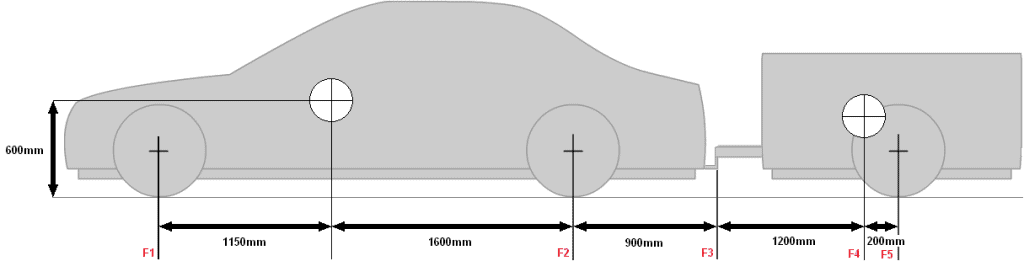
To calculate the noseweight, it is easier to first draw only the trailer. The car itself is not important in the calculation.
The noseweight is indicated by F3 and the force with which the tyre presses on the road surface by F5.
F3 is taken as the pivot point and we are going to calculate the force F5. The centre of gravity is a downward force, so positive. The force acting at F5 is an upward force, so it is negative (so a minus sign is placed in front of it). The weight of the trailer is 4000 N.
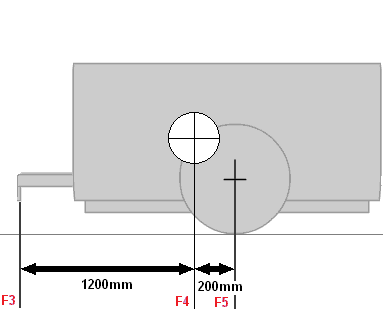
Calculating the force F5:
4000 x 1.2 – F5 x 1.4 = 0
4800 – F5 x 1.4 = 0
F5 = 4800 / 1.4
F5 = 3429 N
Calculating the noseweight (F3):
4000 – 3429 = 571 N
571 / 9.81 = 58.2 kg
The noseweight with this trailer is 58.2 kg.
If the centre of gravity moves backwards, the noseweight becomes smaller. To get a feel for this and to practise the calculations, it is useful to make the distance between F3 and F4 and therefore also between F4 and F5 larger and smaller and perform the calculation again.
Calculating the influence of noseweight on the rear axle:
Now that the noseweight is known, we can calculate what influence this has on the rear axle. The weight cannot simply be added to it, because the distance between the rear axle and the towball head is very important (force x arm). We again use the same drawing of the car with trailer.
In the previous calculation it was found that the noseweight (F3) is 571 N. F2 was also already known, namely 6154 N. The forces cannot be added together because the distance between the rear wheel and the towball head still acts as an arm. We set up the complete formula again, as at the very beginning of this page. In this formula we now add 571 x 3.65 (the force at F3 with the distance from F1 to F3 added).
14715 x 1.15 + 571 x 3.65 – F2 x 2.75 = 0
19006 – F2 x 2.75 = 0
F2 = 19006 / 2.75
F2 = 6911 N = 691 kg.
This means that there is a weight of 691 kg on the rear axle.