Introduction:
Due to the mass forces in an engine, vibrations occur. The more cylinders an engine has, the fewer vibrations will be produced. That is because in a 3-cylinder engine a power stroke occurs every 240 degrees, in a 4-cylinder engine every 180 crankshaft degrees, in a 6-cylinder every 120 degrees, in an 8-cylinder every 90 degrees and in a 12-cylinder every 60 degrees. If an engine has more cylinders, there are more power strokes in a short time and the engine is virtually vibration-free. In most passenger cars, 4-cylinder engines are used. In these engines many vibrations are generated and transmitted to the interior. The counterweights on the crankshaft mainly limit the engine vibrations.
To further reduce engine vibrations, designers of a number of car brands have applied the “balance shaft” principle. Each brand has its own design (a single balance shaft, 2 balance shafts at the same height, 2 balance shafts of which 1 is low and 1 higher in the block, etc.) The balance shaft drive takes place via the timing system (gears, belt or chain) and must also be “timed” correctly during work. A balance shaft that is not correctly timed will amplify the engine vibrations even more, resulting in damage to components.
Operation of the balance shaft:
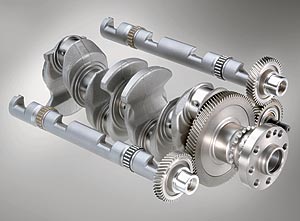
The balance shaft is a shaft that is itself unbalanced and thus compensates for the mass forces that are mainly caused by the secondary piston movement. Over its entire length there are thickenings, lobes or deformations which, when rotating, cause the required imbalance. Both the primary forces (the up-and-down piston movement) and the secondary forces (the lateral forces due to the connecting rod being pushed down at an angle) are absorbed by the balance shafts. To achieve this, the balance shafts rotate at twice the speed of the crankshaft. When there are two balance shafts in the engine, they rotate in opposite directions to each other.
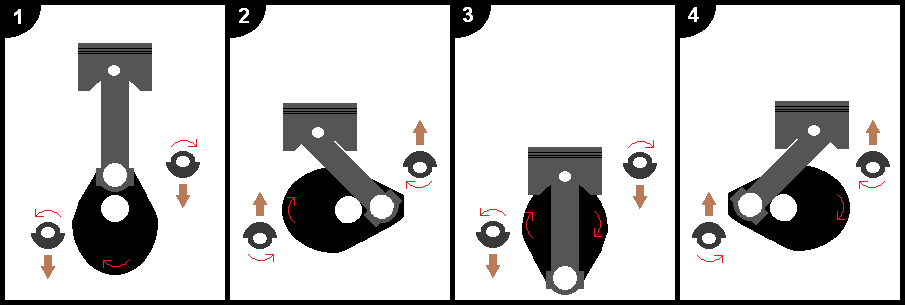
1: The piston is at TDC. The balance shafts are pointing downward. The lower balance shaft rotates counterclockwise and the upper balance shaft rotates clockwise. Both balance shafts rotate twice as fast as the crankshaft.
2: The crankshaft rotates 45 degrees and the piston moves from TDC to BDC. In this position, the mass forces caused by the secondary piston movement are at their greatest. With the secondary piston movement, mass forces arise that are directed downward. To compensate for this, the balance shafts are pointing upward in this position.
3: The crankshaft rotates another 45 degrees and is at BDC. The balance shafts are pointing downward.
4: The crankshaft moves from BDC to TDC. After 45 crankshaft degrees, the balance shafts are pointing upward again. Once more, in this position the greatest (downward-directed) mass forces arise, originating from the secondary piston movement. The upward-pointing balance shafts compensate for these mass forces.
Related pages: