Topics:
Imbalance:
Every tyre, whether it is new or old, has small irregularities. The tyre is always slightly heavier on one side than on the other. As a result of these irregularities in the tyre, an imbalance occurs while driving due to the radial forces that arise (from the centre outwards). This imbalance can be noticed by vibrations in the steering wheel or the entire car.
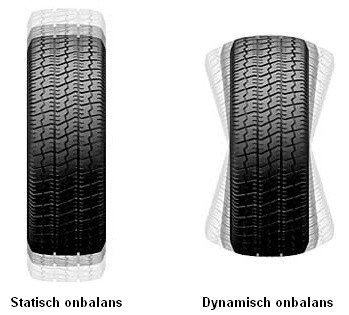
There are 2 different types of imbalance: static and dynamic imbalance. With static imbalance, the tyre moves up and down because, for example, the weight at the top of the tyre is greater than at the bottom. The forces on the rolling tyre are therefore not evenly distributed. As the rotational speed increases, the force of the imbalance will also increase. The vibration will become stronger and stronger. With static imbalance, the car will mainly vibrate as a whole.
With dynamic imbalance, the tyre moves more from side to side, creating a wobbling effect. This is especially noticeable in the steering wheel, when it moves very quickly from left to right. Here too, the vibration will increase as speed increases.
Balancing:
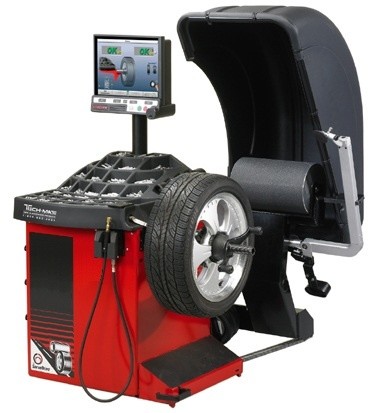
After mounting the tyre on the rim, the complete wheel must be balanced. The wheel is placed on a balancing machine, which can determine exactly where the irregularities in the tyre are and how large they are. By hammering or sticking a small weight onto the indicated side of the rim, this imbalance is corrected. On the screen, the left side shows how much weight needs to be stuck to the inside of the rim, and the right side shows how much on the right. By rotating the wheel to the position indicated by the machine, the weight can be applied to the rim.
By closing the cover again, the wheel starts to spin and the imbalance is measured again. The screen should now show 0 on both the left and right sides. If there is still imbalance (for example 5 or 10 grams), it means the wheel has not been properly balanced and the previously applied weight should actually be removed and the wheel rebalanced. Otherwise, the “excess weight” would also cause imbalance again and would then have to be compensated as well.
When the rim is damaged or bent, sometimes the only option is to apply weights in several places because there is imbalance in multiple spots. A bent rim can usually still be brought to 0 grams of imbalance, but it will still always cause a vibration in the car due to the out-of-round movement of the wheel.
Amount of imbalance:
A normal wheel usually has between 10 and 30 grams of imbalance. It occasionally happens that a wheel has no imbalance at all because the tyre has, by coincidence, been mounted in exactly the right position on the rim. The deviations in the tyre then exactly compensate for the deviations in the rim. Modern balancing machines can find this point.
When a wheel has more than 50 grams of imbalance, it is advisable to rotate the tyre in relation to the rim. If the rim itself also has a deviation in exactly the same spot as the tyre, this will increase the imbalance. By rotating the tyre, the imbalances can cancel each other out. The best approach is to rotate the tyre half a turn the first time. If this does not improve things, or even makes them worse, then rotate the tyre a quarter turn. If the imbalance is still too high, the tyre can be rotated another half turn (the tyre has now had 4 different positions on the rim). If there is too much imbalance in all 4 positions, the quality of the tyre or rim may be in doubt. A deviation in the rim is usually visible while it is spinning; the wobble is easy to recognise.
Weights:
Strictly speaking, the “lead” that is used to correct wheel imbalance is no longer real lead, but zinc. This is much more environmentally friendly and cheaper. Despite this, it is still commonly referred to as lead (or balancing weight).
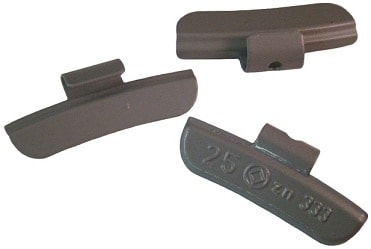
There are 2 types of weights: clip-on weights and adhesive weights. Clip-on weights are always used on steel rims. The weight is hammered onto the rim edge.
Alloy rims often also have a special rim edge on the inside where a weight can be clipped on. You normally don’t see this anyway, and it is cheaper than adhesive weights. Clip-on weights for alloy wheels are slightly different from those for steel wheels: the hook on the weight is wider and larger than that of a steel rim.
Each weight has its own mass. The higher the weight, the bigger the size. The weights range from 5 to 60 grams, in steps of 5.
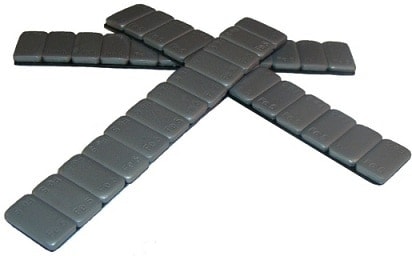
Adhesive weights are always used on alloy rims. The weight is stuck inside the rim. Adhesive weights are sometimes supplied per specific weight (from 5 grams to 60 grams in steps of 5), or as strips that must be torn off to size (1 block is 5 grams, so for 20 grams you need 4 blocks).