Introduction:
The bodywork is the coachwork of the car, without the separate components such as the suspension, the drivetrain and the interior. We often speak of a “self-supporting body” when the body and the chassis are executed as one whole and are strong enough for separate components to be mounted directly onto it. It is also possible for the body to be mounted on the chassis and thus be separate from it. This page describes various chassis and body construction methods.
Ladder chassis:
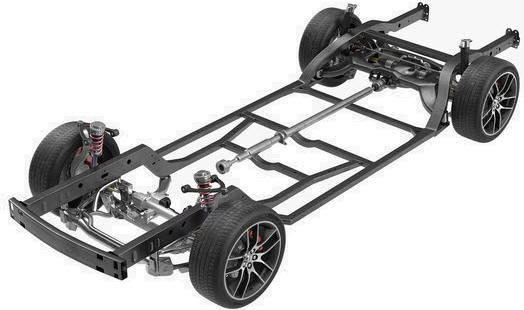
The ladder chassis owes its name to the fact that the chassis actually looks like a ladder. Between two thick longitudinal steel beams, a number of cross members are fitted. All components of the suspension system are mounted to the longitudinal and transverse beams.
The ladder chassis is mainly used in vehicles that must be able to carry a lot of weight, such as SUVs, pick-ups, off-road vehicles and trucks. Disadvantages are: a high weight, it takes up a lot of space and it is not flexible enough to absorb the torsional forces while driving.
An example of a ladder chassis is shown alongside:
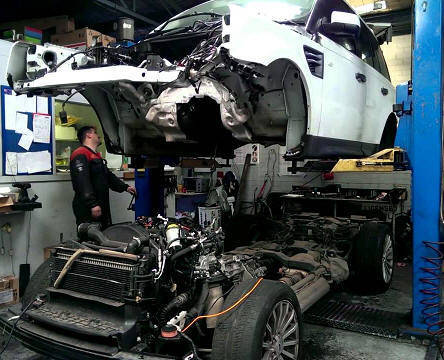
The body is attached to the ladder chassis with bolted joints. During repair work on the suspension or the drivetrain, the ladder chassis and the body can be separated from each other. This can be seen in the image below:
In the early twentieth century, the ladder chassis made it possible for Ford to mount different body styles on one type of chassis on the assembly line. In the early days of the automobile it was common practice to buy a chassis, which determined the make of the car, and then have a coachbuilder fit it with a body. With trucks and buses this is still done in a similar way.
Modern vehicles in which a ladder chassis is used include the BMW I3 / I8, Chevrolet Silverado / Suburban / Tahoe, Ford Expedition, GMC Yokon, Jeep Wrangler, Mercedes-Benz G-Class, Toyota Hilux / Land Cruiser / Tundra.
Monocoque:
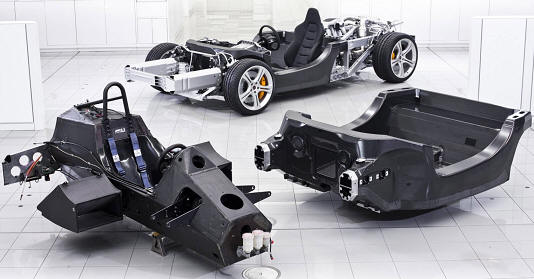
In a monocoque construction there is no separate chassis and body. The load-bearing structure is formed by the shell, without internal reinforcements. An egg is a good example of this. The term “monocoque” is a combination of the Greek “mono” and the French “échelle coque”, which stands for “hull shell”. The monocoque can be constructed from profiled steel sheets and from carbon fibre. The latter has the advantage that the weight of the vehicle remains low. Because there is no separate chassis, this benefits the space in the passenger compartment and the engine bay.
Vehicles that are built with a monocoque body include a Formula 1 racing car and the McLaren F1 (left and right in the image below).

Unibody:
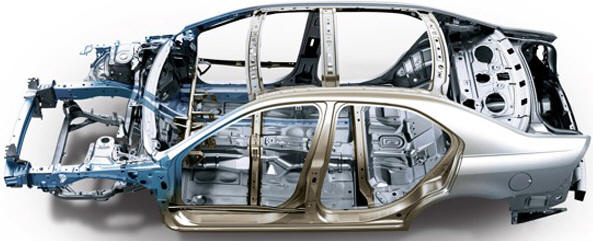
In modern cars, the unibody is mostly used. Unibody is derived from the phrase “unitized body”. The unibody body consists of various box sections, cross members and tubes. Not only the body structures, but also the bonded windows, the roof structure and the floor panels contribute to the stiffness of the body. The body and the chassis are regarded as one unit. The drivetrain and suspension are mounted to this body using a subframe. That is why we also refer to it as a “self-supporting body”.
The unibody is made up of separate parts that are welded, bonded or bolted together. Because various parts are joined together, not everything has to be made from one type of material such as steel. An important advantage of this is that the weight is reduced. The use of lightweight materials such as aluminium and carbon fibre does not affect safety, because unibody vehicles usually contain crumple zones and other structures that are specifically designed to absorb the forces that occur in a collision.
Tube frame and space frame:
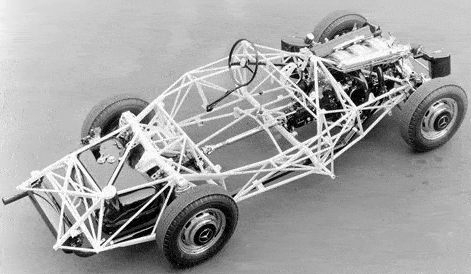
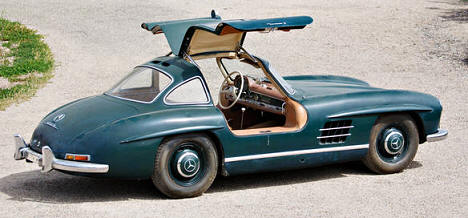
In the case of a tube frame we also speak of a self-supporting body. A tube frame, also called a space frame, is a three-dimensional, highly complex structure of aluminium tubes that are joined together. The tubes form the basis of both the body and the chassis. The drivetrain, suspension and panels are attached to these aluminium tubes. An example of this is the Mercedes-Benz 300SL:
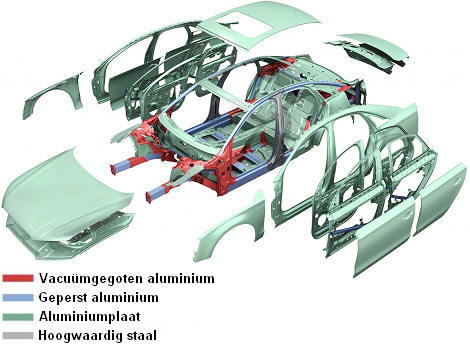
Audi also uses the term “space frame”. In the aluminium frame structure, all panels and sheets contribute to the rigidity of the body. Due to the very strong aluminium panels, the aluminium body is extremely strong and therefore very resistant to crashes, while the weight of the vehicle is actually reduced. The image below shows the construction of an Audi space frame.
Backbone chassis:
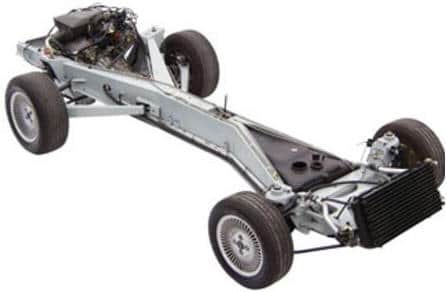
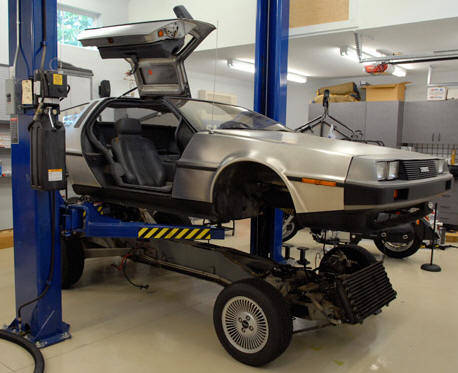
The backbone chassis is made of one or more steel sections that connect the front axle and the rear axle. The backbone chassis is strong in relation to its weight. The disadvantage of this type of chassis is that it offers no protection at all in side impacts.
A car in which the backbone chassis is used is the DeLorean DMC-12.
Self-supporting body:
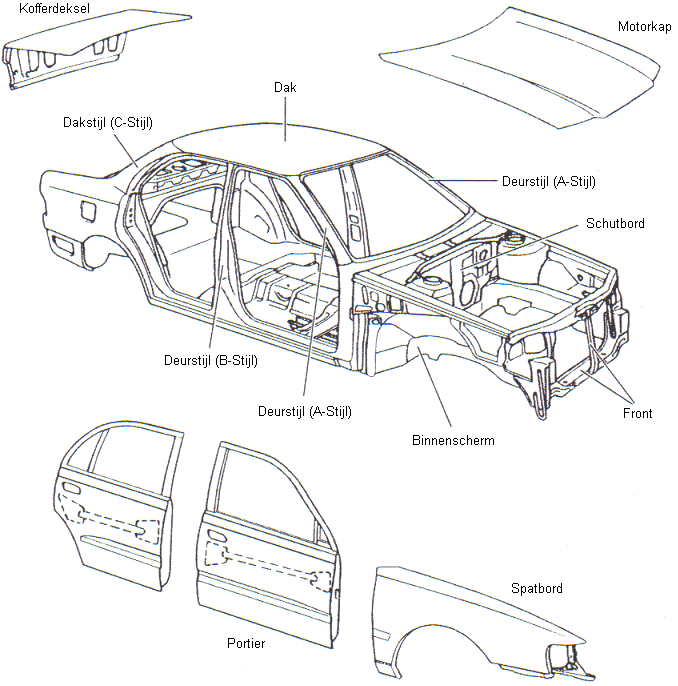
The different body types have been described in the paragraphs above. A unibody is an example of a self-supporting body. The floor panel, bulkhead, roof panel, door pillars and even the bonded windows form the load-bearing parts of the self-supporting body.
The non-load-bearing parts include, among others, the doors, the bonnet, the boot lid, the fenders and the side windows. These parts are usually bolted to the body and do not contribute to the stiffness of the body.
Window and door pillars:
Window and door pillars are often designated by a letter. The pillars from front to rear are called the A-pillar, B-pillar, etc. (see body image)