Crumple zone and cage construction:
Crumple zones are parts of a self-supporting body that are deliberately weakened for forces in a certain direction, because more easily deformable materials have been used than in other parts of the body. The crumple zones include, for example, the trunk or the front around the engine compartment. In a collision, the area in the crumple zone will crumple in a certain pre-calculated way.
The force exerted on the entire body will then be partly absorbed by the deformed materials. The deceleration will also be less, because the time that the crumple zone is crumpling effectively brakes the vehicle. The impact is thereby absorbed as much as possible, which protects the occupants.
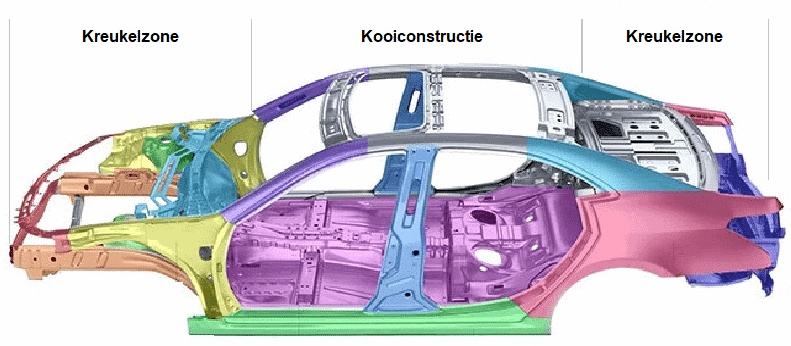
A so-called cage construction has been installed around the interior where the occupants are located. The materials in this part of the body are so strong that the cage construction will deform little or not at all in severe collisions. In the event of collisions and rollovers, the occupants will be protected as much as possible against being trapped.
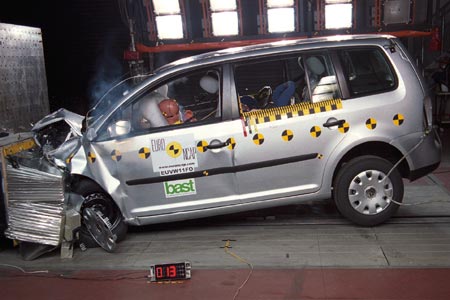
In the following image, a crash test of a VW Touran can be seen, clearly showing how the crumple zone absorbs the frontal impact and the material around the occupants has hardly deformed.
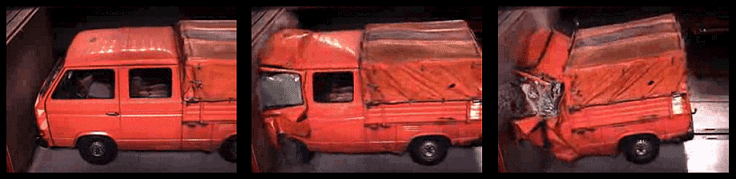
In vehicles where there was no cage construction yet, the body around the interior will deform too easily. An example can be seen in the following image, where a VW Transporter T3 undergoes a crash test.
Body materials:
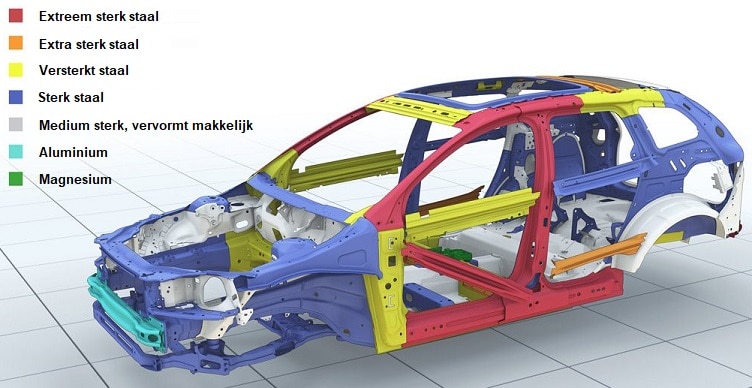
To obtain a crumple zone and cage construction, a mix of materials that can deform easily or are very difficult to deform was used in the manufacture of the car. The image below shows the relationship between the different types of materials.
- The steel parts of the cage construction are indicated in red. These parts must be as strong as possible in order to protect the occupants in a collision;
- In addition, we also find extra high-strength steel in the rear doors;
- Around the engine compartment and the trunk, a mix of high-strength steel and medium-strength steel has been used. These parts will deform easily in a collision, giving us the crumple zone;
- Finally, we see an aluminum bumper beam, which deforms the easiest in a collision and may offer protection to a pedestrian or cyclist;
- In the interior we see a magnesium component. This may be a mounting bracket for the center console. This body part is not subject to any load, so it is made as light as possible.
Crash test:
Manufacturers are required to have new vehicles tested for safety by means of a crash test. The vehicle is tested in all conceivable scenarios.
The data obtained from this shows that the body and the safety systems are capable of protecting the occupants of the vehicle and pedestrians from injury during a collision. Important results include the deformations of the body, the steering column, the protection around the child seat, etc. So-called crash test dummies are placed in the car to allow comparison with the human body.
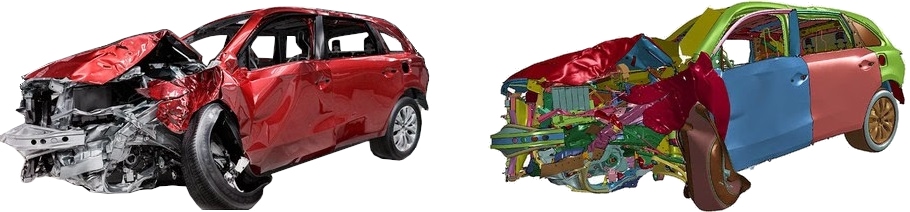
Crash tests are recorded by cameras so that the footage can be analyzed. In addition to the human eye, the computer also analyzes the footage. A crash simulation is then made: with the computer, the deformation of the materials can be analyzed in even more detail.
Related pages: