Corrosion and rust:
The concepts of corrosion and rust are closely related to each other. Rust is the result of corrosion. However, these two terms are often used interchangeably.
- Corrosion is an overarching term for the degradation of material through (chemical) reaction with its environment;
- Rust forms on the surface of iron or steel as a result of contact with water and oxygen. Rust refers to the oxidation of iron, which is also a form of corrosion.
As soon as metals are exposed to the normal atmosphere (the outside air), this metal will enter into a chemical bond with oxygen. In this case, the metal will rust. Rust can be recognized by the reddish-brown layer that appears on the metal and forms when iron reacts with oxygen in the presence of moisture from the outside air or water. It is a mixture of iron oxides and iron hydroxides. Rust continues to develop and can completely eat away metal. Over time, all the iron is converted into rust and thereby loses its favorable properties.
When iron is exposed to oxygen and water, over time the oxygen and iron will begin to bond at the atomic level. This creates a new compound: iron oxide. Water accelerates the entire process because water acts as a catalyst. The small water molecules penetrate the metal and form even more acids, exposing the metal even more to oxide formation. Rusting proceeds even faster in seawater due to the higher concentration of sodium chloride ions.
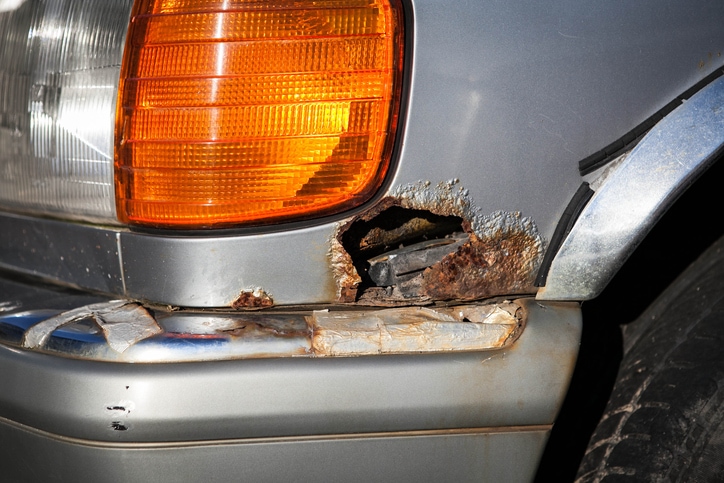
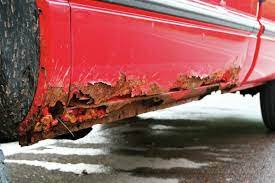
Rust spots can develop underneath the car paint. This is because the paint is also more or less porous and can therefore let moisture and oxygen through. To keep the paint layer sealed, it is good to wax the car regularly. Especially in winter, with many damp conditions and road salt, this is an effective way to counteract rust as much as possible.
When there are deep scratches or stone chips, the protective layer of paint is missing at that spot and the surrounding area can also begin to rust. It is therefore wise to touch up these spots as quickly as possible with a touch-up pen or have them resprayed.
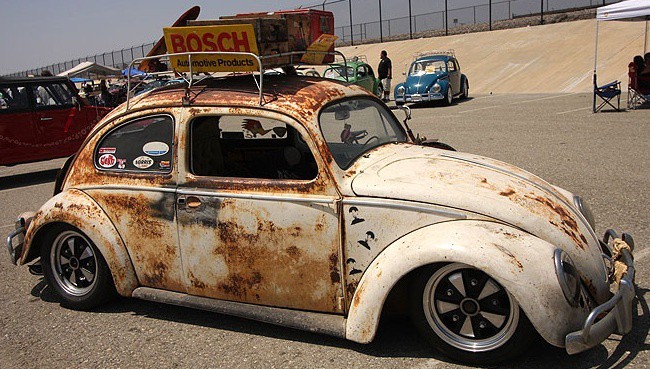
In the image alongside we see a VW Beetle with rusty body parts. This vehicle falls under the heading of a “Rat rod”. Vehicles that have been converted into a rat rod consist of deliberately worn and unpainted parts (in this case rust) and discarded components.
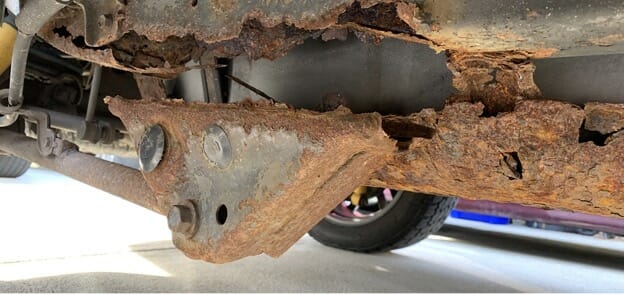
In very few cases can rust be appreciated. Yet every vehicle will have to deal with it sooner or later. In addition to the damp climate in the Netherlands, road salt on the road surface in winter increases the likelihood of rust. Besides the cosmetic parts, sections of the chassis or bodywork can also be affected. In the longer term, this can lead to an unsafe vehicle and to rejection during the MOT inspection.
Car manufacturers try to make the materials in and around the car as rust-resistant as possible. These are some of the anti-rust treatments:
- galvanizing the bodywork;
- applying wax treatments;
- applying primer and undercoat layers;
- applying high-quality paint layers.
Combating rust:
Rust forms because iron has bonded with oxygen. It is incorrect to think that rust can be combated simply by ensuring that no more oxygen reaches the iron. Steel is not a homogeneous substance, but a mix of materials that are brought together during recycling, for example old car wrecks. Other metals are also present in the steel. Between the crystals of two different materials there is a small voltage difference, in which a conductive liquid can create contact between the crystals. The resulting tiny electric current ensures that the less noble metal goes into solution. If, for example, a current flows between iron and copper, the iron dissolves. The dissolved iron particles bond with oxygen. Even the smallest amount of water in the bodywork layer, even if it is only a single water molecule, keeps the process going.
When there is rust under the paint, it is pointless to spray paint over the rust. The rust will continue to eat away beneath the paint layer unabated. Because the volume of rust is greater than that of steel, in time the paint layer will crack. This creates an opening where additional water can penetrate and the rusting process accelerates. To combat rust, steel is derusted by blasting the surface. A rust-inhibiting primer layer is then applied as quickly as possible. One should not wait too long with this, because otherwise the moisture from the outside air will bond to the iron particles.
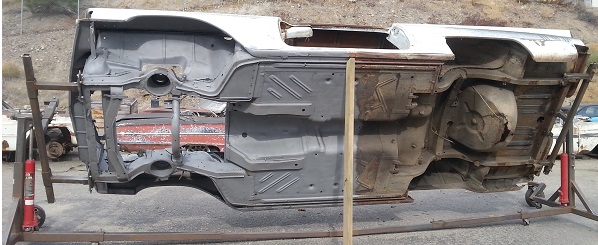
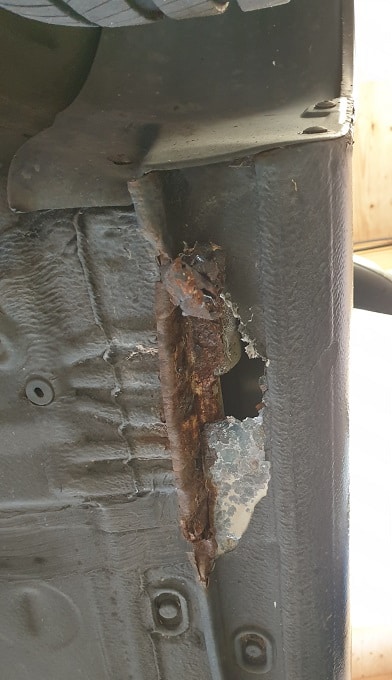
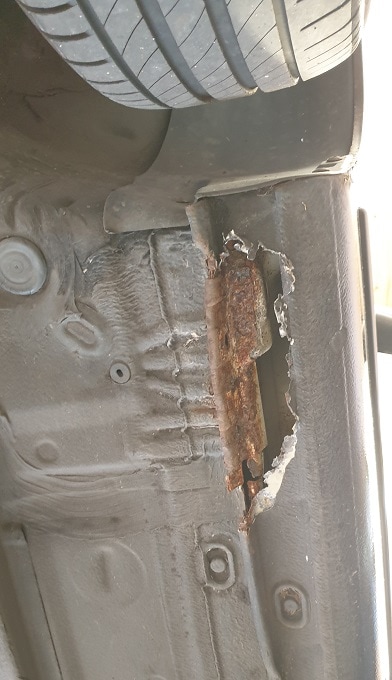
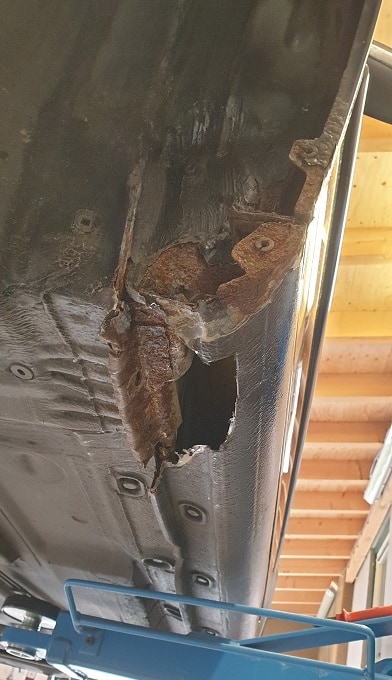
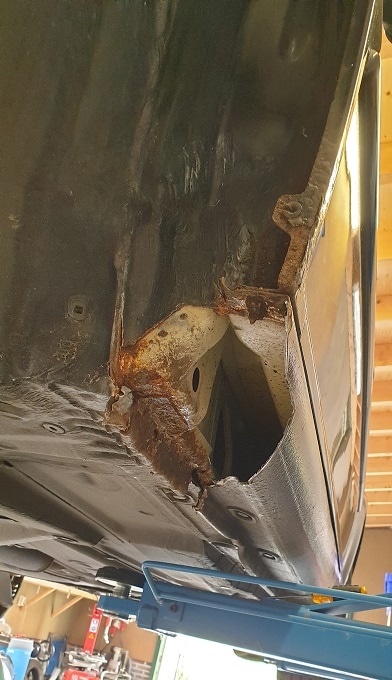
Rust forms under the paint layer. Early-stage rust is therefore not always easy to recognize. In the four images below, a box section of a VW Golf IV is shown where the rusty metal has been cut away. Before the work started, there was only some loose bitumen on the edge under the sill. The box sections showed no irregularities. When the bitumen was removed, the brown edges became visible. The metal around them had already been affected to such an extent that it broke off easily. The photos show how rust can behave underneath bitumen.
Preventing rust:
In the first paragraph, in the list of measures to prevent rust, “galvanizing” was mentioned. During the production of the car, manufacturers apply a thin layer of zinc. This provides what is known as cathodic protection. Because electrons will escape more readily from zinc, the zinc dissolves earlier than the iron. Zinc more easily forms a bond with the oxygen in the air. The zinc is quite hard and forms a sealing layer. With deep scratches through the paint and zinc layer down to the steel, the steel will hardly react. With sufficient zinc nearby, the electric current will flow in the right direction. For that reason, zinc offers long-term protection against corrosion and rust.
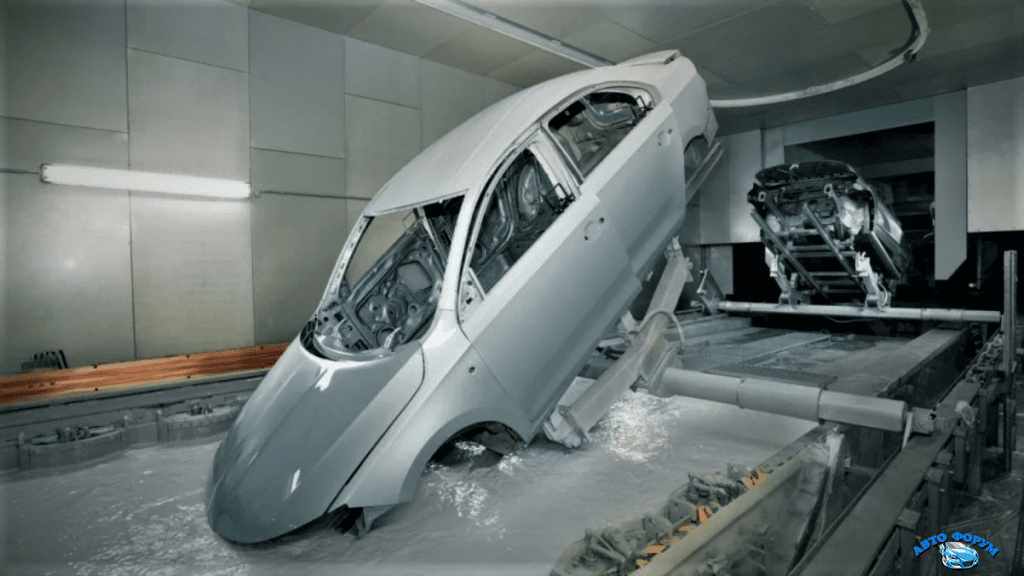
Galvanized steel does not only have advantages. As its use increases, the amount of pure steel decreases. Manufacturers need zinc-free steel to make, among other things, engine components. Zinc has the property of forming bubbles in the steel, resulting in weak spots.
Pitting corrosion:
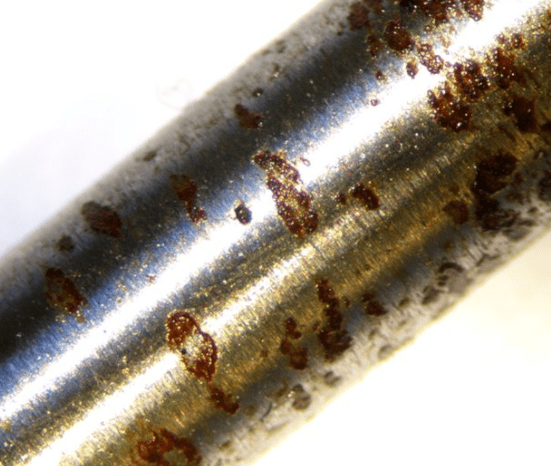
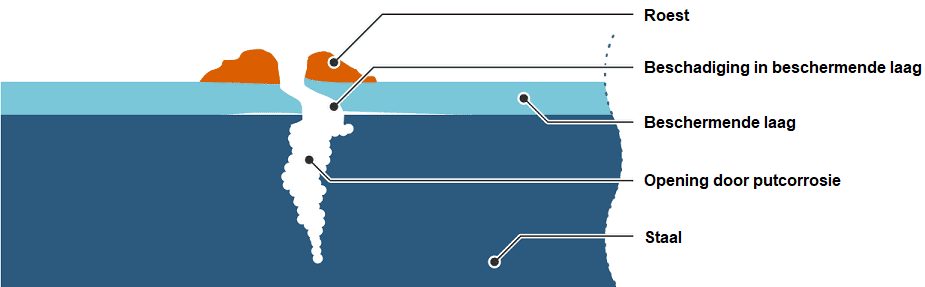
Pitting corrosion is a localized attack on the material surface. Pitting corrosion occurs in materials that protect themselves against corrosion by means of an oxide layer and mainly develops where this oxide layer has been damaged. Pitting corrosion quickly eats deep into the material. This is the most dangerous form, because the material can still appear to be in good condition and the depth of the corrosion cannot be properly seen.
The image below shows the cross-section of a steel object with pitting corrosion. At the top, only a small amount of rust is visible. The “pit” in the rust reveals the opening that has formed in the steel.
We can encounter pitting corrosion in, among other things, brake lines. As the opening becomes deeper, there is a risk that brake fluid may leak out through it.
Contact corrosion:
This occurs when two different metals come into close contact with each other. A voltage difference is generated between these two metals, causing a reaction. We see this, for example, when a stainless steel screw is screwed into a galvanized steel plate. The more noble metal promotes corrosion and therefore starts to rust. This is called contact corrosion.
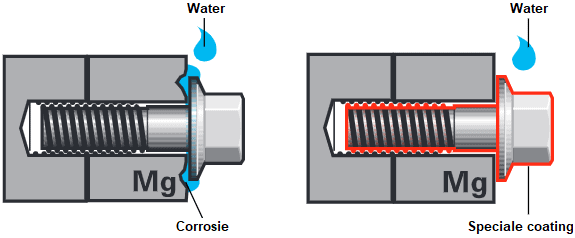
In the following image two examples are shown of a magnesium component, for example a gearbox, which is fastened with a bolt made from an iron alloy. When the contact surface is exposed to water, an electric current arises between the two metals and this leads to contact corrosion. At the same time, the magnesium is broken down. Contact corrosion can be prevented by slowing the electric current between the two metals by coating the bolt with a non-conductive, i.e. insulating, layer.
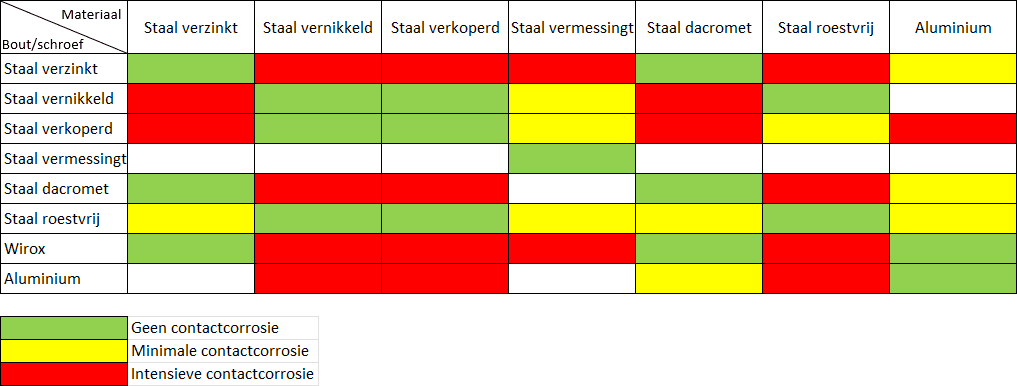
The table below shows the different combinations of materials (for example of engine parts or the gearbox housing) and how the choice of materials for the bolt or screw affects contact corrosion.