Topics:
- Introduction
- Driving style and maintenance
- Engine damage
- Engine damage due to lubrication problems
- Engine damage due to cooling problems
- Crankshaft damage
- Crankshaft and connecting rod bearings and bearing journal damage
- Camshaft damage
- Types of camshaft wear
- Valve damage
- Piston damage
- Bent connecting rod
- Broken piston pin
Introduction:
Every vehicle requires maintenance. Prescribed parts are replaced periodically during a service, and for other parts the state of wear is checked at every inspection. If it is suspected that the part will not make it to the next service, it is recommended to replace it. In addition to routine maintenance with an inspection, it can happen that a part fails. The quality of the material has a lot of influence on this, as does the extent to which timely maintenance has been carried out. In a vehicle where maintenance intervals are exceeded, repairs are postponed, or an unqualified person overlooks wear parts, the chance of failures is greatest. It becomes especially annoying when you are on the road and end up stranded at the roadside with a failure that could have been prevented.
This page about engine damage originates from the chapter “Diagnostic techniques, mechanical measurement” which describes measurements on engine components. Such measurements are performed on disassembled engine parts (e.g. comparing piston diameter and cylinder diameter, determining cam lobe height, checking clearances) and arise from a diagnosis in which one was looking for the cause of a malfunction. A car may be brought into the workshop where the customer states the complaint as:
“The engine warning light is on and the engine has noticeably less power than before”.

- The mechanic or diagnostic technician connects the EOBD tester to the vehicle and reads out the fault codes:
- Fault code P0172 – fuel mixture control bank 1: system too rich
- The fuel trims are read out via the live data. This yields the value: -15.
From the fault code and the long-term fuel trim it can be concluded that the oxygen sensor in the exhaust gases is measuring a mixture that is too rich. The mechanic or diagnostic technician performs a number of electronic tests and looks for mechanical causes. During the diagnosis, he or she removes the valve cover and discovers that the cam lobes on the camshaft above cylinder 4 show signs of wear. This raises the questions:
- Is the camshaft wear the cause of the malfunction? Worn cam lobes can result in less oxygen being able to flow into the cylinder, leading to an overly rich mixture (an excess of fuel as a result);
- In the case of wear: what was the cause? How can it be prevented in the future that the problem arises again?
On the pages “Mechanical diagnosis” and “Measuring engine components” we discuss measurement techniques for various components, such as measuring the camshaft. On this page we focus on the actual damage and its cause. If we can determine the cause, we can also prevent the customer from returning within the foreseeable future with the same problem.
Driving style and maintenance:
Sooner or later, any internal combustion engine can suffer damage. Some engines are known for their sensitive and weak points; in other cases the vehicle owner has been negligent in maintenance or the driving style has played a role in a wear process. Age also sometimes throws a spanner in the works: no engine lasts forever.
A good driving style benefits every engine:
- Do not let a cold engine idle for too long: the engine stays cold for too long;
- Drive gently with a cold engine and give the oil time to warm up properly;
- Do not drive too many short trips. An occasional long drive is also good for an engine;
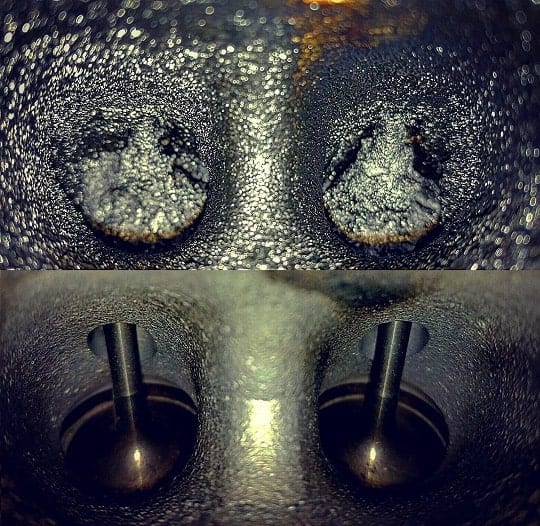
- Always driving gently at low RPM, especially with modern engines, increases the chance of internal contamination. Think of: a clogged intake port (intake manifold), extremely dirty intake valves, coked-up EGR, carbon deposits between the piston rings resulting in oil consumption. In extreme situations, stuck piston rings cause scratches in the cylinder wall.
- Do not load the engine too much at low RPM: driving at fifty in fifth gear gives the engine a low RPM. Bearings are heavily loaded. If you then also accelerate, enormous forces act on the crank / connecting rod mechanism;
- Do not seek out the high-RPM range too often. It does no harm to accelerate firmly now and then, but do not overdo it.
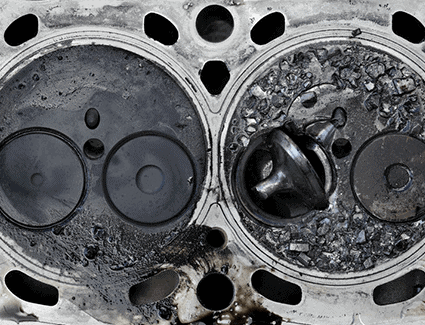
The following image shows a contaminated intake tract. The intake air can pass the valve less easily, meaning less oxygen is available for combustion during the intake stroke. This can be determined, among other ways, by inspecting with an endoscope.
In addition to good driving style, every engine should be maintained preventively:
- Aged engine oil increasingly loses its dirt-carrying and lubricating effect. Parts that slide along each other are covered with a – less well-lubricating – contaminated oil film. The result is that the oil turns into a solid substance (black sludge) and adheres to all (especially cold) engine components. Oil passages become clogged with all the consequences that entails;
- Poor-quality oil: topping up oil with incorrect specifications or viscosity can have an adverse effect in the short term on contamination, oil consumption and engine damage;
- Mechanical work such as: checking valve clearance (if applicable), replacing spark plugs, the air filter, the timing belt, etc. should be checked periodically. A car that mainly does motorway miles can often drive more miles on the same spark plugs than a car that does a lot of city traffic. That is why, in most cases, in addition to a mileage-dependent interval, there is also a time-dependent interval;
- Defects in components can often be detected early. Do not keep driving too long with warning lights or unusual noises. Have the car checked periodically by an experienced mechanic.
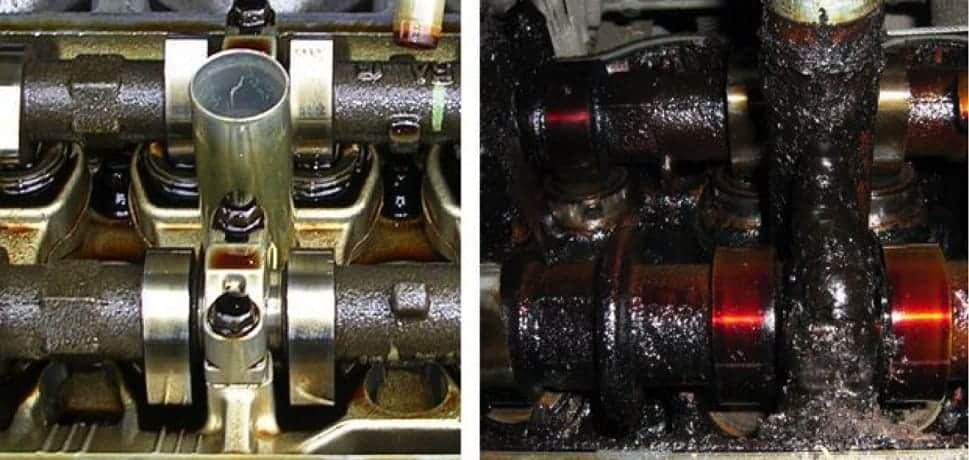
The photo below shows two situations: the same type of engine with good, preventive maintenance (left) and an extremely contaminated engine that has driven 100,000 km with the same oil (right). In addition to the black deposits on the camshaft (black sludge), the engine components have also turned reddish-brown. This is usually the result of old engine oil and an excessively high temperature due to an oil level that is too low.
Engine damage:
Engine damage is not always directly the result of contamination. When we discover extreme contamination of the intake valves, this has led to complaints such as reduced power, an illuminated engine management light with a negative fuel trim appearing during readout, but it has not directly caused lasting damage. A professional cleaning (carbon / wallnut blasting) can make the complaints disappear. If, nevertheless, one continues driving with the extremely contaminated valves, damage can eventually occur because the valves can no longer seal properly on the valve seats in the cylinder head.
Internal contamination due to aged engine oil, poor driving style, or another cause of accelerated wear can cause parts to fail prematurely. If the resulting complaints are investigated and correctly traced, this wear process can be stopped. If one ignores the indications that something is wrong, the car may stall while driving, or the consequential damage may be greater than if the problem had been addressed immediately.
Engine damage due to lubrication problems:
Maintenance intervals have been extended more and more in recent years. In the 1970s it was not uncommon to change the oil after 7,500 km. Nowadays we see specifications where the oil only needs to be changed at 30,000 or even close to 40,000 km. With extended maintenance intervals, you run the risk that, if you do not check the oil level often enough, you will drive with too little oil. The (too small) amount of oil therefore gets much hotter, evaporates faster, causes more contamination and has an increasingly poorer lubricating effect. For that reason, vehicles equipped with extended maintenance intervals are fitted with an oil level and quality sensor. With many short trips, the oil is subjected to as much as three times the load compared to driving the same distance on the motorway. The level sensor naturally monitors the level and shows the driver a message when it is too low. The quality sensor (often in the same housing) monitors quality. With thickened, aged oil, the service interval becomes considerably shorter. We speak of “variable maintenance intervals” when a standard interval of 30,000 km and 2 years is specified, but a service message already appears after 20,000 km and one year: the oil quality has become so low due to the driving conditions that the oil must be changed earlier.
If the oil is not changed in time, it will, as already described, evaporate and thicken more quickly. The sludge that remains ends up throughout the engine. The first place this substance collects is in the oil pickup screen in the oil pan. The oil pump draws the oil from the pan through this screen. The oil pump then forces the oil through the filter. The coarse particles are retained by the screen.
Another cause of a contaminated oil pickup screen is a buildup of fibres originating from a wet timing belt, as is now used in PSA and Ford engines. When engine oil with the wrong specifications is topped up, the wet timing belt becomes damaged and the fibres that come loose mix with the engine oil.
The following image shows an example of an oil pickup screen in good and contaminated condition. It goes without saying that less oil can pass through the heavily contaminated screen: due to this blockage the oil pump is less able to circulate the oil through the engine.
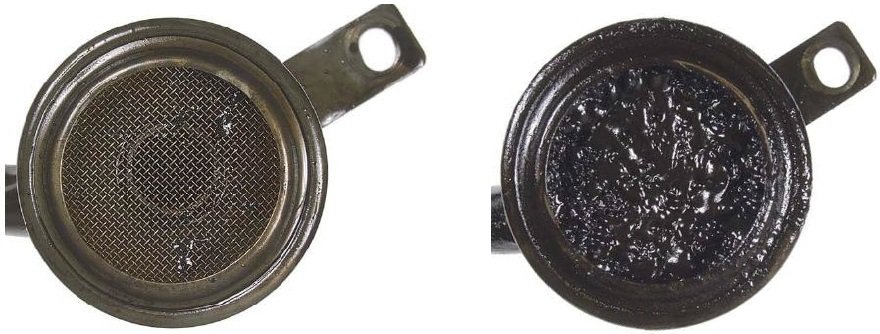
The problems start with the clogged screen: at low engine speeds the oil pump turns too slowly to achieve good oil pressure. At idle speed, a lack of oil pressure can therefore occur. Components such as the crankshaft and connecting rod bearings, the camshafts in the cylinder head, the pistons in the cylinders and the turbo shaft risk moving with an oil film that is too thin, resulting in more heat build-up and the chance of metal-to-metal friction.
In addition to thickened oil and black sludge, other materials and constituents can also cause the oil pickup screen to clog. Think of: plastic parts from a broken timing chain guide, remnants of (excessively applied) liquid gasket from, among other things, the valve cover or oil pan, dirt that entered the oil while unscrewing the oil filler cap and pulling out the dipstick, etc.
If it is suspected that the engine is heavily contaminated internally, the engine can be “flushed” by mixing an additive with the old oil. This flush agent serves as a cleaner and ensures that dirt particles come loose from engine components. In extreme situations the dirt particles collect in the oil pickup screen and remain there, even if the oil has been drained. That is why, in the case of such contamination, it is wise after flushing to remove the oil pan and the screen and clean both thoroughly before filling the engine with fresh engine oil.
Engine damage due to cooling problems:
Cooling problems can be a direct result of lubrication problems. In the previous paragraph, examples were given of causes that can lead to a shortage of lubricating oil. If the lubricating oil film between moving parts is too thin, a lot of heat build-up occurs, with a high chance of direct engine damage.
A defect in the cooling system can also cause a lack of engine cooling:
- Insufficient flow through the radiator as a result of a blockage;
- A cooling fan that does not function properly due to a fault in the control;
- Restriction in a coolant hose or passage: e.g. due to a kink, a softened hose or a clogged radiator;
- Air in the cooling system because the system was not properly bled after a repair and topping up;
- Insufficient circulation of the coolant due to a defective water pump (broken impeller blades) or slip between the pulley and the auxiliary belt (if not driven by the timing system);
- A defective thermostat;
- A defective head gasket: combustion gases reach the cooling system and vice versa.
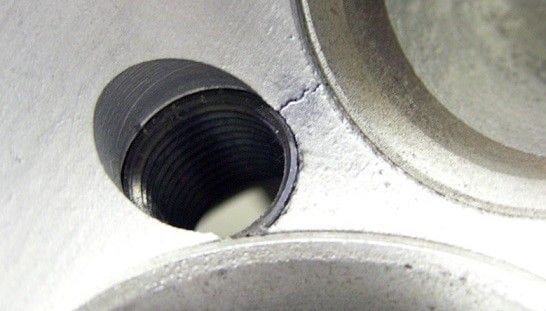
Overheating of the engine can lead to warping and cracking of the cylinder head. Therefore, after removing the cylinder head, its flatness must be checked and the head must be checked for cracks. The cracks will usually occur in the areas with the least material: this is where heat transfer is lowest.
Examples of this are: cracks between the valve seats, or between the valve seat and the spark plug hole (petrol engine) or the prechamber (older diesel engine). Specialist reconditioning companies have the knowledge and tools to weld the cracked cast-iron cylinder head in most cases.
The following image shows a crack between the valve seat and the spark plug hole.
As a result of overheating, wear can occur on pistons and cylinders. In that case, the temperature has caused too much expansion of the components, which can cause the piston to seize in the cylinder.
Crankshaft damage:
In an earlier paragraph, damage to the crankshaft and connecting-rod bearing journals was discussed. Such damage is the result of a lack of lubricating oil.
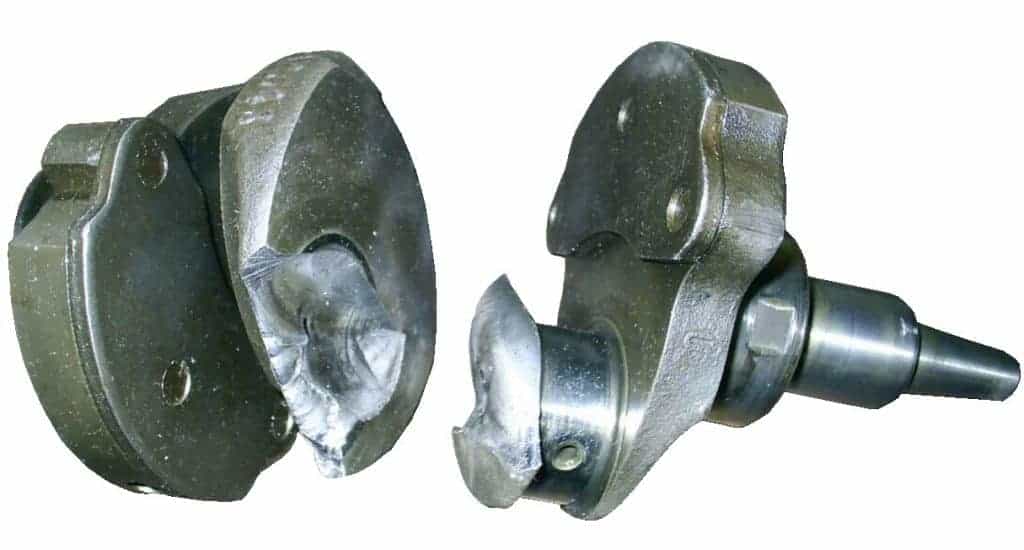
A crankshaft has to withstand a lot of forces and vibrations. In extreme cases, the crankshaft can break. In almost none of the cases is this a material problem, but rather the result of a defect in another part of the engine or an event while driving:
- Mechanical overload due to abnormal combustion or water hammer;
- Sudden seizure due to a defect in the final drive (gearbox or differential);
- Excessive vibrations due to a defective dual-mass flywheel, play in the torsional vibration damper, or installed equipment such as a PTO on commercial vehicles where, in a certain RPM range, a vibration occurs with too high a frequency;
- Material weakening due to previous bearing damage;
- Unskilled installation of connecting-rod and main bearing journals;
- Mechanical damage to the crankshaft prior to installation.
Crankshaft and connecting-rod bearings and bearing journal damage:
The crankshaft and connecting-rod bearings are located at the bottom of the engine block. Lubrication is provided by oil that, through the crankshaft oil passages, reaches the space between the journal and the plain bearing via the holes in the crankshaft bearing journals. Very high forces act on plain bearings, so an oil film between the moving parts is essential.
One of the biggest causes of connecting-rod bearing damage is a lack of oil. This can occur, among others, in the following situations:
- The engine loses its oil due to a leak. This can be: due to a defective turbo, an incorrect seal between two components caused by a torn gasket;
- The driver does not check the oil level often enough, despite the engine consuming a lot of oil;
- The oil pump has too low an output due to a defect in the pump or a restriction in the suction section;
- The engine block is tilted too far:
– in a car this can, especially in combination with an oil level that is too low, lead to lubrication problems.
– On motorcycles, bearing damage occurs after the motorcycle falls over and the engine is not switched off in time. Switch off the engine as quickly as possible via the ignition switch or the kill switch.
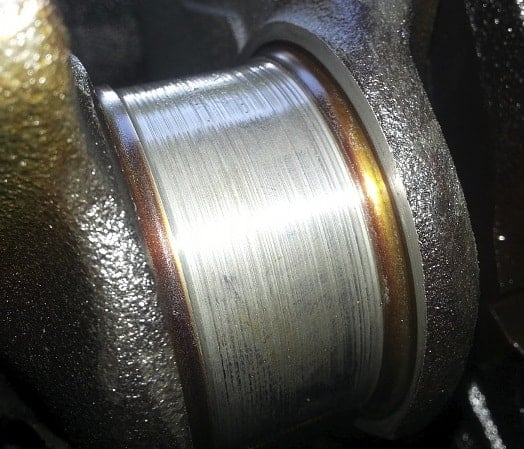
When there is a shortage of oil, the oil pressure warning light comes on. The pressure has then dropped to 1 bar. This indicator light alerts the driver that the engine must be switched off to prevent further damage. In many cases it is already too late: when the oil pressure warning light is on due to an oil level that is too low, the temperature has already risen significantly and the pressure has already been too low for some time. The oil temperature between the crank journal and the plain bearing has also increased. The back pressure through the oil passages will also have dropped, creating more clearance. Normally, the oil film absorbs this clearance. Without an oil film, the parts contact each other and mechanical friction occurs.
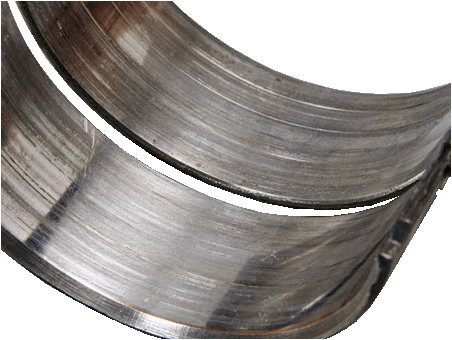
Modern cars are often equipped with an oil level and temperature gauge. Both will give a warning in advance, before the oil pressure warning light is activated by oil pressure that is too low. Whenever the oil pressure warning light has been on, it is always advisable to check the connecting-rod bearings for damage. The two images below show the damage caused by a lack of oil.
Damage to crankshaft and connecting-rod bearings and journals does not occur only due to a lack of lubricating oil. Other factors also contribute to possible damage:
- Low Speed Pre-Iginition: in the case of uncontrolled combustion that occurs while the piston moves from TDC to BDC. Especially in downsized direct-injection engines that are often equipped with a turbo. Combustion takes place at the wrong moment, causing enormous forces on the piston. This can damage the piston, timing system, and bearings.
- Driving style: with a cold engine, the oil is still thick and lubrication between the bearings and journals is not yet optimal. Under heavy engine load with a cold engine, the chance of bearing damage is high.
– high load at low RPM: the upper connecting-rod bearings have to withstand extremely high forces at the point where the connecting rod is positioned (almost) perpendicular above the crankshaft;
– low load at high RPM: when the piston moves upward, extremely high forces are released and absorbed by the lower connecting-rod bearings.
Besides bearing and journal damage, other engine components such as the pistons also wear faster with this driving style. Naturally, the above can be prevented by accelerating gently with a cold engine, i.e. with little load and not above 3000 rpm.
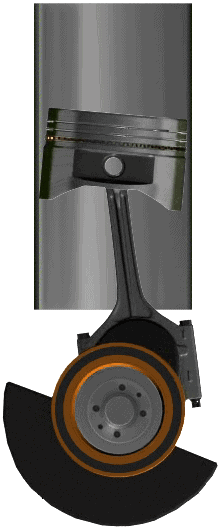
The image below shows the forces in the engine during rotation in five different positions. The resolution of the piston forces is further explained on the page: resolving the piston force. In these images we see the force Fh recur a number of times. Fh indicates the force on the main bearing. This force is different in each engine position. Also, when the piston moves from BDC to TDC the upper main bearing is loaded, and from TDC to BDC the lower main bearing is loaded. The list under the image explains the force on the main bearing for the following five images.

- The connecting rod is perpendicular above the crank journal. The force on the upper main bearing (Fh) is as high as the force on the piston (Fz) as a result of the combustion pressure (p). The upper connecting-rod bearing is also loaded with an equally large force.
- The crankshaft rotates and the force Fh has decreased;
- The force on the main bearing is 0 because a 90-degree angle has formed between the crank journal and the connecting rod;
- The lower main bearing and the upper connecting-rod bearing are loaded;
- The force on the lower main bearing and the above-mentioned connecting-rod bearing increase again here.
By means of a visual inspection of the bearing shells and bearing journals and by measuring the ovality and taper of the main bearing journals and the connecting-rod bearing journals with the micrometer, one can determine the wear.
When installing connecting-rod bearings, close attention must be paid to the fact that bearings must absolutely not be swapped with each other. The bearings have worn in to their journals. Swapping them will always cause increased wear on the bearing and possibly also on the journal. When installing new bearings, one must use plastigage to check the clearance between the bearing and the journal. Bearings that are too thick make it more difficult to form an oil film between the two, which causes friction.
Camshaft damage:
The camshafts are located at the top of the engine. In an engine that has just been started, lubricating oil will reach the camshafts last. Damage to the camshafts can occur as follows:
- Due to oil pressure that is too low, the cylinder head, in addition to the turbo and the connecting-rod bearings, will suffer the most damage;
- When the engine runs at high RPM immediately after starting, the oil has not (sufficiently) reached the cylinder head yet;
- Moisture in the oil or cylinder head can have a devastating effect on the camshaft. This is discussed further in the following example.
Frequent short trips can cause sludge formation. In winter, the sludge (consisting of water vapor and oil residues) can freeze, which can form a blockage for the oil supply and return.
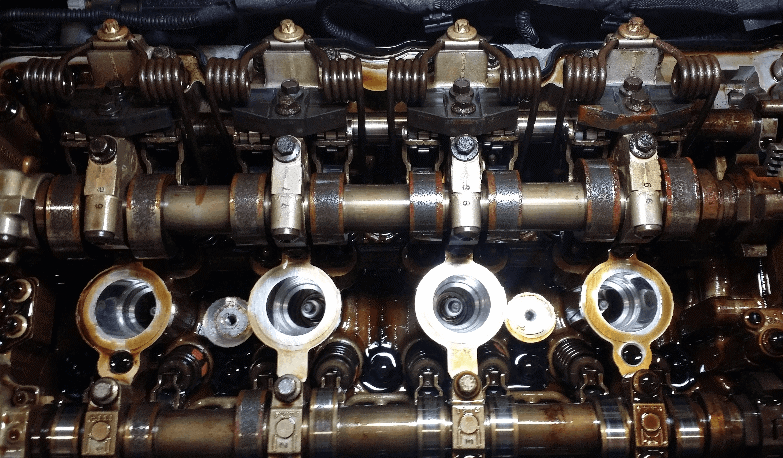
Moisture can also have a devastating effect, as can be seen in the following image. The cam lobes are affected and show pitting corrosion. What stands out is that the upper camshaft is more severely affected than the lower one. Presumably this has to do with temperature: the intake camshaft warms up less quickly than the exhaust camshaft, causing moisture to do more damage.
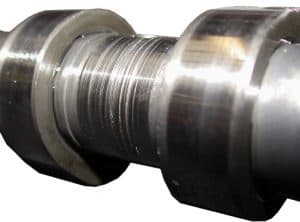
If there is a lack of oil, or if the bearing caps are swapped, camshaft damage can occur as visible in the following image. Deep scratches have formed because material has been removed.
Such damage can lead to oil pressure loss: because significantly more space has formed between the bearing cap and the camshaft due to the camshaft diameter becoming smaller, the oil can also flow out more easily.
The damage affects the camshaft bearings after this bearing. Example: the oil passage runs from cylinder 1 to cylinder 4. The camshaft damage is at cylinder 3. Because too much oil “leaks away” past the bearing at cylinder 3, the bearing at cylinder 4 receives too little oil.
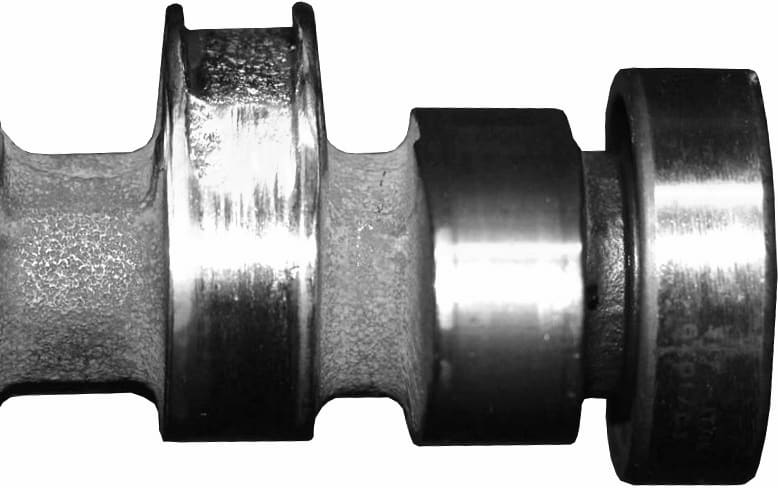
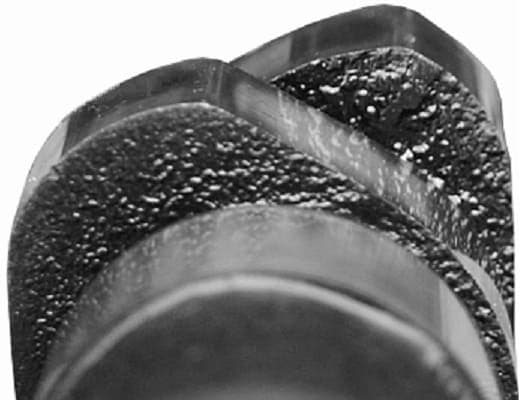
Due to a lack of lubrication, the camshaft will not only wear at the bearing caps, but wear can also occur on the cam lobes. Lobe height can decrease because material wears away. The two images below show an extremely worn lobe (left) and blunt lobes (right).
A blunt, i.e. less pointed (high), lobe has a negative effect on valve timing. Not only will the valve open later and close earlier, it will also open less far. The volumetric efficiency decreases. This can be noticed as lower torque and less power at (mainly) higher RPM.
It sometimes happens that a camshaft breaks. The reason cannot always be determined. In certain cars, including Opels (with engine codes Z12XEP and Z14XEP), it is a common problem for which a recall has been issued.
With incorrect removal and installation work, there is also a risk of breaking the camshaft. During wrenching work, one must follow the correct sequence:
- Installing: start at the innermost camshaft bearing and go diagonally toward the outside (see the image from 1 to 10);
- Removing: when removing, always start with the outermost camshaft bearings. First remove the two bolts of camshaft bearing A or E, remove the bearing cap, before removing camshaft bearing E. Finally remove bearing cap C.
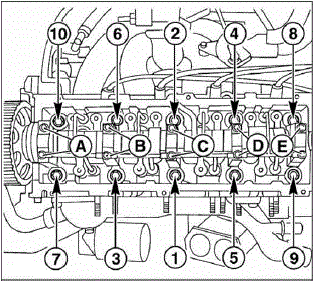
If an incorrect removal and installation sequence is followed, the forces released by the valve springs pressing against the camshaft and by the “trapping” of the camshaft, causing it to bow as it were, can cause the camshaft to break.
Types of camshaft wear:
The wear that occurs on camshafts can be divided into three groups:
- pitting;
- adhesive wear;
- abrasive wear.
Pitting:
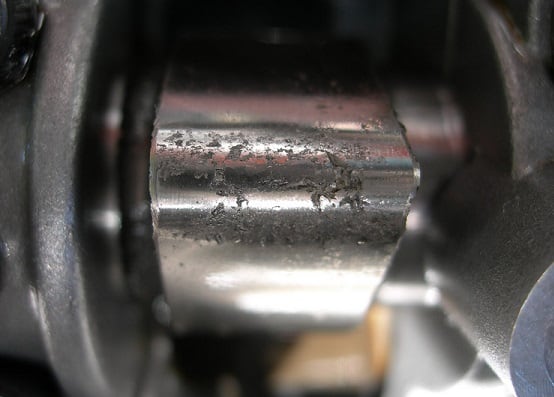
When we find small pits and cracks in the material of the cam lobes, we are dealing with so-called “pitting”.
In pitting, small cracks form beneath the hardened surface of the material as a result of fatigue. This phenomenon mainly occurs with sliding contact, as in this case, where the camshaft slides over the rocker arm or hydraulic tappet.
With pitting, material disappears, so the only remedy is replacing the camshaft in question.
Adhesive wear:
This occurs when the surfaces come into contact with each other, for example due to an oil film that is too thin. This contact can cause small pieces of metal to break off the camshaft. If the pieces are small enough, it does not have to cause immediate engine damage: the particles are carried off to the oil filter. When surfaces slide against each other under great force, there is a chance that the metal parts weld to each other (micro-welding). Over time, the material next to these welds breaks away and grooves form in the components that fit exactly into each other. This is so-called “galling” of the camshaft.
Abrasive wear:
This form of wear occurs when particles of another material unintentionally end up between the moving parts. This can be the case with adhesive wear, where loosened metal particles end up somewhere in between, or dirt particles that, for example, entered via the oil filler cap. The dirt particles scrape material from the surfaces of the components.
Valve damage:
A petrol or diesel engine can be confronted with valve damage. In practice, we encounter the following damage:
- burnt valves and valve seats;
- corrosion, erosion and dirt deposits on valves and valve seats.
- deformation as a result of a timing defect;
- breakage;
- damage to the valve stem.
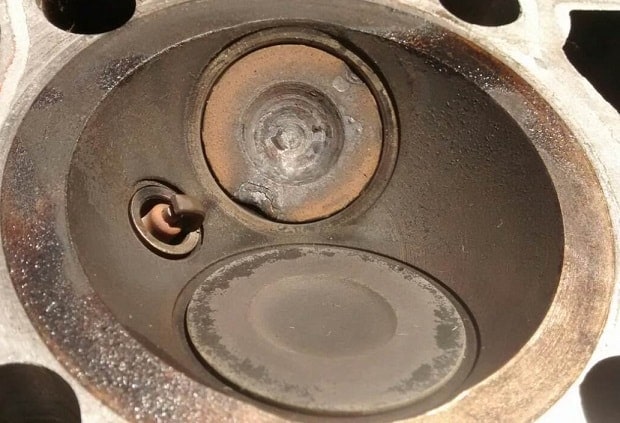
The following image shows a burnt exhaust valve. The valve head shows deformations with discoloration. A burnt valve causes compression loss: in the closed position the valve must retain the air during the compression stroke, but in this case it will not seal properly. During the compression stroke, part of the air escapes past the valve to the exhaust. Although an exhaust valve gets much hotter than an intake valve, an intake valve can also burn.
A valve can burn when it overheats. The valve will deform, which can lead to material fracture. Causes of overheating can be:
- insufficient ability to dissipate heat via the valve head to the valve seat, e.g. due to dirt deposits between the sealing parts and excessive valve guide clearance;
- an exhaust gas temperature that is too high;
- too little valve clearance, which may cause the valve to remain open.
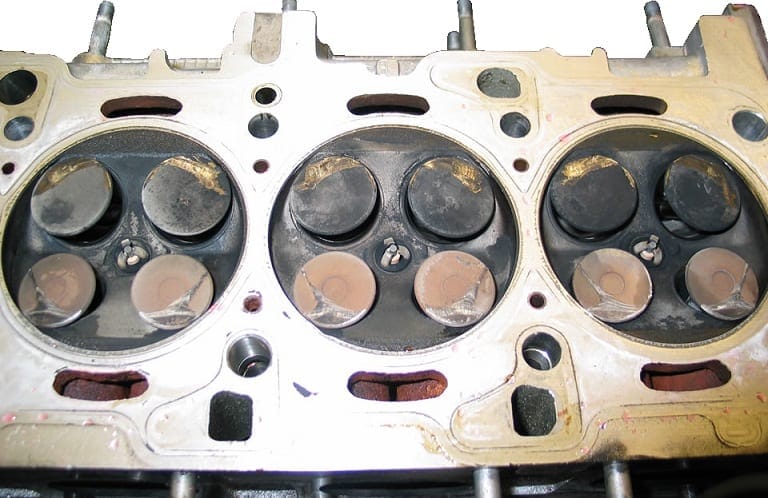
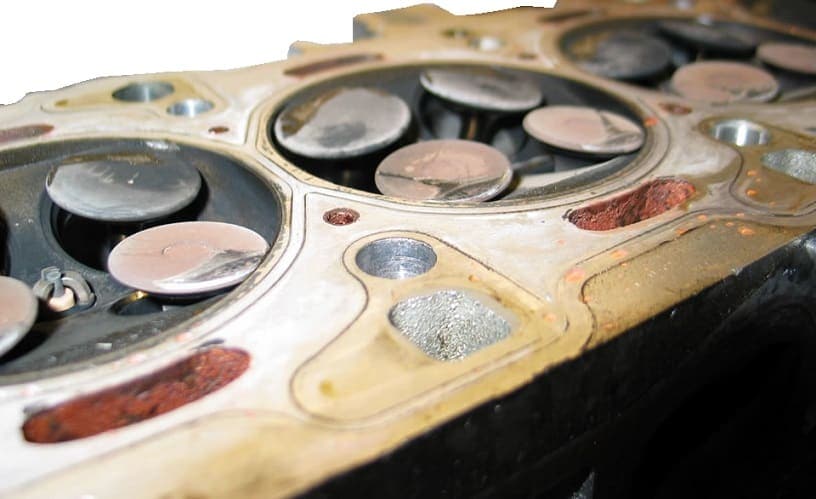
The two images below show the result of a broken timing belt. All twelve valves are bent and you can clearly see the imprint of the piston on the valves. Besides a broken timing belt, this damage can also occur with a broken or stretched timing chain.
Piston damage:
There are various forms of piston damage, e.g.: deformation, scoring, melting marks, fracture or detached metal particles. Possible causes of piston damage can be:
Scoring on the piston skirt:
Severely aged and contaminated oil, oil with an incorrect viscosity index, or a lack of oil cause lubrication problems. This can be a cause of scoring on the piston skirt. When the oil film breaks down, dark-colored scoring marks occur. Usually this surface is not shiny and the piston damage mainly occurs on one side (thrust side).
When, as a result of an overly rich mixture or a failing ignition system, there is prolonged incomplete combustion in which the injected fuel does not ignite, the fuel deposits on the cylinder wall and weakens the oil film.
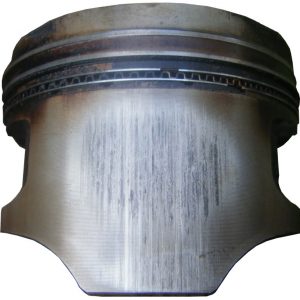
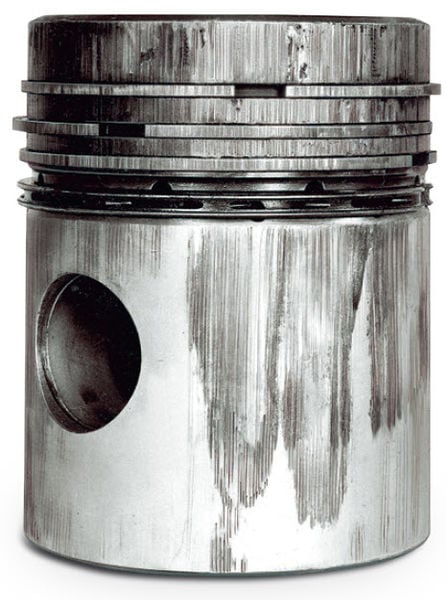
Scoring on the piston crown and piston skirt:
Due to overheating, the clearance between the piston and cylinder may have become smaller and the oil film may have been squeezed out. Boundary lubrication occurs because the oil film is broken down by the high temperature. Dry friction develops. The piston skirt (the side) is damaged (scoring) and pieces of piston may break off at the piston rings or the piston material may melt. Possible causes are:
- Pre-ignition, detonation, or a dripping injector;
- Prolonged high load during the engine break-in period;
- Faults in the engine cooling system, such as a lack of coolant, defective coolant pump, insufficient cooling of the coolant, etc.
- Faults in the oil supply (oil spray nozzles under the piston).
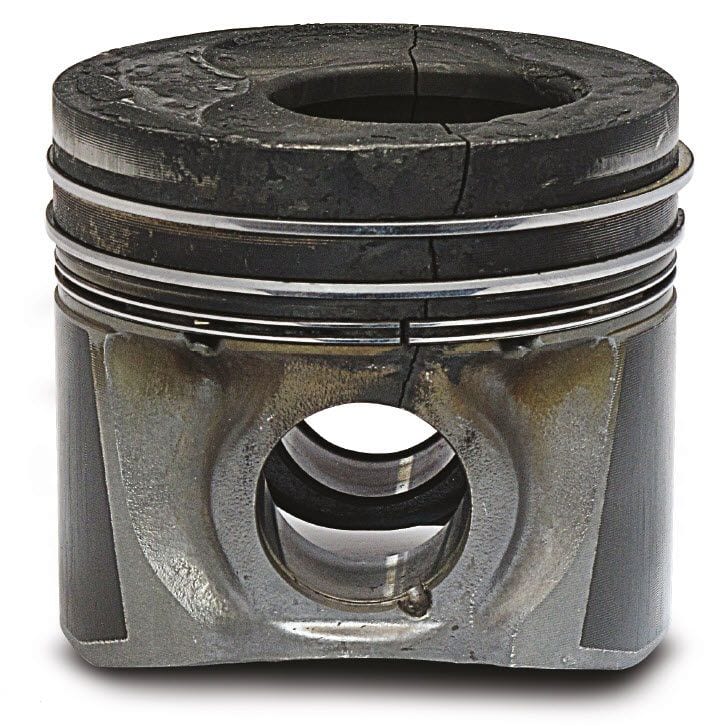
Piston breakage
If you drive for a prolonged period at a (too) high engine speed or under too heavy a load, such as after software tuning without mechanical modifications, especially when the engine has not yet reached operating temperature, there is mechanical overload. This can happen due to:
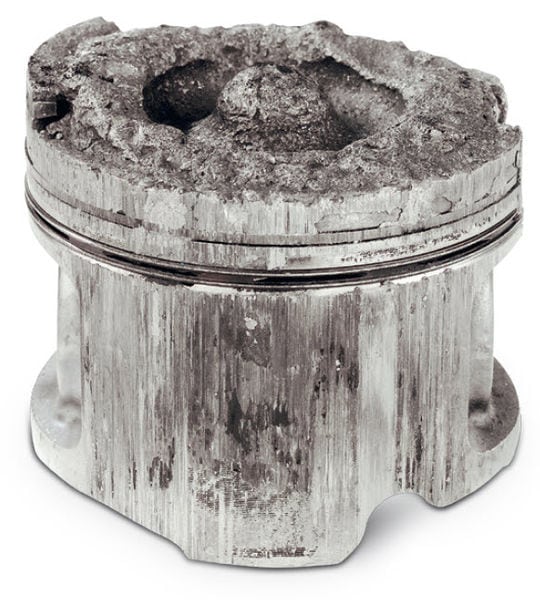
- Detonation: petrol engines can start to detonate due to an incorrect octane rating, too high a compression ratio, a mixture that is too lean, incorrect ignition timing, or excessively high intake temperatures. Detonation creates very high pressures, which forces away the lubricating oil film and causes temperatures to rise sharply. The result is that piston material breaks off between the piston rings, or a hole forms in the piston;
- After chiptuning: in an engine that has been modified via software, the pressure can rise too high for the unmodified engine components. As a result of combustion pressure, the piston can break;
- A dripping injector in a diesel engine: this causes too much fuel to enter the combustion chamber and part of the fuel ignites on/in the piston crown. Metal particles in the piston crown can come loose due to the mass forces that occur and erosion caused by the combustion gases.
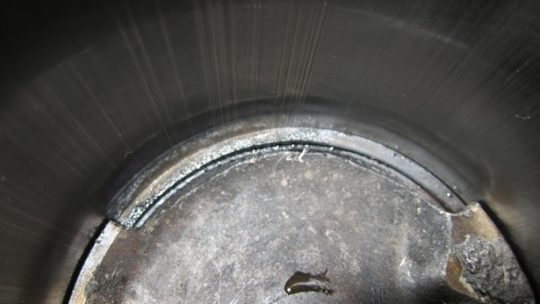
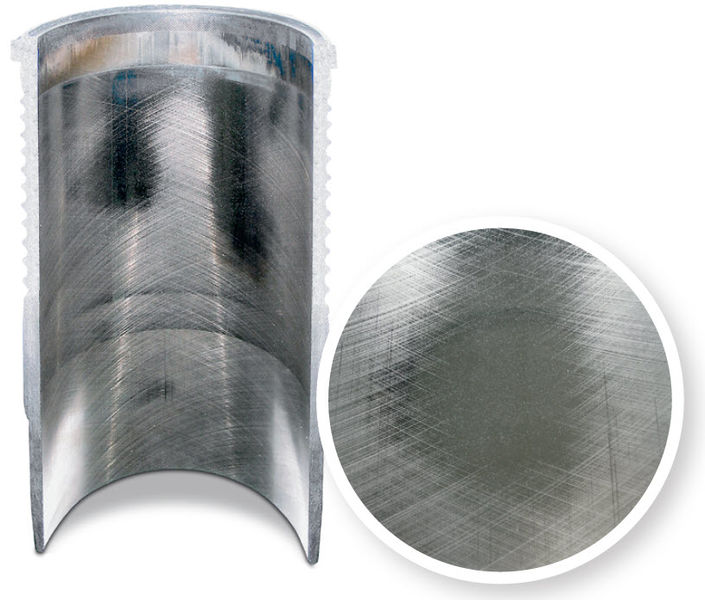
Wear of the piston coating and cylinder liner
In engines with high oil consumption or rocking pistons, we often see wear of the piston coating and bright spots in the cylinder liner. In certain areas, the honing marks are worn away and have become smooth. Causes may include:
- high mileage;
- frequent idling and driving short distances;
- insufficient maintenance, resulting in increased wear due to aged oil.
This wear can be recognised by one or more consequences:
- increased oil consumption because oil can easily pass the piston rings into the combustion chamber;
- blue smoke or black soot particles in the exhaust gases;
- rattling noises at idle and higher engine speeds because the clearance between piston and cylinder has increased. This is also referred to as a “rocking” piston.
Not only due to the circumstances and consequential damage mentioned earlier, but also after a repair or overhaul, new piston damage can occur:
- Cylinder wall contains irregularities: perhaps an old wear process or defect was not noticed properly and the piston was installed in a damaged cylinder;
- Unskilled installation: if the piston rings and pistons are not installed carefully, a (small) damage can occur that causes consequential damage in the longer term. Too little clearance between the piston and cylinder also has a high chance of consequential damage: as the piston expands, galling marks can occur. Usually, galling marks due to a small clearance can be recognised by shiny spots with a dark-coloured edge.
Over-tightening or unevenly tightening the cylinder head bolts can also lead to piston damage because it can cause deformation of the cylinder liner; - Installation of incorrect piston rings: if the ring end gap is too small, the piston ring can seize as it expands after warming up and start scraping in the cylinder;
- Pistons contact the valves: after installing an incorrect type of piston with incorrect valve reliefs, a head gasket that is too thin, insufficient valve clearance, or an incorrectly installed timing belt or chain, the piston can hit the valves.
Bent connecting rod:
One or more bent connecting rods may be found as a result of a defect or event. A bent connecting rod leads to a lower end-of-compression pressure, because the piston can no longer reach TDC of the cylinder. Some causes of a bent connecting rod are:
As one of the most common causes, a liquid in the combustion chamber during the compression stroke leads to a bent connecting rod. Unlike air, a liquid is not compressible. This is called “hydrolock”. You may encounter this in the following situations:
- The head gasket is torn between a coolant passage and the cylinder. The coolant can leak into the combustion chamber unhindered. While the engine is running, the chance of hydrolock occurring is small. In particular during pressure testing (pressurising the cooling system), the coolant is forced through the crack. When we suspect that a torn head gasket is the cause of coolant leakage, the cylinder can be inspected during the pressure test with an endoscope. In the event of leakage, a small puddle of coolant may be lying on the piston;
- (Rain)water has been sucked in from outside. During heavy rainfall, deep puddles can form on the road. Also consider a high water level in a tunnel. When driving through a deep puddle, a considerable amount of water can enter the engine – via the air filter;
- A physical part has entered the cylinder, such as a small screw or other material that is drawn in via the intake.
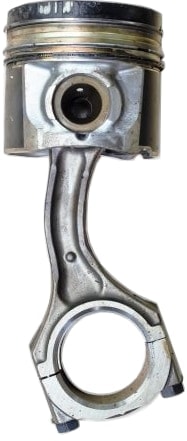
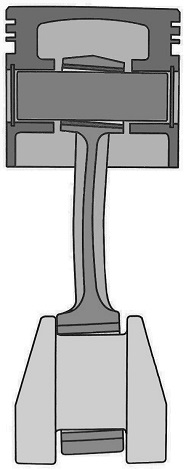
At the moment the damage occurs, an enormous pressure develops above the piston. The connecting rod is pushed onto the crankpin of the crankshaft with an unusually high force. This force can squeeze out the lubricating oil film between the plain bearings and the bearing journals, both of the connecting rod and the main bearings of the crankshaft. After the oil film has been forced away, mechanical friction immediately occurs, causing bearing damage and possibly also crankshaft damage.
In addition to the friction between the bearings and the bearing journals, with such damage to the connecting rod there is a high chance that damage to the piston pin will also occur immediately.
The above image shows the cross-section of the piston, in which the consequences of a bent connecting rod can be clearly seen. The piston pin and the connecting rod bearing journal are no longer loaded centrally, but at an angle. The piston pin can break and the bearings will immediately wear in and start to “gall”.
Broken piston pin:
A broken piston pin can occur after an overload due to abnormal combustion when, for example, detonation occurs, or due to foreign objects or liquid in the combustion chamber during the compression stroke. The overload can also be caused by excessively high combustion pressures as a result of performance improvement (chiptuning, turbo, etc.).
Careless installation can also be a cause of piston pin breakage. When an impact damage is inflicted with a hammer, it can lead to a small crack.
This initial crack can lead to the piston pin breaking, even under normal load.