Engine mount:
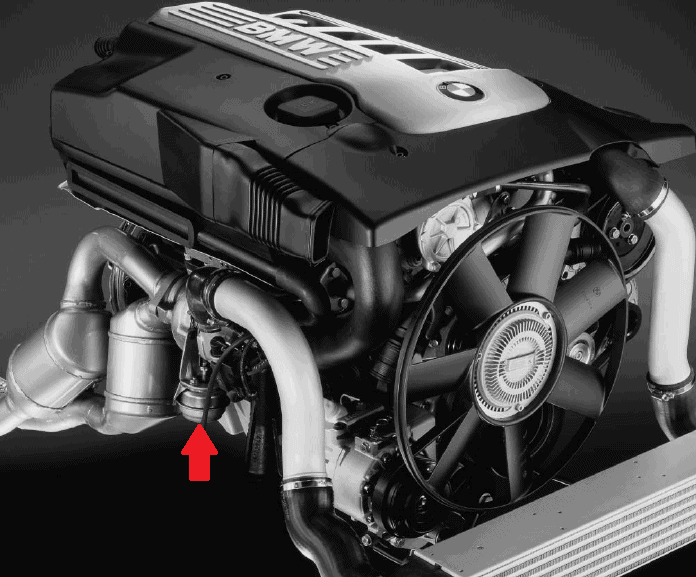
A car engine often has 3 engine mounts; 2 on the sides and 1 at the rear. In cars with transverse engines, the engine mounts are located at the timing belt side, on the gearbox, and at the bottom on the subframe (the torque rod). In engines mounted longitudinally (such as the BMW engine in the image below) the engine mounts are located on the sides exactly in the middle (where the red arrow is, and of course also on the other side). There is also a mount at the rear against the body to prevent tilting.
The engine block hangs or rests in the rubber parts of the engine mounts. The engine has some play in these mounts; it can move slightly in the mounts. This is necessary to damp vibrations and to absorb the large engine forces resulting from idling and from movement during acceleration / deceleration.
The rubber of the engine mount must be of good quality. Not too hard, because then vibrations will be poorly damped. Also not too soft, because then the engine block can move too much and wear will be greatest. Based on the weight of the engine block, the proper engine mount is designed.
As they age, the rubbers often become weaker. This can be noticed as a “thumping” feel and noise when engaging the clutch, or noises when suddenly accelerating or releasing the accelerator pedal. (Note, this can also have other causes such as worn control arm bushes, a defective dual-mass flywheel, etc.)
With worn engine mounts, engine vibrations can also be transmitted into the interior. This can be recognized as a droning sound, or even vibrations in the interior that depend on the engine speed. It is best to replace the engine mounts before other components get damaged by the vibrations.
Hydraulic engine mount:
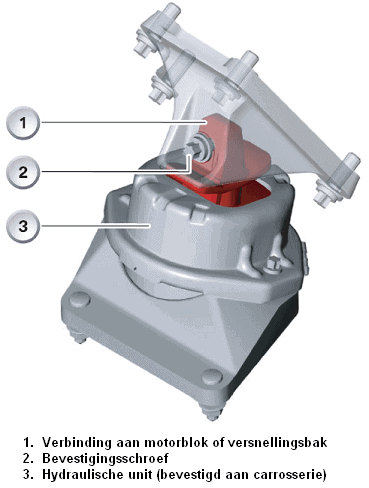
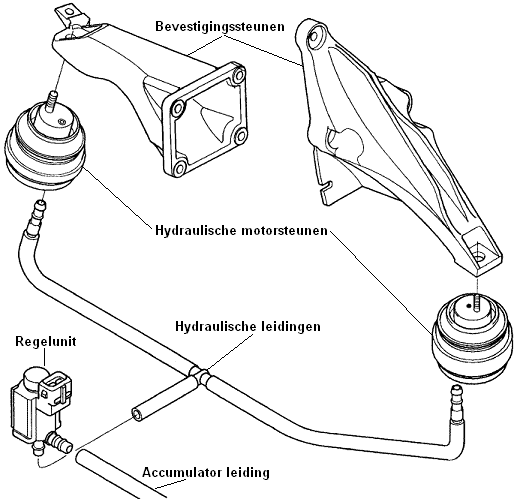
In luxury cars, hydraulic engine mounts can be used. These engine mounts increase comfort, because vibrations are damped even better than with conventional ‘rubber’ engine mounts. In the hydraulic unit (no. 3 in the image) oil is stored under pressure. The oil is located between two sections of this mount. The weight of the engine rests on the oil. This oil takes over the task of the rubber in the other mount; the vibrations and movements are damped in it.
Active (adjustable) engine mount:
In cars where the comfort level can be set in the on-board computer (including BMW / Mercedes), the damping of the engine mounts can be adjusted. By activating the ‘sport mode’ in the on-board computer, additional oil is pumped from the accumulator through the control unit into the hydraulic engine mounts. Due to the larger amount of oil, these engine mounts become stiffer and can therefore move less easily. Vibrations are now also more easily transmitted into the interior. The engine block now has fewer possibilities to move in the engine bay, which benefits a sporty driving style (with lots of cornering). The extra engine vibrations can also be interpreted as sporty by the driver.
In comfort mode, the control unit lets some oil escape from the engine mounts. This provides, as the name suggests, more comfort. Often a choice can be made on a scale from 1 to 5 between sporty and comfortable. The damping of the air suspension is also adjusted simultaneously in the same way.
In cars without adjustable engine mounts, the manufacturer has chosen a certain comfort level. Comfort must be as high as possible, but at the same time the handling must also be optimal. A compromise must always be made, whereby the car is both comfortable and sporty. Only by replacing parts of the suspension (e.g. the springs and shock absorbers) can the driver adjust this.
Torque rod:
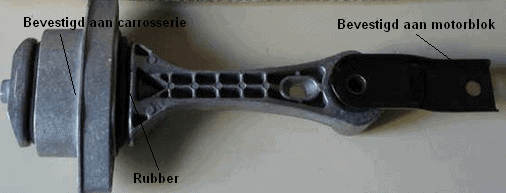
A torque rod is an engine mount that is mounted at the bottom of the car. This mount is attached to the underside of the engine (at the level of the bottom of the oil pan and gearbox) and the other end is attached to the body or subframe. The torque rod ensures that the engine block does not tilt when accelerating or when releasing the throttle. This mount is only used in cars with a transverse engine (so with the bonnet open the cylinders lie from left to right and not from front to back).