Topics:
Exhaust:
The exhaust is responsible for discharging the exhaust gases that are released during combustion in the engine. The exhaust is attached to the engine block.
When the exhaust gases leave the cylinder, they go directly into the exhaust via the exhaust manifold (sometimes also via a turbo). The purpose of the exhaust is to discharge the gases behind the car. If the exhaust were to end halfway down the underside of the car, the exhaust gases (which are harmful to health) could easily enter the interior.
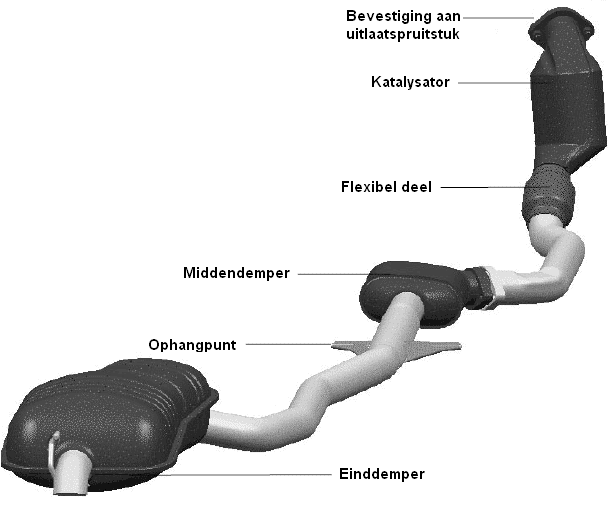
The exhaust usually consists of an exhaust manifold, a catalytic converter, a flexible section, a center muffler and a rear muffler (commonly referred to as the “knalpot”). These are discussed below.
Flexible section:
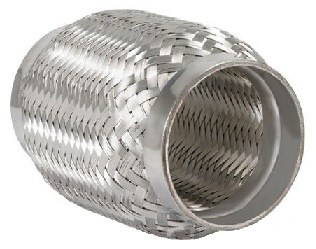
The engine produces a lot of vibrations. The flexible section (see image below) dampens these vibrations so that the rest of the exhaust remains as vibration-free as possible. Otherwise, there is a high risk that parts such as the exhaust manifold and the exhaust connection pieces will crack and break off after a short time.
The flexible section is mounted close behind the exhaust manifold. Sometimes the catalytic converter is mounted directly after the exhaust manifold so it heats up as quickly as possible (as in the image), and in other cars it is the other way around, with the catalytic converter placed after the flexible section.
Muffler:
The primary function of a muffler is to reduce the noise generated by the combustion of fuel in the engine. Sound is caused by vibrations in the air that arise from the fast exhaust gases leaving the engine cylinders. Every power stroke of the engine generates a wave of gas pressure that causes the air in the exhaust to vibrate, resulting in a high sound frequency. The muffler is designed to dampen these sound waves and weaken the vibrations so that the engine noise is less disturbing.
A muffler generally consists of several metal tubes placed inside each other. These tubes are fitted with holes or slots that partially divert the airflow. The air has to pass through a series of bends and chambers, where the sound is absorbed or redirected in these chambers, which dampens the sound vibrations. Around the tubes there is often heat-resistant damping wool (usually made of fiberglass or metal fiber) that further absorbs the sound frequencies.
The noise reduction is not only due to the slowing of the airflow, but also to the interference of sound waves in the muffler. In the muffler there are so-called loudspeaker effects, where sound waves cancel each other out at certain points due to sound interference. This process ensures that both the low and high frequencies of the exhaust noise are effectively dampened.
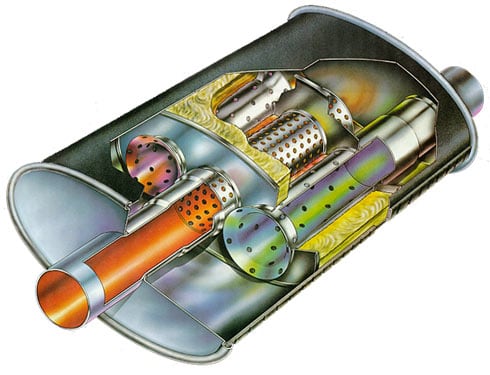
A muffler is often made up of a front and rear muffler.
The rear muffler, often the most common type of muffler, is the final line of sound reduction and is located at the end of the exhaust system, just before the tailpipe. It is able to reduce most of the remaining sound waves, bringing the final noise level down to an acceptable level.