Introduction:
In vehicles with a combustion engine, the heat for the interior heating is extracted from the cooling system. The low efficiency of the combustion engine (both petrol and diesel and LPG) is mainly due to heat losses. In the heater radiator, coolant circulates at temperatures up to 90 degrees Celsius. The interior fan blows air through the heater radiator, causing the air to enter the interior already heated. To warm up the interior more quickly in winter, auxiliary heating systems are also available for vehicles with combustion engines, in the form of electric heating resistors or an auxiliary heater.
In electric vehicles, the heat source (the combustion engine) is missing. As a result, the warm air that the heater must produce has to be generated in another way. This can be done in two ways:
- via electric heating resistors (PTC heating);
- by means of a heat pump (possibly in combination with PTC heating during start-up).
Because the heating resistors require a lot of power and can consume up to 10% of the capacity of a fully charged HV battery, the heat pump is becoming increasingly popular. The heat pump is simply much more efficient. The heat pump uses the same components as the A/C system, but with the addition of extra components, the heat pump works as a “reversed” air conditioner. Knowledge of the operation of the conventional air conditioning system is therefore required before studying the operation of the heat pump.
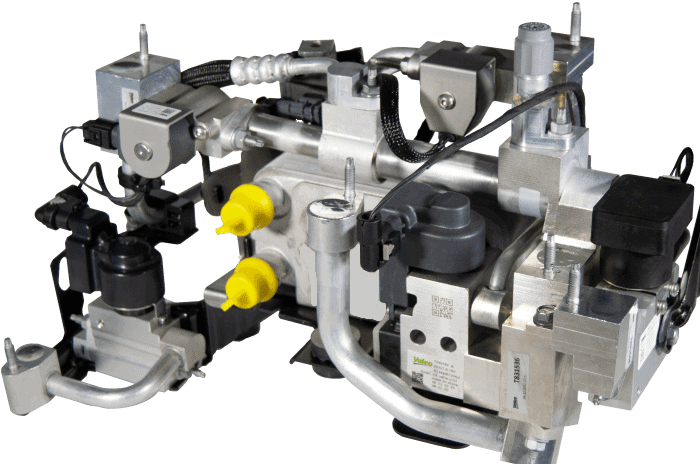
Video showing the construction of the heat pump: Valeo heat pump
The following image shows the cycle of the heat pump. In principle, a heat pump consists of the following main components: a compressor, evaporator, expansion valve and a condenser.
The compressor moves the gaseous refrigerant under increased pressure to the condenser. As a result of the compression, the temperature of the refrigerant has risen. The refrigerant transfers the heat to the air and condenses. The heated air flows into the interior. The refrigerant changes from gaseous to liquid.
When the refrigerant flows through the expansion valve, another state change takes place: here it changes from liquid to gaseous. In the evaporator, the refrigerant evaporates completely. The required evaporation heat is extracted from the warmer outside air, which therefore cools down.
The gaseous refrigerant flows from the evaporator back to the compressor.
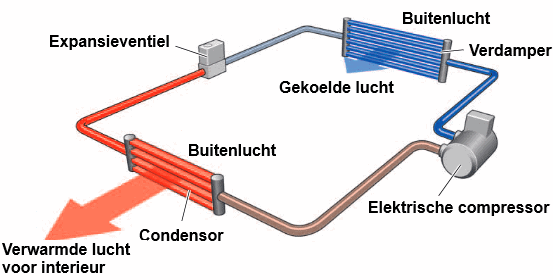
As the explanation above already shows, the heat pump uses the same components as the A/C, with the condenser and evaporator having swapped roles. The condenser is located under the dashboard and the evaporator in the front end near the radiator. The expansion valve has also been given a different place in the system, namely at the front of the vehicle near the evaporator. In addition to heating, the heat pump can also cool: for that, the components are used again as we are familiar with in the air conditioning system. By means of switching valves, the condenser and evaporator swap functions, and the expansion valve will again allow the refrigerant to evaporate in the evaporator under the dashboard.
The heat pump therefore has both a heating and a cooling function. This is useful not only for the interior, but also for cooling and heating, among other things, the HV battery pack.
Heat pump with R134a or R1234yf:
As briefly described in the introduction, the heat pump can heat and cool both the interior and the components of the HV system.
In vehicles we find heat pumps with two different types of refrigerant: the familiar R134a and R1234yf, or R744 (CO₂). The latter is discussed in the next paragraph.
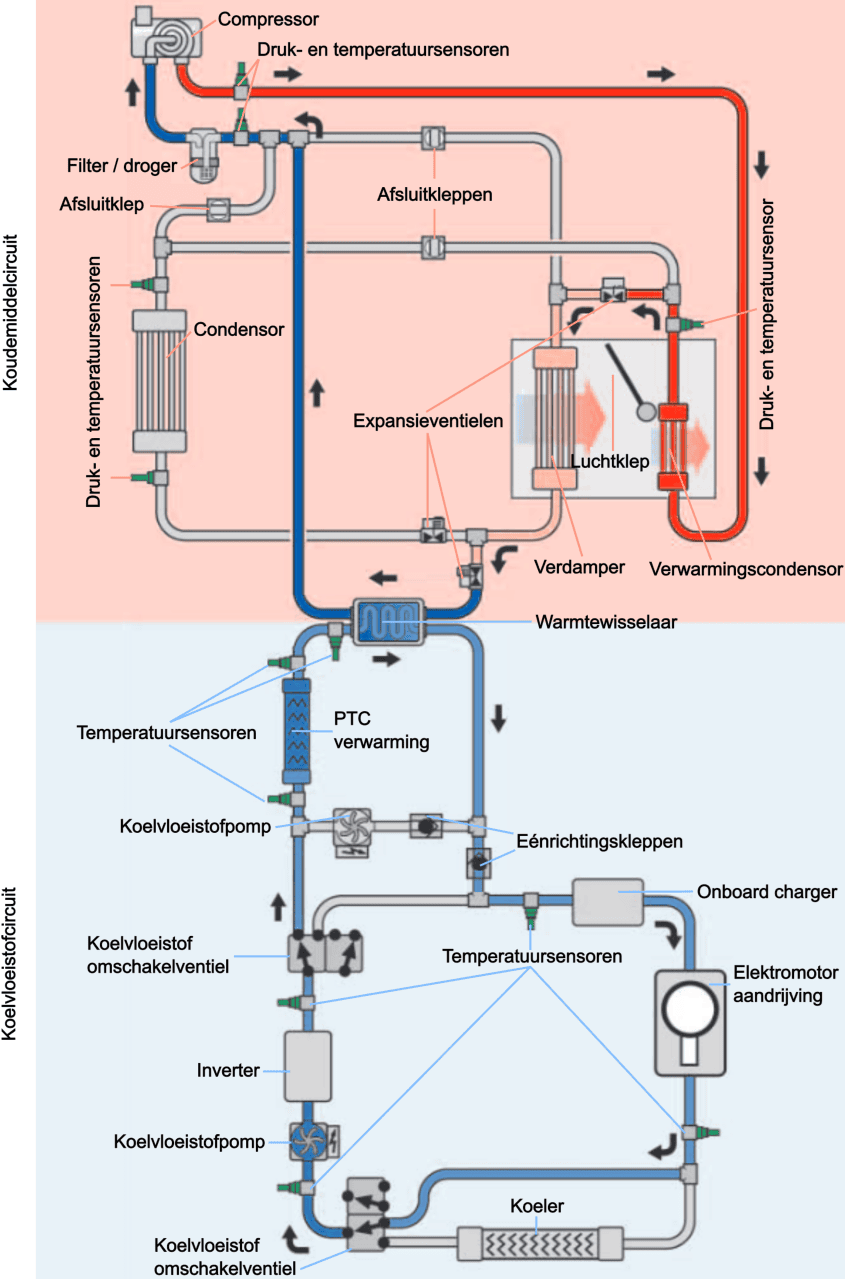
In the following image, two circuits are shown: at the top the red-colored refrigerant circuit and at the bottom the blue-colored coolant circuit. Both circuits are separated from each other, but temperature transfer is possible via a heat exchanger.
The upper circuit focuses on the refrigerant cycle. The three shut-off valves direct the refrigerant in the correct direction. In addition, there are three expansion valves which are activated depending on the position of the shut-off valves.
The components are named as in an A/C system: the condenser is located in the front end near the radiator, and the evaporator in the heater housing under the dashboard. In addition, there is a heating condenser in which the airflow can be directed or blocked by means of an air flap. The heating condenser is used for heating with the heat pump, while the evaporator plays a role in cooling with the air conditioning. Pressure and temperature sensors at multiple locations measure the pressures and temperatures when the refrigerant changes direction via the shut-off valves.
The red lines in the refrigerant circuit indicate high pressure, the blue low pressure. The orange line and the evaporator have a medium pressure, because an expansion valve is placed on both sides. Arrows indicate the flow direction of the refrigerant.
The lower part shows the cooling system of the HV system. The heat exchanger transfers the temperature of the warm coolant to the refrigerant. The cooled HV components include the on-board charger (where AC is converted to DC while charging the battery pack), the electric drive motor, and the inverter (where the DC from the battery pack is converted into sinusoidal AC for the electric motor).
The coolant switching valves determine the flow direction of the coolant. Arrows indicate how the flow runs in the switched state. The coolant can be routed through the cooler for cooling, or via the PTC heater for heating.
As described above, the heat pump can function as air conditioning or as heating. The three situations below show the direction of the refrigerant through the components to make the heat pump function as air conditioning, interior heating, or interior heating and HV pack cooling.
1. Air conditioning
The (A/C) compressor draws in the gaseous refrigerant via the low-pressure line (blue) and forces it via the high-pressure line (red) to the heating condenser in the heater housing. The air flap is closed, so there is no airflow through the heating condenser and no heat is released. As a result, no condensation occurs.
The refrigerant flows on to the condenser via SV2 (shut-off valve 2). In the condenser, the refrigerant condenses and becomes liquid.
After the condenser, the refrigerant reaches EV2 (expansion valve 2). Here it undergoes a pressure drop, causing the refrigerant to evaporate and release heat to the evaporator. This heat is extracted from the interior air, which is then blown into the interior.
From the evaporator, the gaseous refrigerant flows back to the suction side of the compressor via SV1 (shut-off valve 1).
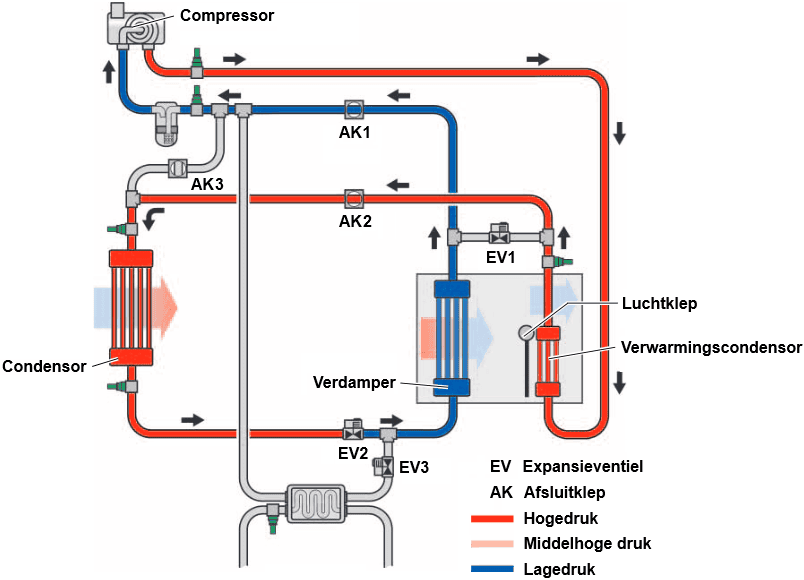
Shut-off valve 3 is closed, so the refrigerant cannot use this line. Expansion valves EV1 and EV3 are also closed, blocking the passage. All expansion valves can operate in two directions. In heating functions, the shut-off valves direct the refrigerant in another direction, while the expansion valves provide pressure reduction in the opposite direction.
2. Interior heating
The compressor compresses the refrigerant, after which the gaseous refrigerant is transported via the high-pressure line to the heating condenser.
The temperature of the heating condenser rises, causing the interior air, which has previously been preheated in the evaporator, to absorb the heat released when the refrigerant condenses in the heating condenser.
Shut-off valves SV1 and SV2 are closed, so that after the heating condenser the refrigerant undergoes a pressure drop in EV1 (expansion valve). As a result, the refrigerant becomes partly gaseous. In the evaporator, which in this situation acts as a condenser, the refrigerant condenses again and in doing so releases heat to the incoming interior air. The refrigerant then undergoes another pressure drop in EV2, where the temperature falls below the ambient temperature. In the condenser, which in this situation acts as an evaporator, the refrigerant evaporates and absorbs heat from the outside air that has a higher temperature. The gaseous refrigerant flows back to the compressor via SV3.
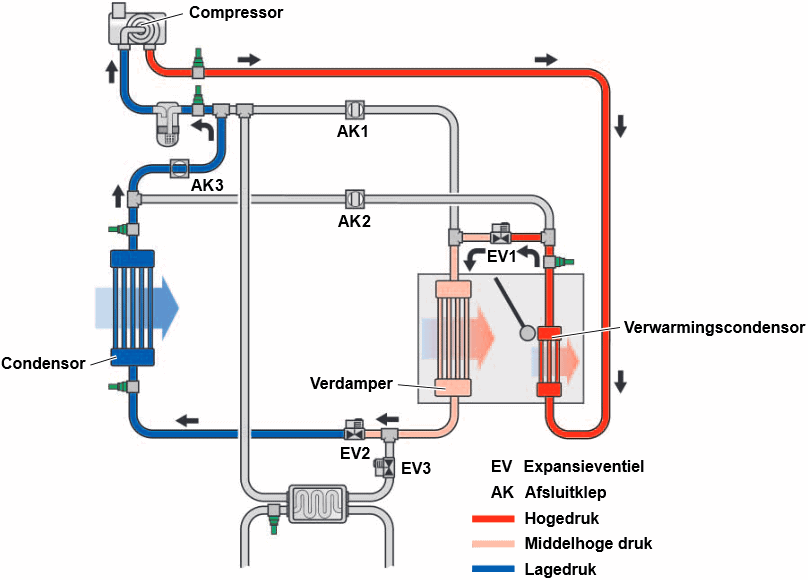
In traditional A/C systems, the condenser is located in the front of the vehicle, where the ram air (or airflow from the fan) absorbs the heat from the refrigerant and allows the temperature of the refrigerant to drop. In a heat pump, however, this heat is not transferred to the ram air, but is used to heat the incoming interior air. In this case, therefore, the condenser and evaporator have swapped functions.
3. Interior heating and cooling HV components
In the heat pump system, the refrigerant must expand for the transition from liquid to gas. There are expansion valves ahead of the condenser (which acts as an evaporator) and ahead of the heat exchanger, which is responsible for heat transfer between the refrigerant and the coolant circuit of the HV components.
EV2 and EV3 are open in this situation. It is also possible that only EV3 is open. In that case, the heat from the cooling system of the HV components is used for expansion. After expanding, the temperature of the refrigerant is lower than the ambient temperature. Due to this drop, the refrigerant in the heat exchanger extracts heat from the cooling circuit of the electric drive. This helps to cool the HV components: the coolant transports the heat from, among other things, the inverter and the electric motor and releases it via the heat exchanger to the refrigerant.
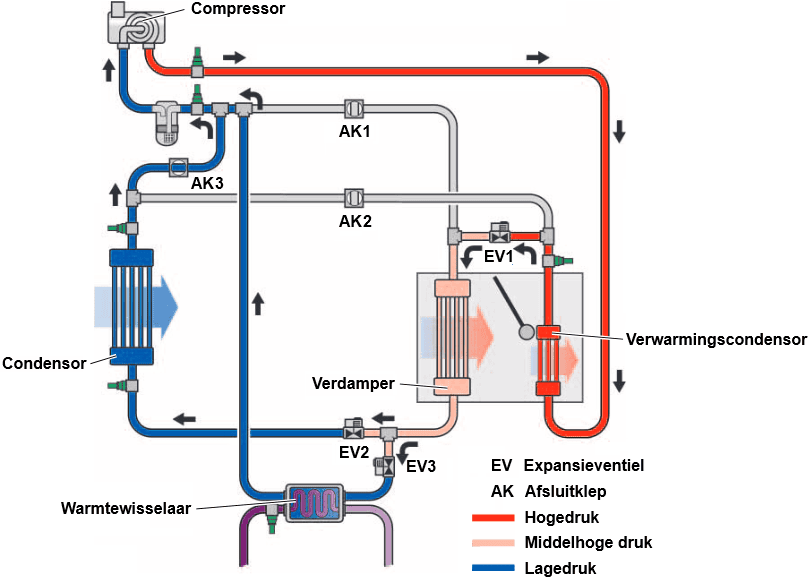
If both the condenser and the heat exchanger generate insufficient heat to allow the refrigerant to condense, for example if the vehicle is stationary for a long period with the heating switched on, the PTC heating element is activated in the cooling system and the coolant temperature in the heat exchanger is increased. The shielded cooling circuit with its own coolant pump prevents sensitive components such as the power electronics, the on-board charger and the electric motor from being unintentionally heated. After all, the heating is only intended to allow the refrigerant to expand. This situation will not arise if the inverter and electric motor have to deliver a lot of power: in that case, enough heat is generated which may even need to be limited via the cooler.
Heat pump with R744 (CO₂):
The refrigerant R744 (CO₂) is increasingly being used in A/C and heat pump systems, such as in electric vehicles. CO₂ has the property of absorbing a lot of heat during evaporation and releasing a lot of heat during condensation. This makes it very effective for heat transfer. An important limitation of CO₂, however, is the critical temperature of 31 °C. Above this temperature, CO₂ cannot condense, which makes it difficult to remain efficient at summer outdoor temperatures. To solve this, an additional internal heat exchanger has been added in vehicles, which uses low-pressure refrigerant between the evaporator and compressor to condense the hot, high-pressure refrigerant in the gas cooler.
Compared to other refrigerants, such as R1234yf, CO₂ has much higher operating pressures. The standstill pressure at 20 °C is 57 bar, and during operation the pressure on the low-pressure side can rise to 90 bar, with a relief valve that opens at 160 bar. This requires more robust systems, such as a compressor with thicker walls and flexible lines with a corrugated steel sheath for protection against the high pressure and thermal load.
An important advantage of CO₂ as a refrigerant is that it can still heat effectively at extremely low outdoor temperatures, such as below -10 °C. Unlike R1234yf, which boils at -29 °C, CO₂ remains gaseous at temperatures below -79 °C, allowing it to continue operating in very cold environments. This makes CO₂ particularly suitable for use in vehicles as both a cooling and heating system, with better performance at low temperatures than traditional refrigerants.
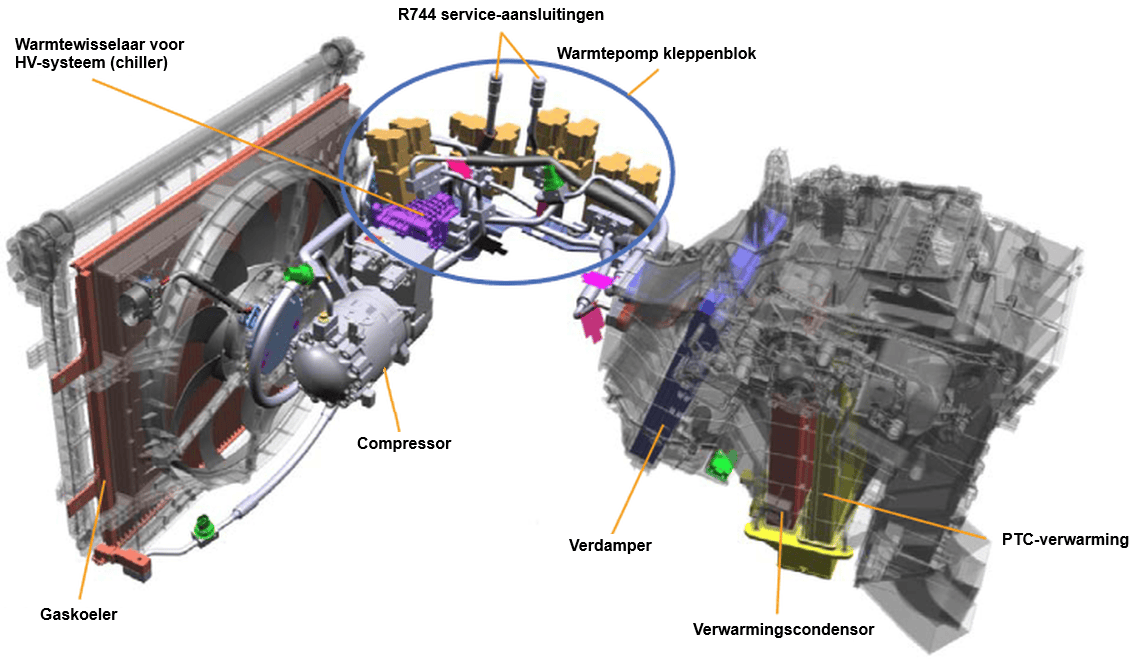
The image above shows the components of the R744 heat pump system (illustration: VAG). Below, seven options are shown for how the heat pump can provide cooling and heating for the entire system, or parts of the system.
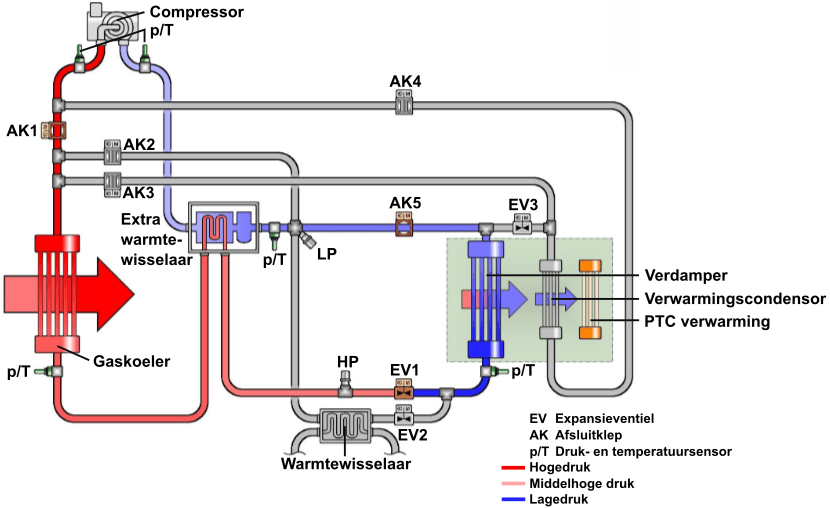
1. Cooling the interior:
The refrigerant flows via the compressor to the gas cooler at the front of the car, where it condenses and releases heat to the outside air. Via the expansion valve (EV1), the refrigerant undergoes a pressure reduction, after which it absorbs the warm air from the interior in the evaporator, causing the temperature of the air flowing into the interior to drop. The additional heat exchanger between the gas cooler and the expansion valve ensures that the refrigerant is cooled further so that it fully condenses. At higher outside temperatures, the operation of the gas cooler may be insufficient to fully condense the refrigerant, since the critical temperature of CO₂ is 31 °C.
2. Cooling the interior and HV battery pack:
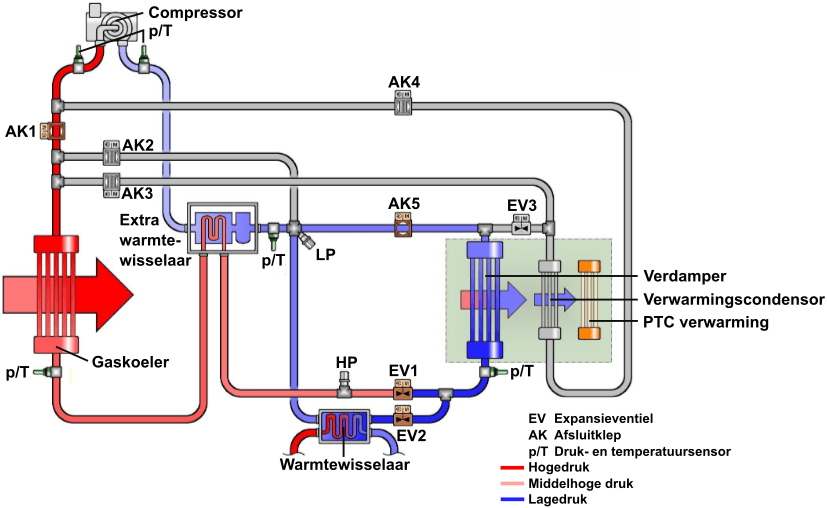
As in situation 1, where only the interior was cooled, in this situation the compressor moves the refrigerant to the gas cooler at the front of the car. Now EV2 (expansion valve 2 for the heat exchanger) is also open. The two expansion valves (EV1 and EV2) expand the refrigerant to cool both the air in the interior and the HV battery pack via the heat exchanger (chiller). The battery pack is actively cooled in this way as soon as the temperature exceeds 30 to 35 °C.
3. Cooling the HV battery pack:
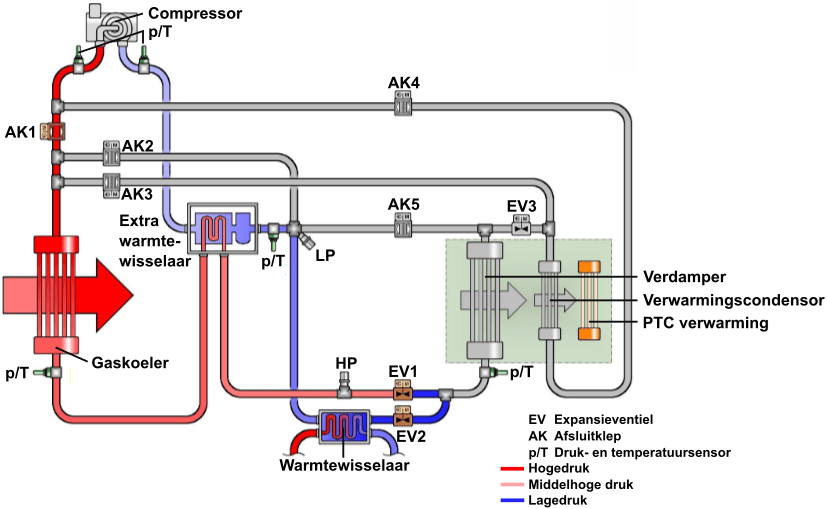
The HV battery pack can be cooled without cooling the interior. When the temperature of the HV battery exceeds 30 to 35 °C, the refrigerant is routed from the gas cooler, via EV1 and EV2, through the heat exchanger (chiller), where it absorbs heat from the battery and keeps the temperature under control. This cooling is essential for the battery’s service life. To prevent the refrigerant from flowing through the evaporator, shut-off valves AK3, AK4, AK5 are closed.
4. Reheat phase:
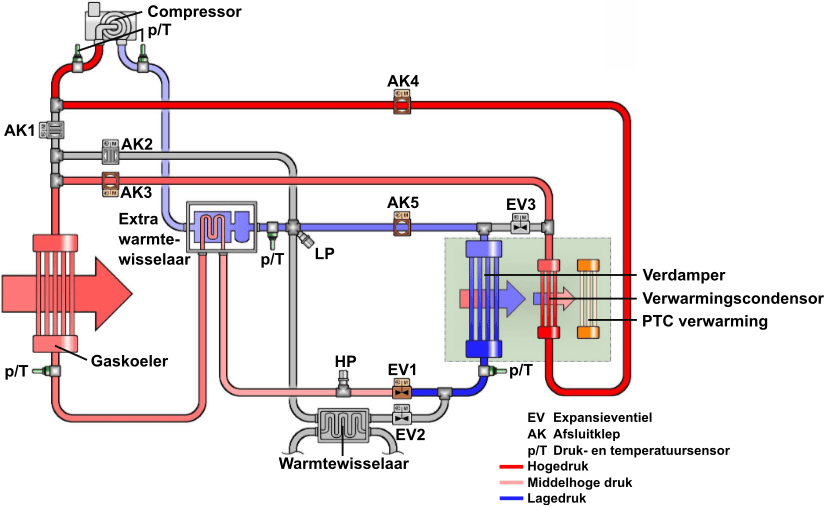
In the reheat phase, the cooled air coming from the evaporator is reheated using the heating condenser.
The reheat function is used at low outside temperatures, for example when the windscreen needs to be defogged while humidity is high. The dry, cold air from the evaporator is warmed so that the interior is heated and dehumidified at the same time.
5. Air heat pump:
As with the R134a heat pump, the gaseous refrigerant flows from the compressor through the heating condenser and the evaporator, where the heat from the refrigerant is transferred to the incoming interior air.
However, when starting the CO₂ heat pump, it takes some time before the heating condenser reaches a sufficient temperature to bring the interior air to the desired temperature, because heat cannot yet be extracted from the HV circuit.
To obtain heat in the interior immediately after starting the car, the PTC heater is activated.
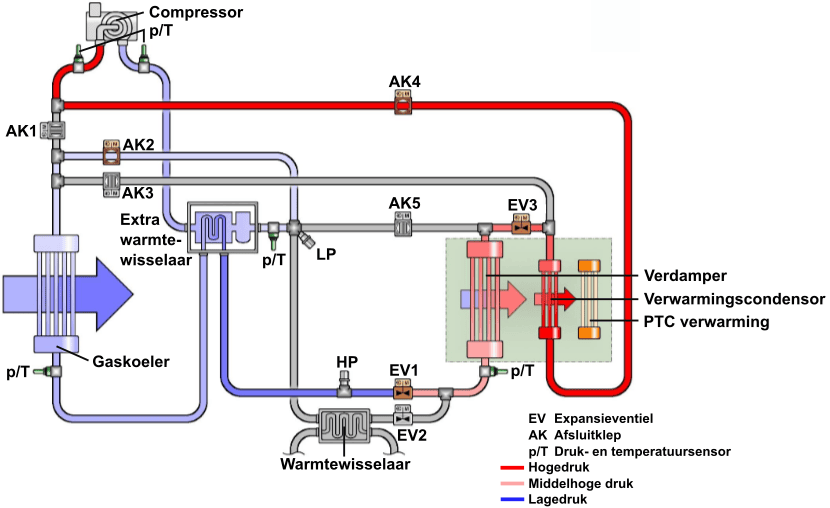
6. Air-to-water heat pump:
As in situation 6, the heat pump can absorb heat from the outside air, but in this situation heat is also extracted from the cooling system of the HV battery pack.
Via the compressor and the open shut-off valve AK4, the refrigerant is directed to the heating condenser and the evaporator, where it releases heat to the incoming interior air. At the same time, the refrigerant flows via EV1 through the gas cooler at the front of the car, where it absorbs heat from the outside air, and via EV2, where it absorbs heat from the cooling system of the HV system.
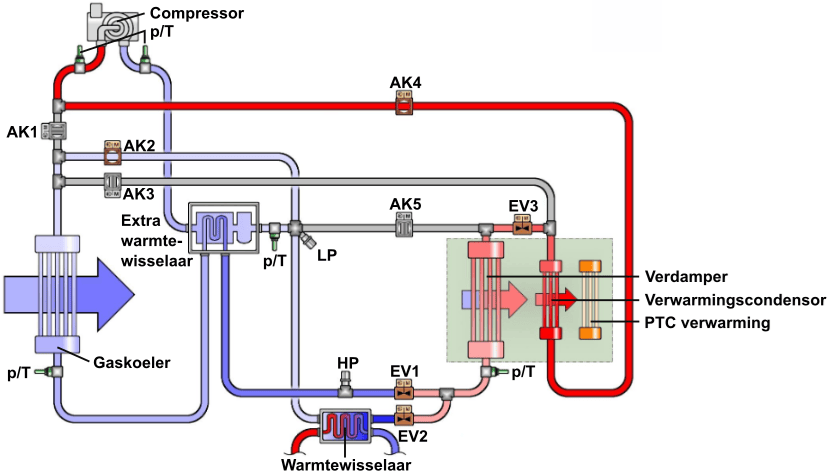
7. Water heat pump:
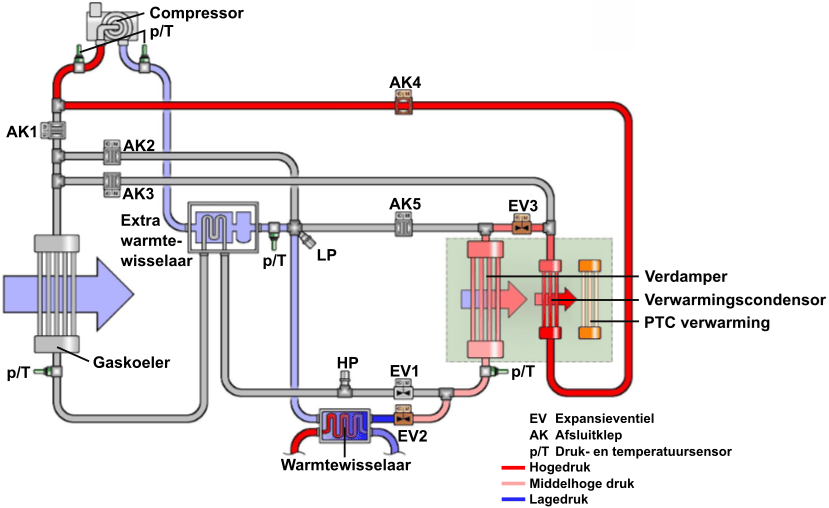
At low outside temperatures, the CO₂ heat pump can also operate as a water heat pump, in which the refrigerant extracts heat from the HV cooling system and transfers it to the interior or other systems of the vehicle.
Via the compressor, the refrigerant is directed under high pressure to the heating condenser and the evaporator to heat the incoming air. The refrigerant then expands via expansion valve 2 in the heat exchanger (chiller), after which it is drawn in by the compressor via the additional heat exchanger.
Related pages: