Introduction:
The HV system in vehicles with an electrified or fully electric drivetrain is equipped with multiple safety features. The system can only be activated once all safety requirements are met. As soon as a fault is detected, the HV system switches off immediately. This can occur in the following situations:
- A component of the HV system has been removed and the system is switched on.
- Due to a collision or water damage, electrical components or wiring short-circuit with each other or with ground.
- Components have been damaged due to overloading.
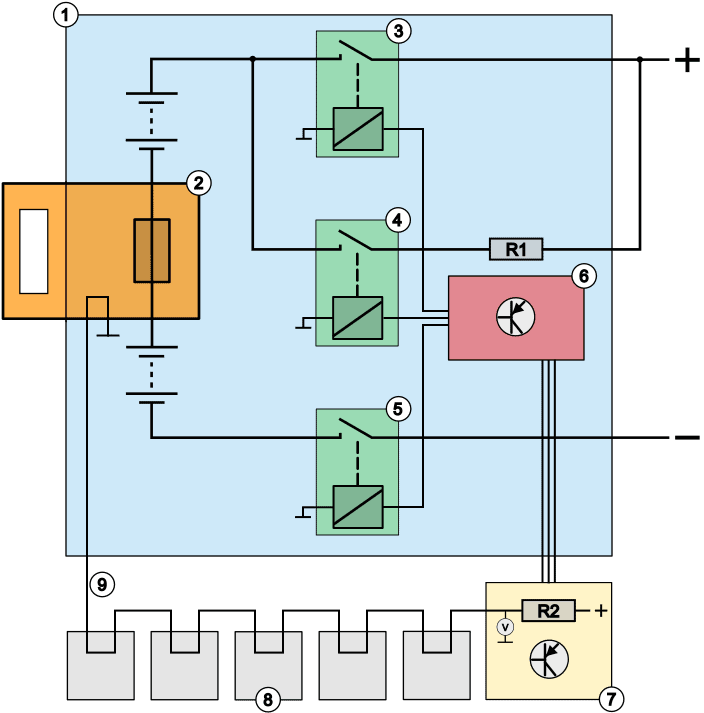
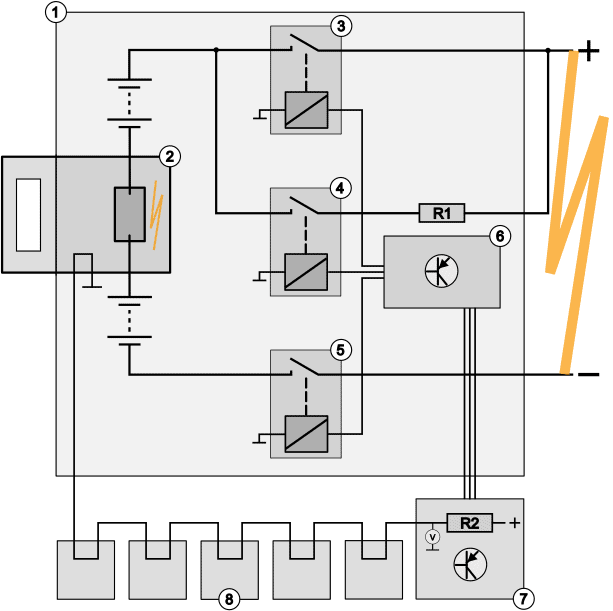
The image below shows the components that are part of the safety system. In blue you can see a section of the HV battery (1), with the orange service plug (2) on the left. In the middle are three relays (3 to 5), which are switched on one by one by the ECU (6). Below the HV battery is the ECU (7), which is connected to the consumers (8), such as the electric motor, PTC heater, air-conditioning compressor, power steering and charging system.
Legend:
- HV battery
- Service plug with fuse
- Relay 1
- Relay 2
- Relay 3
- ECU of HV battery
- ECU of HV system
- Electrical consumers
- Interlock wire
Activating the HV system:
The driver activates the HV system by pressing the start button. At the moment the message “HV ready” appears in the display, the HV system is activated. Before the HV system becomes active, the relays in the HV battery pack are controlled to connect the battery pack to the consumers.
When the HV system is switched on, the ECU (6 in the image below) controls the HV relays in the positive circuit (relay 4) and the ground circuit (relay 5). First, the current circuit on the positive side is switched on via a resistor. In the image below we see that relay (4) allows current to flow to resistor R1. The resistor limits the current flowing through it, thereby limiting the inrush current. This allows the capacitors in the inverter to be charged slowly. At this moment, the system can perform a safety check at a lower voltage. After the voltage across the capacitors in the inverter is approximately equal to the voltage of the HV battery pack, relay 3 closes and relay 4 opens, applying the full voltage to the inverter and other electrical components.
Interlock:
The interlock system is the safety system that provides protection against electric contact when open connections are present. Each component that is connected to the HV battery contains at least one contact that can switch off the HV system when an interruption occurs. These contacts can be integrated into the wiring or included as a switch in the housing of a component.
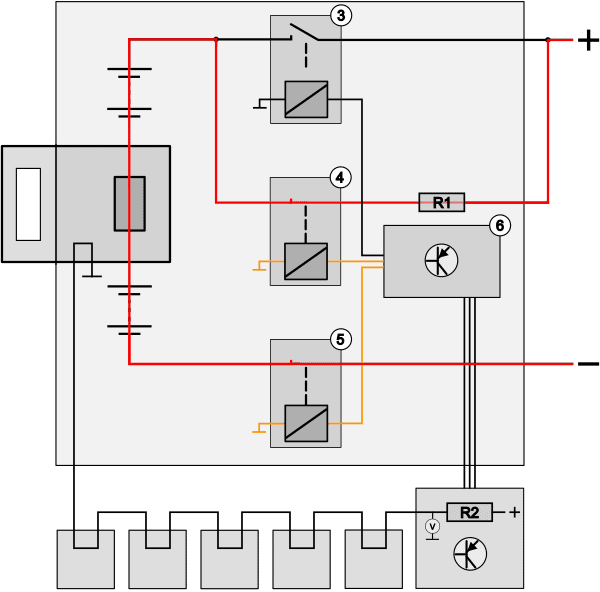
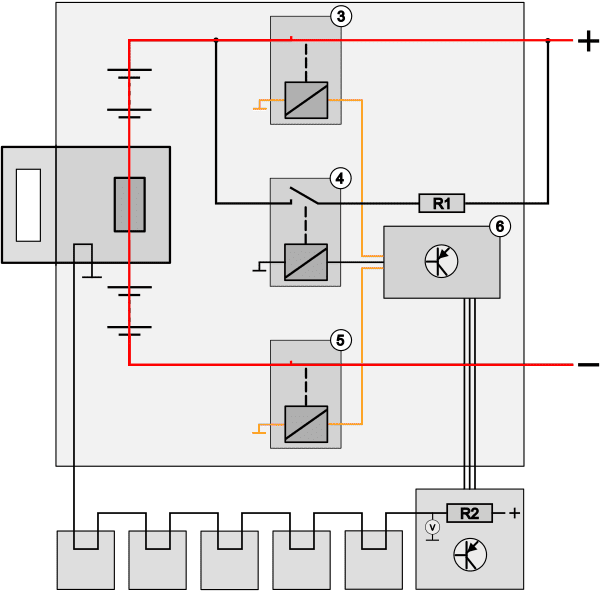
In the image at the bottom left we see the active system: relays 3 and 5 are closed, which means the voltage from the HV battery is passed on to the consumers. The interlock circuit is shown in blue from the vehicle ECU (7). A voltage is applied to resistor R2 from the ECU. The interlock is routed as a series circuit through the electrical consumers (8). In the battery pack the interlock is connected to ground. Between resistor R2 in the ECU (7) and the output to the consumers there is a branch where the voltage on the interlock is measured.
- Interlock OK: voltage after resistor R2 is 0 volts;
- Interlock interrupted: the voltage is not dissipated in resistor R2 and amounts to (depending on the supply voltage) 5, 12 or 24 volts.
The voltage after resistor R2 is continuously monitored during activation as well as while driving.
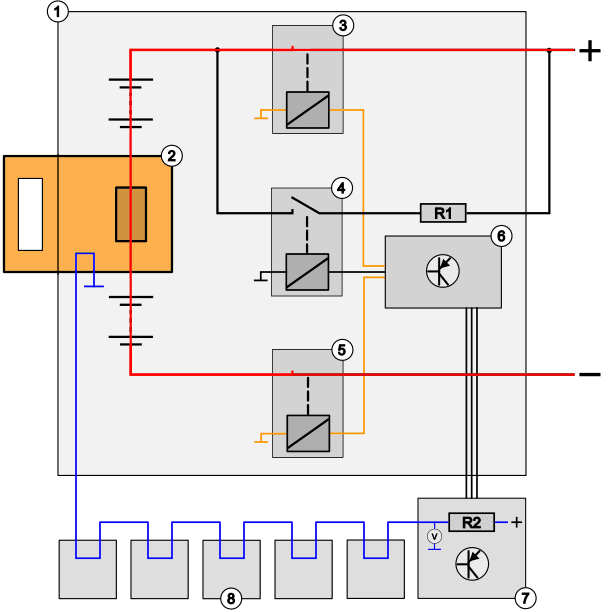
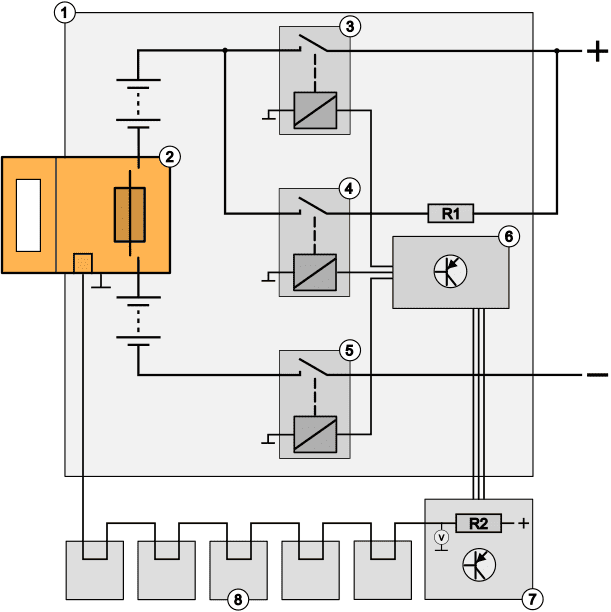
When the service plug (2) or one of the electrical components (8) is removed, the interlock circuit is also interrupted. This situation can be seen in the right-hand image above, where the service plug is shifted. Both the fuse between the battery modules and the interlock circuit are interrupted. Because the interlock is no longer connected to the vehicle ground, the voltage after resistor R2 rises to the value of the supply voltage. The vehicle ECU (7) immediately sends a signal to the battery ECU (6), causing relays 3, 4 and 5 to no longer be activated. The HV system is then switched off.
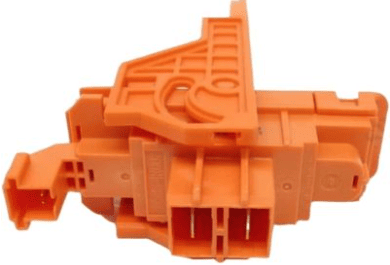
In the image we see the orange service plug with in the middle the large contacts to switch through the positive and negative leads of the HV battery, and on the left a smaller connector with two pins. These are the two pins of the interlock. We also find these connections on connectors of the HV components.
Short-circuit protection:
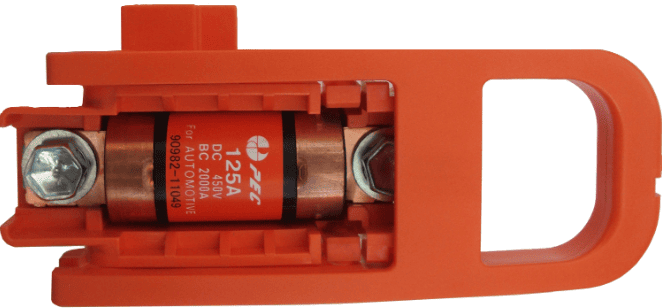
The HV system must be protected against excessively high currents that can occur due to short-circuiting in the wiring or in the electrical components. Without protection, this can lead to an electric arc, melting of cables, or even fire. A fusible link is designed to protect the system against these hazards. The fuse may be located in the service plug, but also elsewhere in the battery pack. Vehicles can also be equipped with multiple fuses, each designed to protect a specific circuit.
In addition to the fact that the fuse protects the system against excessively high currents, the current sensor in the positive or negative lead of the HV battery sends the current value to the ECU. The ECU decides to switch off the relays when there is an overload.
Permanent insulation monitoring:
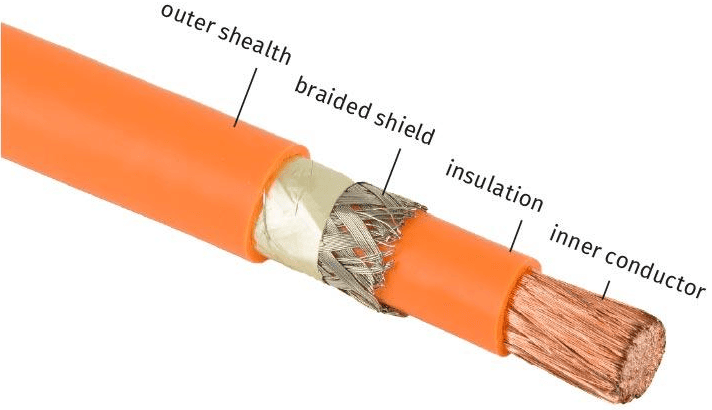
The positive and negative sides of the HV battery do not come into contact with each other, nor with the surroundings. Around the positive side (from the + battery to the + of the inverter) there are several layers of insulation with a braided shield in between. But the negative side is also insulated and does not make contact with the bodywork or the housings of the components. The vehicle body itself, on the other hand, is connected to the negative terminal of the on-board battery (12 volts in passenger cars). In the HV section this is not the case. Possible causes of a fault are:
- After a collision, damage may have occurred to the wiring, causing the copper of the positive and negative wires to come into contact with each other or with the bodywork of the vehicle;
- due to overloading – and the resulting overheating – the insulation in an electrical component has failed (melted), allowing contact with the surroundings;
- Or there is conductive liquid because the vehicle has been submerged in water, or due to coolant leakage in the HV battery pack a short circuit has occurred between positive and negative. Leakage of refrigerant in the electric A/C pump can also cause conductivity.
In the electrical components, poor insulation can create a connection between the positive or negative leads from the HV battery and the housing. Since the housing is usually mounted on the vehicle body, a current could arise in the event of poor insulation if the safety systems did not intervene. At the moment the positive terminal of the HV battery – as a result of an insulation fault – is connected to the vehicle body via the housing, high voltage of hundreds of volts is present on the bodywork. However, because no connection can be made with the negative terminal of the HV battery in any way, nothing will happen, as no current will flow. Things will only go wrong if there are multiple insulation faults, where both the positive and the negative terminals of the HV battery come into contact with the bodywork.
In the three images below we see the HV battery pack (1) with the positive and negative leads, with the vehicle bodywork (2) at the bottom and in between two electrical consumers (3 and 4).
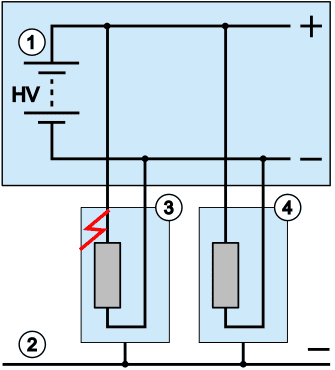
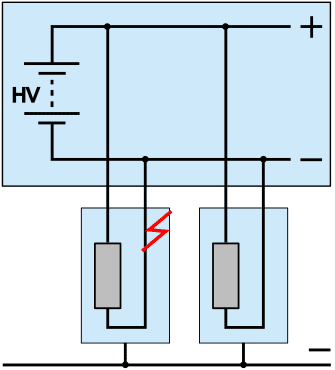
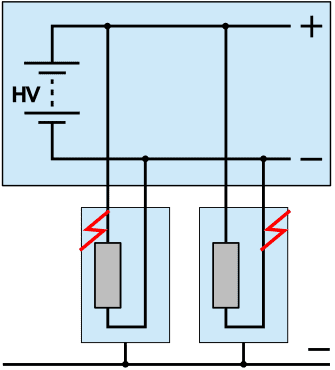
- poor insulation on the positive side of a component: when there is poor insulation between the positive and the housing in a consumer (for example the electric heater), the housing will become live. Because there is no connection to the negative of the HV battery, no current will flow;
- poor insulation negative: again, a (small) voltage will be present on the bodywork, but no current will flow;
- poor insulation in both the positive and negative: in this situation there is a short circuit between the positive and negative of the HV battery. The bodywork becomes the connection between positive and negative. The current will rise extremely quickly until the fuse in the service plug and/or the HV battery blows in order to protect the system.
Because with poor insulation in the positive or negative there is still no closed circuit, the fuse in the service plug will not blow. The permanent insulation monitoring in electric vehicles detects such current transfer, whereby the driver is warned by a fault message. With an insulation fault the vehicle can still operate, unless the manufacturer has it switched off via software.
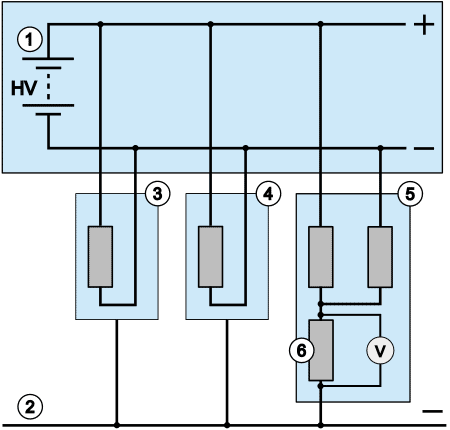
Number 5 in the image below indicates the component where the permanent insulation monitoring takes place. In reality this electrical part is of course more complex.
Number 6 indicates the measuring resistor across which the voltage drop is measured in parallel.
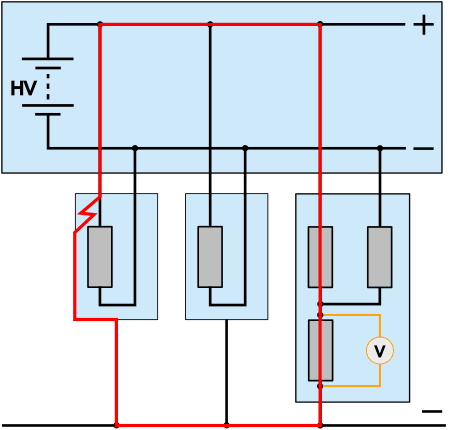
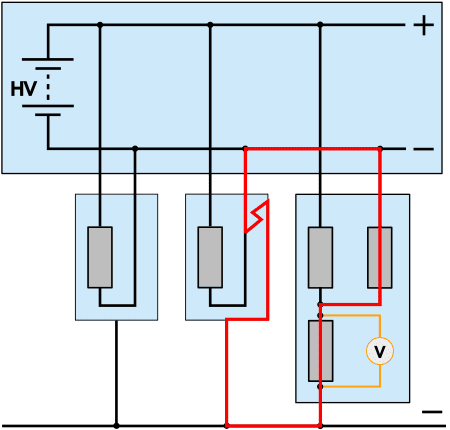
In the two images below, the situations are shown where there is poor insulation in the positive (left) and in the negative (right). Because current flows through the measuring resistor, voltage is used in the resistor circuit. The voltage drop across the measuring resistor is a measure of the amount of current flowing through the resistors.
As soon as the ECU with the permanent insulation monitoring detects a deviation, it stores a fault code. Possible descriptions with the P-codes (such as P1AF0 and P1AF4) can be: “battery voltage system isolation lost” or “battery voltage isolation circuit malfunction”. When a vehicle enters the workshop with an insulation fault, the technician can use the diagnostic equipment, or manually with a megohmmeter, to measure the insulation resistances to check whether there is an insulation leak somewhere.
Diagnosis with the megohmmeter:
In the previous paragraph the term “insulation resistance” was explained and it was shown how the vehicle, using permanent insulation monitoring, checks whether there is a leak from the positive or negative connections from the HV battery to the vehicle body. In this paragraph we will go into more detail and describe how, as a technician, you can use a megohmmeter to locate the fault. Naturally, as a technician you must be certified to work on HV systems. The software in a diagnostic tester can, with certain brands, perform an insulation test itself, for example for components that only show an insulation fault after being switched on, such as the electric heater or the electric air conditioning.
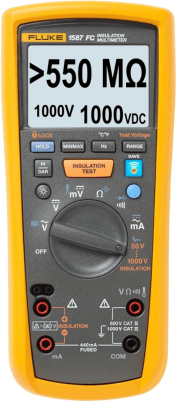
In other cases we can use a megohmmeter to measure the insulation resistance. With a normal multimeter it is not possible to measure the insulation resistance, because the internal resistance of the multimeter can rise to 10 million ohms. The internal resistance is too high to measure high resistance values. A megohmmeter is suitable for this and outputs a voltage from 50 up to as much as 1000 volts to simulate the operating situation. This high voltage ensures that the output current even finds its way through the smallest damage in the insulation, via the copper core, to the insulation. To measure with the megohmmeter, set the meter to the same voltage as that of the HV battery, or one step higher. After connecting the test leads and correctly setting the meter, we press the orange “insulation test” button. The set voltage (in the image: 1000 volts) is applied to the test leads and thus to the component, and then we read the ohmic value from the display.
- An insulation resistance greater than 550 MΩ (megaohm, which means 550 million ohms) is fine. This is the maximum measuring range;
- A value lower than 550 MΩ may indicate a leak in the insulation, but this does not necessarily have to be the case;
- According to the International Electrotechnical Commission (IEC) and the Institute of Electrical and Electronics Engineers (IEEE), the insulation resistance of an EV must be at least 500 Ω per volt. At a nominal HV voltage of 400 volts, the resistance must be (500 Ω * 400 V) = 200,000 Ω.
- Manufacturers often set higher quality and safety standards, which means that higher minimum insulation resistances are specified. For that reason, the factory specifications must always be followed when making a diagnosis.
The manufacturer’s specifications are always leading.
The factory specifications describe the steps, safety regulations and the minimum insulation resistances.
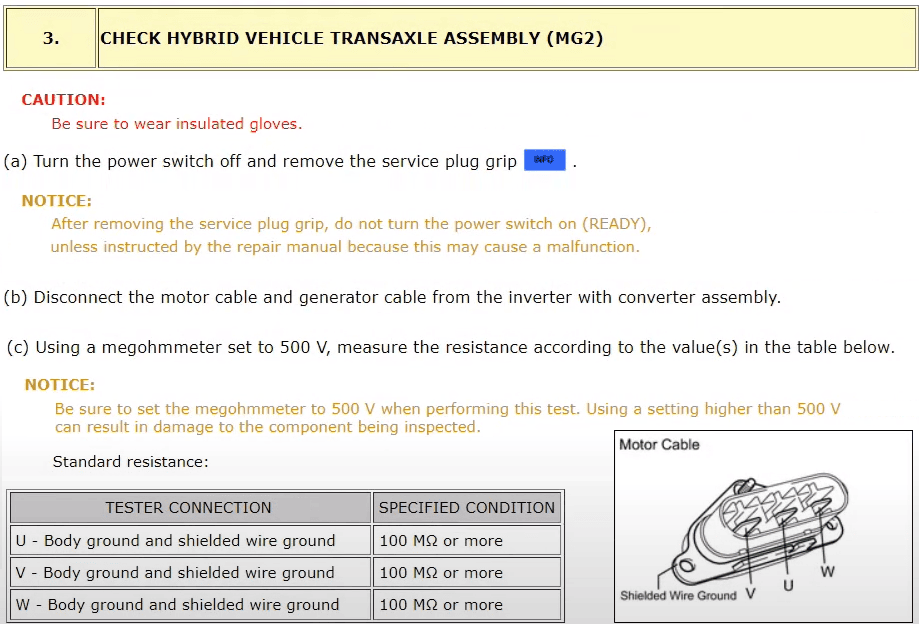
In the next image we see a screenshot from a Toyota manual. For the relevant model, the minimum insulation resistances of the cables to the electric motor are shown.
The megohmmeter must be set to a value of 500 volts and the minimum resistances of the wiring (U V and W) to the electric motor relative to the housing must be 100 MΩ (megaohm) or more.
The insulation resistances of, for example, the electric air conditioning compressor and heating element may be different. When taking measurements on other components, consult that part of the factory data.
1. Insulation measurement on the negative side (no fault):
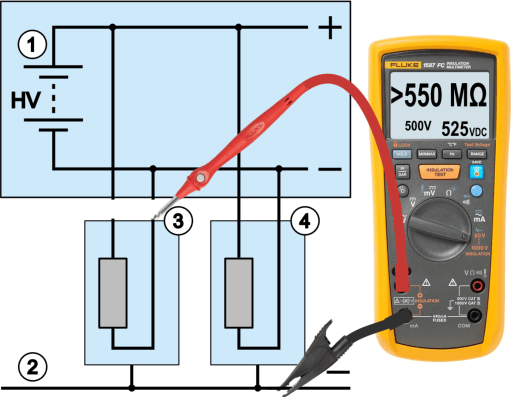
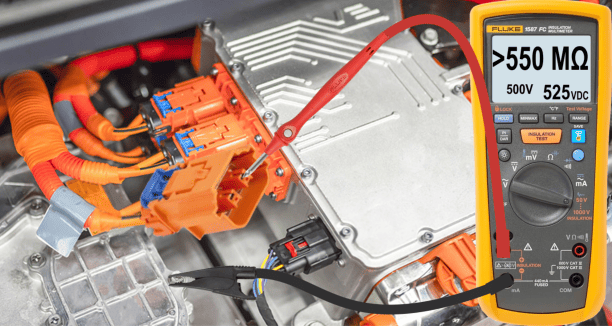
With the disconnected plug we also measure the negative side relative to the vehicle ground. Figures 1 and 2 show what this measurement looks like in schematic form and in reality. The measurement results in an insulation resistance of >550 MΩ, which indicates that the insulation is in good condition.
2. Insulation measurement on the positive side (no fault):
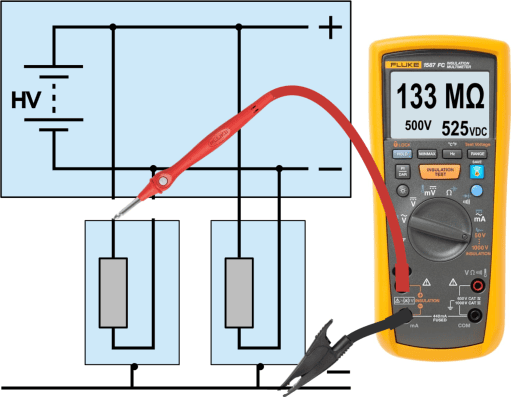
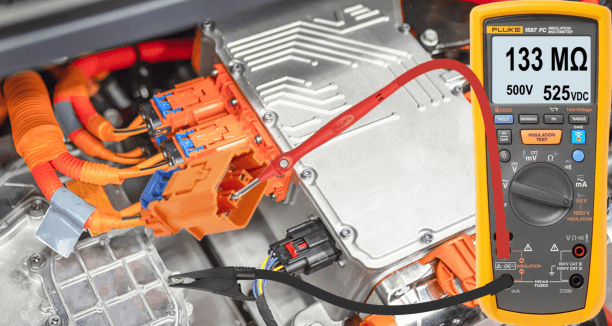
After disconnecting the plug, for example from the inverter, we attach the red probe to the pin in the removed plug (now on the positive side) and the black probe to a ground point connected to the vehicle body. In figure 1, the diagram from the previous paragraph is shown again, with the HV battery (1), vehicle ground (2), and two of the consumers (3 and 4) numbered in it. The megohmmeter is connected, and the orange “insulation test” button has been pressed in order to measure the insulation resistance with the output voltage of 500 volts. This amounts to 133 megaohms. The insulation resistance is lower than in the previous measurement. The manufacturer’s specifications must be consulted. We apply the minimum insulation resistance of 100 MΩ that the manufacturer has specified. The insulation resistance is fine.
3. Insulation measurement in the positive side (fault):
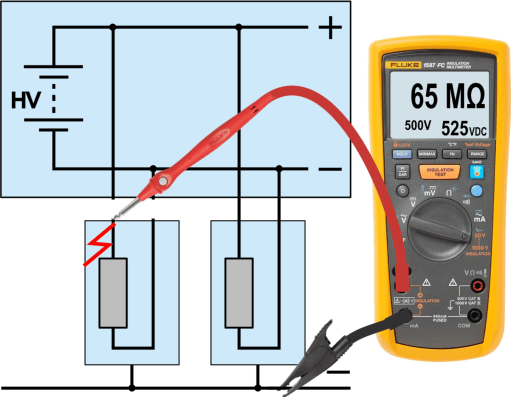
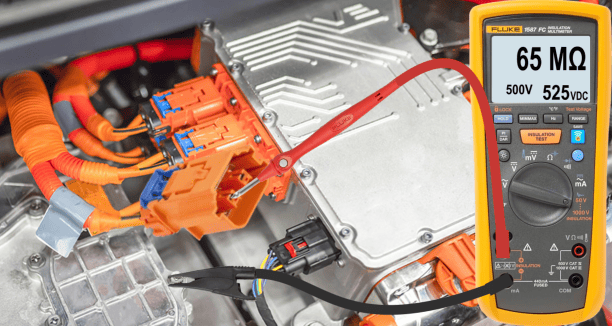
While measuring on the same connections, we measure an insulation resistance of 65 MΩ. Although this resistance value is higher than the minimum 500 ohms per volt required by the IEC and IEEE (see the previous paragraph), the wiring and/or the component is rejected because the manufacturer has specified a minimum resistance value of 100 MΩ. The wiring and/or connector connections may not be repaired and must be completely replaced.
4. Insulation measurement in the positive side (fault):
When an insulation value of 0 MΩ is measured, there is a direct connection (i.e. a short circuit) between the HV wire and the housing. The wiring and/or connector connections may not be repaired and must be completely replaced.
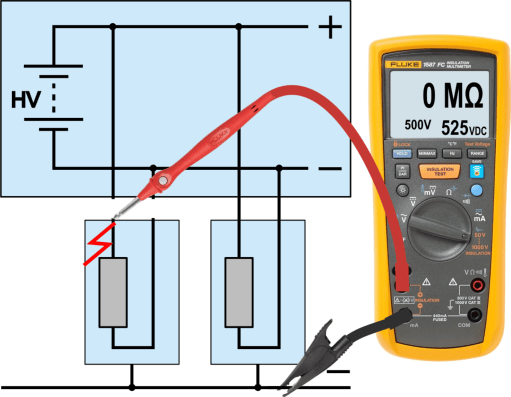
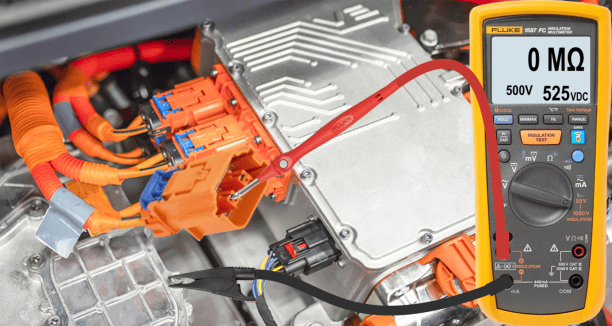
In the event of an insulation fault, the connectors of other consumers can be disconnected one by one in order to measure in the connector, in the manner shown in the text and images above.
Related page: