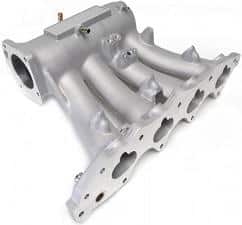
Intake manifold:
The intake manifold is mounted between the intake pipe from the air filter and the engine. The manifold runners are mounted directly to the intake section of the engine, right at the intake valves. In indirectly injected petrol engines, the fuel injector is also mounted in the intake manifold. This injector sprays the petrol fuel directly onto the intake valve.
An intake manifold is not just a bunch of pipes. Its shape and finish must offer as little resistance as possible to the incoming air. All cylinders must receive the same amount of air. So ideally, the intake runners should be equally long for all cylinders. The intake manifold is usually made of plastic, as this is cheaper and less susceptible to heating from high temperatures than, for example, metal. The air in the intake manifold needs to remain as cool as possible.
Air pulses in the intake manifold:
With an open intake valve, the air is drawn in at high speed. The airflow speed in the intake manifold is high. When the intake valve closes, the air that has not yet entered the cylinder collides with the intake valve and causes a pressure increase. This pressure increase creates a wave motion in the intake manifold, which moves against the direction of airflow in the manifold. When the intake valve opens at the moment the pressure wave returns, there is maximum cylinder filling; the pressure wave ensures that extra air enters the combustion chamber. However, this is almost never the case, because the engine speed varies and the intake valve therefore almost never opens at the optimal moment for the pressure wave. With a longer intake manifold it will take longer for the pressure wave to reach the intake valve again than with a short intake manifold. For this reason, it is useful to be able to adapt the length of the intake manifold to the engine’s operating conditions (see the section “variable-length intake manifold”) or by using a so‑called Helmholtz resonator.
Helmholtz resonator:
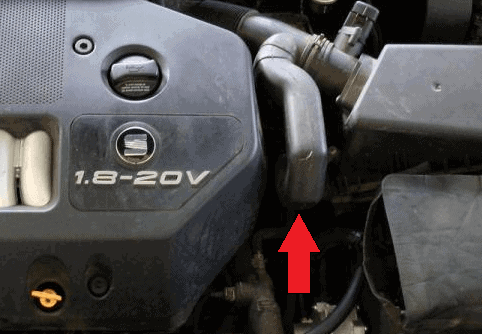
A Helmholtz resonator is a resonance chamber that receives pressure waves created by the closing of the intake valve. The resonator is nothing more than a closed air chamber connected to the intake hose between the mass air flow sensor and the throttle body. An example of a Helmholtz resonator is indicated with a red arrow in the image.
The pressure waves that enter the resonator are reflected back to the intake valve. These pressure waves assist the movement of the air into the engine, resulting in a higher volumetric efficiency. The resonator also muffles the intake noise, making the engine quieter. So the engine becomes more powerful and quieter.
Intake manifold with swirl flaps:
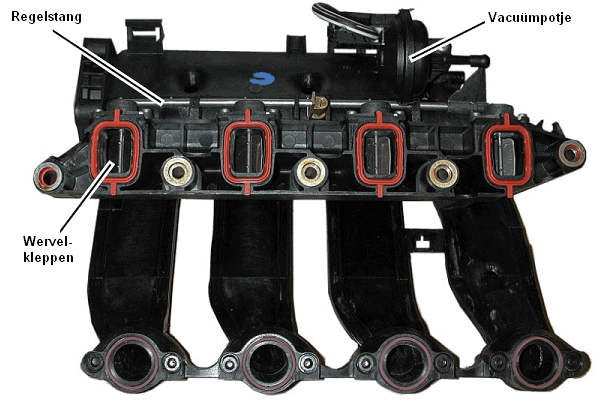
On diesel engines, intake manifolds with swirl flaps are sometimes used. These flaps create turbulence in the incoming air. At low engine speeds, the air velocity can be so low (because the turbo has not yet spooled up) that the air turbulence is insufficient to achieve good mixing with the diesel fuel. Injection pressure is independent of this. If the flaps did not operate, the mixture formation with the fuel, and therefore the final combustion, would not be optimal. As a result, the engine consumes more fuel, delivers less power and emits soot.
When the swirl flaps need to be activated, the vacuum actuator is controlled, which allows the control rod to move from left to right. When the control rod is shifted, the flaps can be set to the desired position.
Variable-length intake manifold:
When designing an engine, the length of the intake runners of the intake manifold must be taken into account. The length of the intake runners determines the pressure pulses that occur when the intake valve opens and closes (see the section on air pulses). If these intake runners are always long, the engine will have high torque at low rpm, but pulling power at high rpm will decrease. Conversely, if they are always too short, the engine will only have sufficient torque and power at higher rpm. By using a variable intake manifold, the length is adjusted according to the driving conditions. The two situations are as follows:
- Long intake pipe: By making the air travel a longer distance and reducing the pipe diameter, the air reaches a higher speed. This is very favourable at high rpm with low load, or at low rpm with high load (more torque).
- Short intake pipe: The air now travels a shorter distance and provides better cylinder filling at low rpm with low load and at high rpm with high load (more power).
DISA valve:
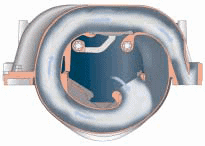
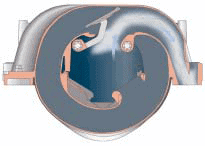
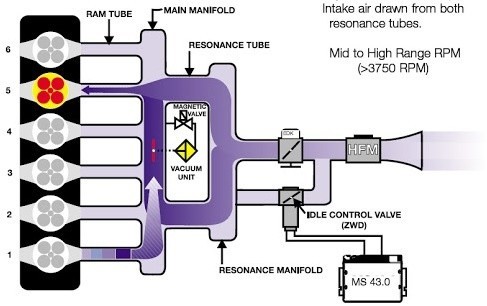
The DISA valve can be found in BMW intake manifolds. DISA stands for: DIfferenzierte SaugAnlage. The DISA valve ensures that the airflow can be blocked in different parts of the intake manifold at certain engine speeds. This splits the intake manifold into two sections. Below is an explanation with three images.
At low or medium engine speeds, the DISA valve is closed. From the throttle body, the air flows directly to cylinder 1. By routing the intake air to the intake valve through one section of the manifold, a higher air velocity is created. With this higher air velocity, the air starts to swirl, allowing better mixing with the injected fuel.
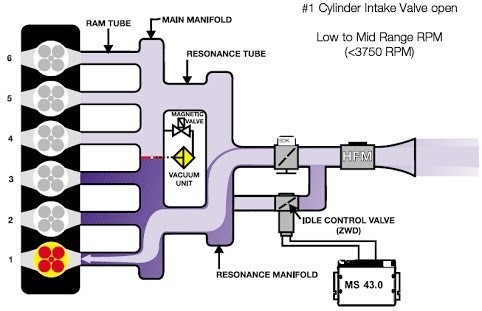
When the intake valves of cylinder 1 close, a pressure wave is created. Because the valve is closed, the pressure wave has to travel a long distance through the resonance tubes to reach the intake valves of cylinder 5. The pressure wave will now have no effect on the airflow of the intake air through cylinder 5.
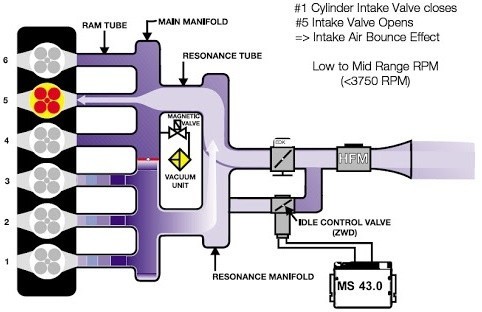
At higher engine speeds, the DISA valve opens. Since the intake length is now increased, higher power is achieved at higher rpm.
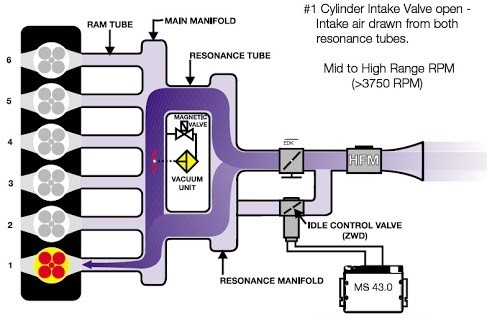
The intake air flows through both resonance chambers. The reflection of the air after the intake valve of cylinder 1 closes propels the air flowing towards cylinder 5; this increases the volumetric efficiency of cylinder 5.
Exhaust manifold:
The exhaust manifold is not just a bunch of pipes either. The faster the exhaust gases can flow out, the better. That is not only a matter of flow resistance. The opening and closing of the exhaust valves must also be taken into account.
Example: a four-cylinder engine has a firing order of 1-2-4-3. At the moment the exhaust valve of the second cylinder opens, the one of the first cylinder is still open. Because the exhaust stroke of cylinder 2 is just beginning, the gases flow out at a higher pressure than is the case with cylinder 1.
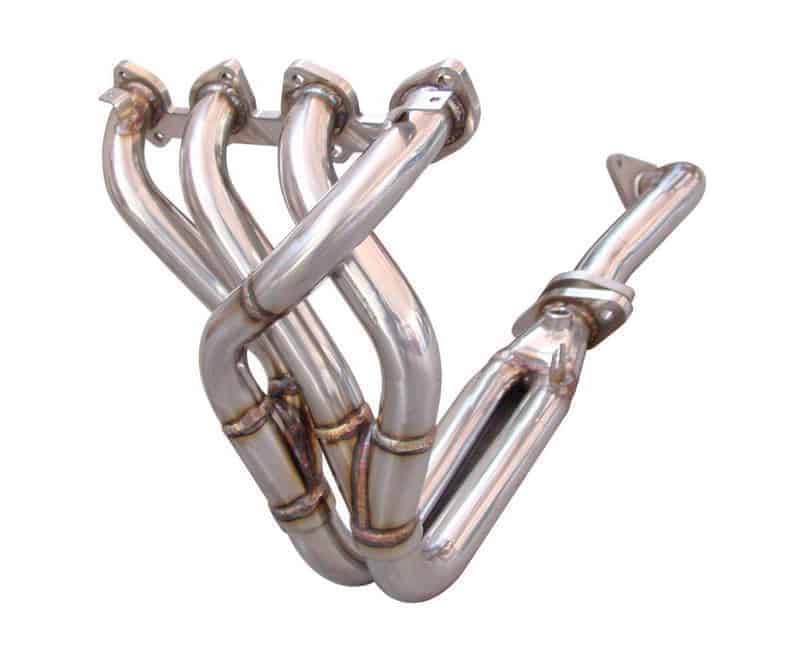
If the manifold does not have the correct shape and diameter, the exhaust gases will suffer from interference problems. The exhaust gases from cylinder 1 can impede those from cylinder 2. With a proper design, the opposite happens and the gases from cylinder 1 help to draw out the remaining exhaust gases from cylinder 2. This is especially the case with a so‑called spaghetti manifold (in the image below).
On some petrol engines and most diesel engines, an exhaust gas turbo is mounted on the manifold. This is mounted as close as possible after the bend in the manifold, in order to slow down the outgoing gases as little as possible.
The hellish noise of an engine without mufflers is caused by the exhaust gases, which flow out at high pressure and speed, making the air vibrate. An exhaust silencer serves to reduce this pressure and speed.