Length:
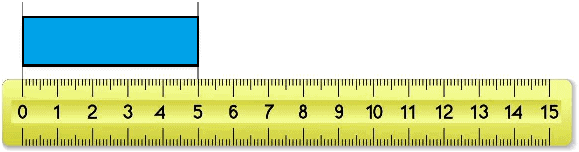
Length is a one-dimensional measure. We can measure the length of all kinds of objects. We express the size of this object in a unit of length. The unit of length is also called the length measure. With the ruler in the image below, a length of 5 cm is measured.
The length measure can be expressed in, among others, the following units:
- millimetre (mm)
- centimetre (cm)
- decimetre (dm)
- metre (m)
- decametre (dam)
- hectometre (hm)
- kilometre (km)
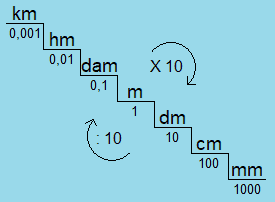
Between each unit of length the step is a factor of 10. From large to small we have to multiply by 10 and the other way around divide by 10.
In the image above you can see that 1 metre is equal to 0.001 km and 1000 mm.
From small to large, multiply by 10.
mm -> cm -> dm -> m -> dam -> hm -> km
From large to small, divide by 10.
km -> hm -> dam -> m -> dm -> cm -> mm
Area:
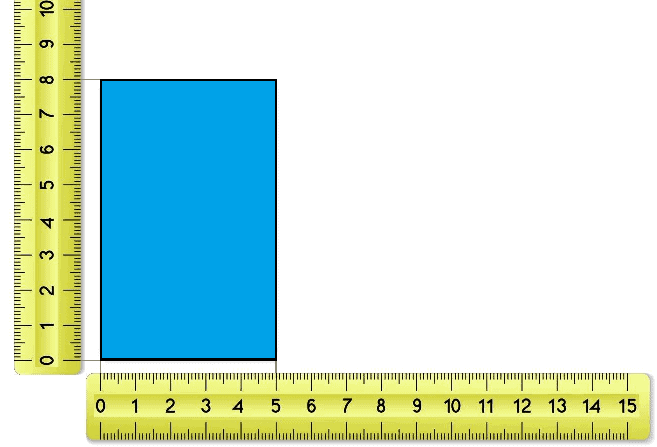
Area is a two-dimensional measure. We express the area of a certain region or object in a unit of area. The area is calculated by multiplying the length by the width.
An object with a length of 8 by 5 centimetres has an area of (8*5) = 40 cm².
- square millimetre (mm²)
- square centimetre (cm²)
- square decimetre (dm²)
- square metre (m²)
- square decametre (dam²)
- square hectometre (hm²)
- square kilometre (km²)
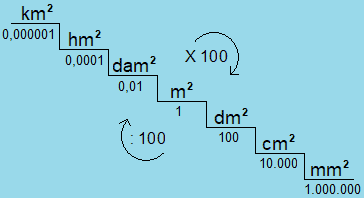
In automotive technology, for example, we deal with the frontal area of a passenger car, which is 1.9 m². This is equal to 19,000 cm².
From small to large, multiply by 100.
mm² -> cm² -> dm² -> m² -> dam² -> hm² -> km²
From large to small, divide by 100.
km² -> hm² -> dam² -> m² -> dm² -> cm²-> mm²
1 hm² = 1 ha.
A square hectometre (hm²) is also called a hectare (ha). One hectare is an area of 100 x 100 metres and is equal to 10,000 m².
1 dam² = 1 are.
A square decametre (dam²) is also called an are. One are is equal to an area of 100 m².
Volume:
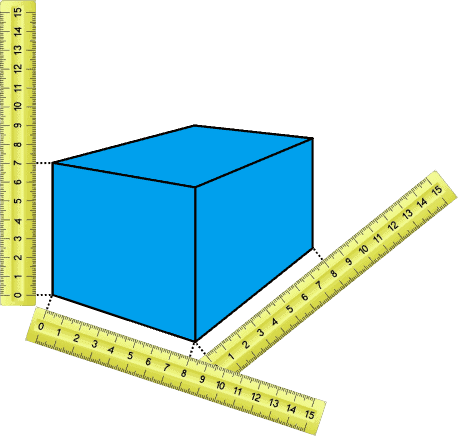
Volume is a three-dimensional measure. For volume we are dealing with the length, width and depth. Multiplying the length, width and depth gives the volume. A cube with a length of 7 cm, a width of 8 cm and a depth of 8 cm has a volume of: 7*8*8 (l*w*h) = 448 cm³.
- cubic millimetre (mm³)
- cubic centimetre (cm³)
- cubic decimetre (dm³)
- cubic metre (m³)
- cubic decametre (dam³)
- cubic hectometre (hm³)
- cubic kilometre (km³)
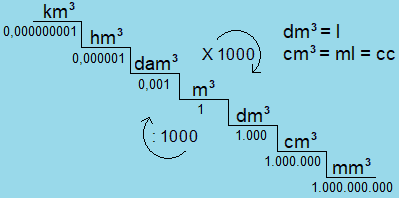
From small to large, multiply by 1000.
mm³ -> cm³ -> dm³ -> m³ -> dam³ -> hm³ -> km³
From large to small, divide by 1000.
km³ -> hm³ -> dam³ -> m³ -> dm³ -> cm³-> mm³
1 cm³ = ml = cc.
In automotive technology, for example, we deal with the cylinder capacity of an engine which is 1988 cm³. This is equal to 1988 ml and 1988 cc.
cm³ to dm³ = litre.
If we look at the table, the multiplication factor between cm³ and dm³ is 1000. If we convert cm³ to dm³, we get 1.988 dm³, which is equal to 1.988 litres.