Topics:
History:
Two years after the first car appeared on Dutch roads, the first license plates (which were still called driving permits at the time) were mounted on a number of cars in 1898. This made the Netherlands the first country in the world to introduce a national license plate.
The first series of license plates ran from 1 through 14, skipping the “crazy number” 11. Documents show that this very first series of numbers had reached 168 on 8 August 1899. Seven years later, on 15 January 1906, the last driving permit (number 2065) was finally issued. From then on, both the car and the driver had to have a driving licence as well as a number certificate. This number certificate, essentially the new license plate, was set up according to a provincial system. Each province received its own letter. This system remained in use until after the Second World War.
The first license numbers were also linked to a province, because in the beginning motorists mostly stayed within the province. But traffic increasingly crossed provincial borders and it was decided to organise the administration nationally, in a central place. This marked the origin of the RDW (then the Rijksdienst voor het Wegverkeer). It was not until 1951 that the license plate system as we know it today was introduced, with the combination of three times two letters or two digits.
Dutch license numbers are constructed in pairs from a combination of 2 letters and 4 digits or 4 letters and 2 digits. Before 1951, extensive research was carried out into which combination of letters and digits would work best. A great many visual options were tested against the criterion of legibility. The license plate as we know it now, divided into three groups of two characters, turned out to be the clearest and quickest to recognise. That is very important, because in some cases the owner of a vehicle must be easy to identify quickly.
Until 1951, issuing and registering vehicle documents was the responsibility of the Provincial Executive (Gedeputeerde Staten) of the provinces. The number certificates were personal and were issued “for life” (of the holder). Each province had one or two fixed letters, followed by a maximum of five digits. Below you can see which provinces had which letters:
A = Groningen
GZ = Noord Holland
B = Friesland
H = Zuid Holland
D = Drenthe
HZ = Zuid Holland
E = Overijssel
K = Zeeland
M = Gelderland
N = Noord Brabant
L = Utrecht
P = Limburg
G = Noord Holland
R = Departments
With the new series, they started placing the two letters before the four digits. The first license plate issued was ND-00-01.
In 1965 the two letters moved to behind the digits. The first license plate then was 00-01-AD. In 1973 the first license plate with the letters between the digits was issued. That was 00-AD-01. In these three series, the letter combinations SA and SS were not used, because they reminded too much of the Second World War. When these three series were used up, license plates with four letters and two digits were introduced. The first plate (DB-01-BB) was issued in October 1978.
After this series was exhausted, it was time for yet another combination: the letters before the digits. DB-BB-01 was the first number and was issued in September 1991.
From June 1999 the digits appeared before the letters. The first number was 01-DB-BB.
In the current series of four letters and two digits, no vowels are used. This was done to prevent unwanted word formation. The letters C and Q are also not used, because they look too much like a zero.
Types of license plates:
License plate for passenger cars, commercial vehicles and trailers
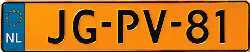
The license plate for vehicles features the EU symbol with the NL mark incorporated in the foil. The size is 52 by 11 centimetres. No more than two license plates may be issued per vehicle (one for trailers). The license plates must be fully visible. Couplings (tow bars) or other objects may therefore not obstruct a clear view of the plate. This license plate is for trailers with a maximum permitted mass of more than 750 kg.
White license plate for trailers, caravans and bicycle carriers
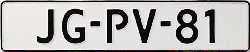
The white license plate is for towed equipment such as trailers and caravans whose unladen weight plus maximum payload is less than 751 kg, and for bicycle carriers. The plate has no EU symbol and no NL mark. This license plate can be supplied without limitation. Objects that obstruct the view of a license plate must also have a white license plate.
Motorcycle license plate
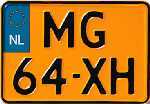
The motorcycle license plate features the EU symbol with the NL mark incorporated in the foil. The license plate measures 21 x 14.3 cm. One new license plate is issued per motorcycle.
Moped license plate
Since 1 September 2005, mopeds and light mopeds have had their own license plate. The license plate comes in a horizontal version measuring 14.5 x 12.5 cm and a vertical version measuring 10 x 17.5 cm.
The license plate for mopeds has a yellow background with black characters, that for light mopeds has a light blue background with white characters. The license plate has no EU logo, but does have a hologram. One license plate is issued per moped.
The moped license plate is used for all vehicles that fall under the definition of moped, including moped scooters, microcars, bicycles with auxiliary motors and electric scooters.
For mopeds there are, just as for passenger cars, a number of special license plates. These have the same dimensions as the other moped license plates, but are a different colour:
- Dealer license plate (green background with black characters), for example for
mopeds in dealer stock for which a test drive is required. - License plate for trailers (white background with black characters)
for trailers behind mopeds - Temporary license plate (white background with black characters)
- Seven-day license plate (white background with black characters)
- One-day license plate (white background with black characters)
- Export license plate (white background with black characters)
The export license plate and one-day license plate do not have to be issued by the approved license plate manufacturer, but may also be made in-house.
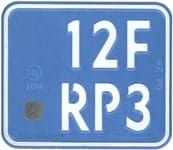
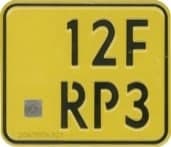
Temporary license plate
Only available after loss or theft of the license plates. This license plate is produced without the EU emblem and the NL mark and has a limited validity period. On the left of the license plate there is a month number. The license plate is valid up to and including that month. In case of loss or theft of one of the two license plates, the vehicle must be fitted with a temporary license plate at the front and rear.
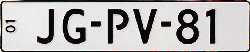
Export license plate
Vehicles that are exported abroad must display white export license plates with black characters if they leave the country driving on the road. The export license plate is issued on condition that the vehicle still has a valid APK inspection.
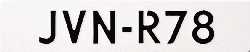
Dealer license plate
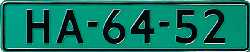
Only available for approved companies in the car or motorcycle trade. The new license plate for approved companies in the car or motorcycle trade is light green with black letters and digits. These plates are used, among other things, to allow customers to make test drives and are only available for approved companies in the car or motorcycle trade.
Taxi license plate
Since 1 December 2000, all vehicles used for taxi services are required to have blue taxi license plates. The reason for this was to combat illegal taxi services and to create clarity for taxi users. If the vehicle is not equipped with these plates, it may not be used to provide taxi services.

Dark blue license plate
The dark blue license plate is intended for historic vehicles with a “date of first admission” before 1 January 1978 and whose license plate number consists of 2 groups of 2 digits and 1 group of 2 letters.

Special license plates
There are special license plates for certain groups of people. These include the Royal House with AA or diplomats and embassies with CD. These are yellow and have a black border and a blue field with the EU symbol and the NL mark.
American license plate
The small American 18:2 license plate is intended exclusively for vehicles whose registration certificate contains a note that this license plate is permitted. A condition for using the small plate is that this is stated on the registration certificate.
Source: rdw.nl