Introduction:
The moving parts in the engine must be constantly lubricated while it is running. If the lubrication is insufficient, for example due to a defect in the oil pump, severe internal contamination, or an oil level that is far too low, friction occurs. Friction means that components make direct contact with each other and there is no oil film present between them. The result is additional noise and wear, causing the engine to fail within a very short time. The lubrication system therefore has one of the most important tasks in the entire engine. The lubricating effect is obtained with engine oil.
Design and operation of the lubrication system:
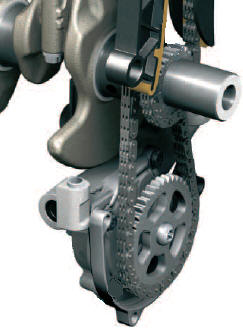
The oil pump supplies engine oil to the components in the engine block. The oil pump is mounted at the bottom of the engine block and, if the engine is not equipped with a dry-sump system, it often hangs partly or completely in the oil pan. The oil pump is driven by a chain or gears that are directly connected to the crankshaft. The illustration shows how the oil pump (via the lower gear) is driven by the crankshaft.
When the crankshaft rotates, the gear of the oil pump is driven by the chain. The pump will start to rotate internally and suck the oil out of the oil pan. Before the oil reaches the oil pump, it first flows through a strainer. This strainer retains the coarse dirt particles. This strainer is also directly visible when the oil pan has been removed.
The pump forces the oil through the oil filter. From the oil filter, the oil is distributed through various oil channels. A number of oil channels go to the crankshaft, so that the connecting rod bearings are lubricated. The oil is also fed through the connecting rod to the piston. The oil hits the underside of the piston. This ensures that the piston can dissipate its heat. The warm oil then falls back down into the oil pan. This can be seen in the image below.
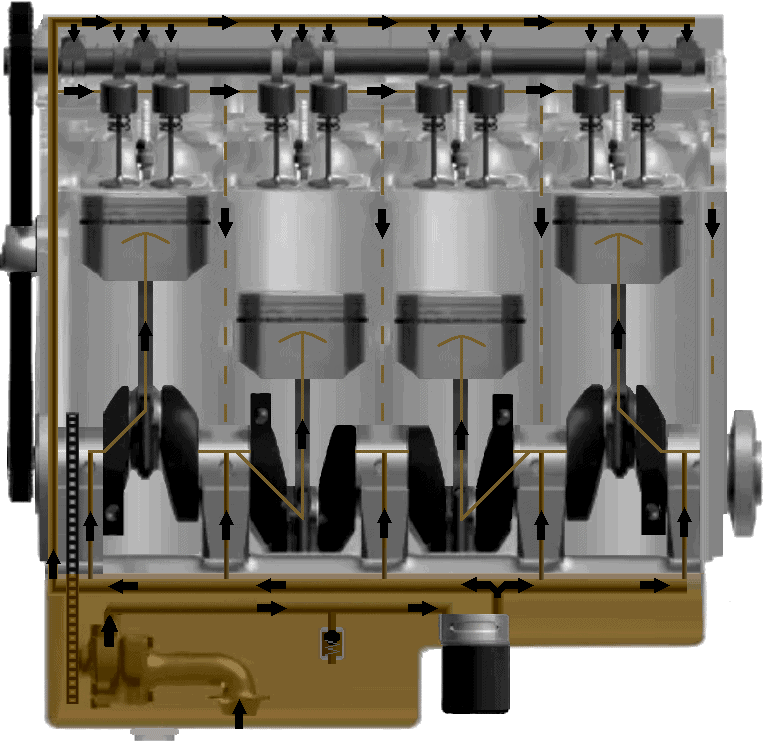
There are also one or more oil channels running to the cylinder head. There the oil is evenly distributed over, among other things, the camshafts. Because there are small holes in the line, enough oil reaches all parts of the camshaft to be lubricated.
From the cylinder head, multiple return channels run back to the oil pan. The oil also flows through these channels when it is topped up by a person. Via these return channels, the oil slowly sinks back down into the oil pan.
Besides the oil channels, various coolant channels are also visible when the cylinder head is removed. The oil and coolant channels run very close to each other.
Cooling:
In the image above, it can be seen that the piston is cooled by the oil that is supplied through the connecting rod. At the top of the connecting rod there are holes to lubricate the piston pin in the “small end”, in other words the “upper connecting rod eye”. From this point, oil is also sprayed onto the underside of the piston.
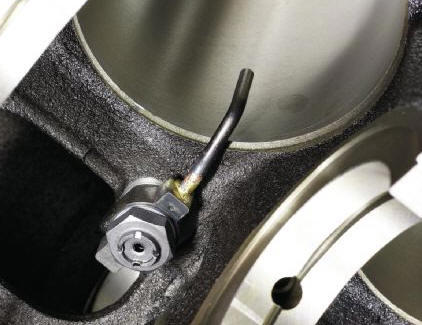
There are also other ways to cool the piston, namely by a hole in the big end of the connecting rod or by a separate oil spray nozzle. This spray nozzle is shown in the illustration. Through this hole in the connecting rod or the oil spray nozzle, a jet of oil is sprayed against the underside of the piston.
Dry-sump system:
A dry-sump system is part of the lubrication system in which the engine is not equipped with an oil pan. On motorcycles, race cars and rally cars, the engine block is mounted as low as possible above the road surface to achieve an optimal center of gravity. It will also have a positive effect on the aerodynamics of the vehicle, because the engine no longer gets in the way when shaping the bodywork. Due to its size, the oil pan limits the possibilities. Other advantages are that the oil can no longer slosh around in the oil pan as a result of occurring g-forces and that there are better cooling possibilities for the oil.
A separate oil reservoir is used to collect the oil. To pump the oil that has flowed down from the engine to the reservoir, and from the reservoir back to the engine, two oil pumps are used.
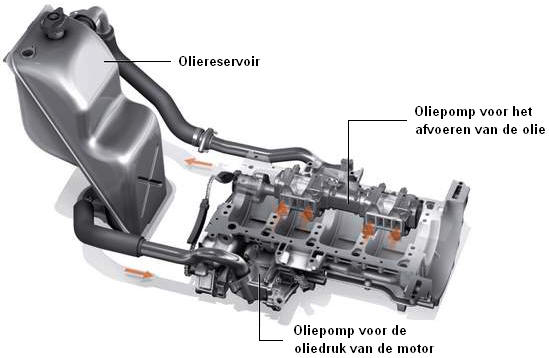
The oil pump that is responsible for transferring the oil from the engine to the reservoir must have a greater capacity, because a lot of air is often drawn in from the engine as well.
The dry-sump system also has disadvantages. It is quite expensive due to the structural modifications to the engine block and because of the system components. The biggest disadvantage is that there is a greater chance of air being present in the engine oil. When the circulated oil contains air bubbles, this causes bearing damage to, among others, the crankshaft and connecting rod bearings.