Measuring radial crankshaft play:
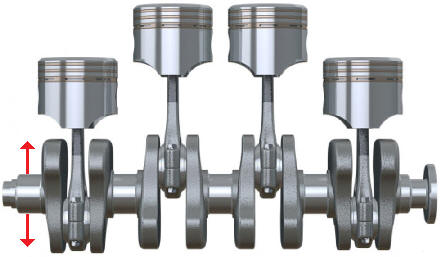
Radial clearance is the play of the crankshaft between the main bearings. There must always be a small amount of clearance, because an oil film needs to be formed. The oil film fills the space between the two moving parts. The image below shows the direction of the radial play.
Of course, the radial play must not be too small or too large. If the clearance is too small, friction can occur between the crankshaft and the plain bearings. If the clearance is too large, there is too much space between the crankshaft and the plain bearings. The consequences of incorrect clearance can include accelerated wear of the plain bearings. This will cause abnormal noises in the engine.
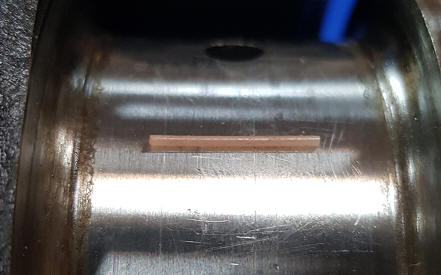
The clearance on the plain bearings of the crankshaft and connecting rods can be measured with Plastigage. Plastigage is a special plastic thread.
A small piece of Plastigage must be placed on a clean surface. This can be a crankshaft bearing. Then the bearing cap must be installed with the correct tightening torque. The Plastigage that is now located between the crankshaft bearing and the bearing cap will deform.
After the bolts of the bearing cap have been tightened, they can be removed again. The imprint of the flattened Plastigage will now be visible on the bearing and the bearing cap (see images below).
Because the radial crankshaft play is different for every engine, Plastigage is available in three different sizes:
- Green: for bearing clearance from 0.025 to 0.076 mm.
- Red: 0.050 – 0.150 mm.
- Blue: 0.102 – 0.229 mm.
- Yellow: 0.23 – 0.51 mm.
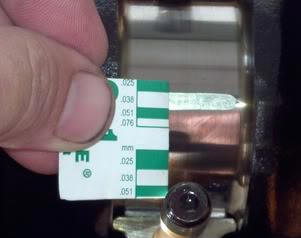
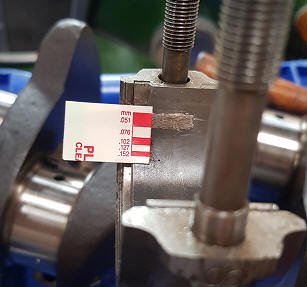
The width of the flattened Plastigage indicates the clearance that is present between the crankshaft and the bearing cap. The thicker the line, the more the bearing cap has been pushed against the crankshaft, and thus the smaller the clearance is. When the Plastigage is hardly deformed, the clearance will be very large.
On the packaging of the Plastigage, a reference width is shown with a dimension in millimetres or inches. By holding the card next to the flattened Plastigage, it can be determined how many millimetres the clearance is.
In the image above with the green card, the clearance is 0.038 mm. This clearance must be compared with the factory data. These often specify tolerances. For the engine in this measurement they amount to 0.030 – 0.050 mm. The measured value falls within the tolerances, so the clearance is OK. The same applies to the measurement with the red card, where the clearance is 0.51 mm. If the clearance were too large, thicker plain bearings could be chosen.
Measuring axial crankshaft play:
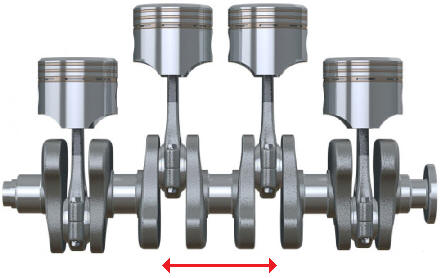
Axial crankshaft play is the clearance that is present in the longitudinal direction of the crankshaft. When operating the clutch, force is exerted in the longitudinal direction of the crankshaft. This is the axial direction. To absorb these axial forces, thrust bearings are mounted on the crankshaft. In the image, the axial direction is indicated with arrows.
Measuring the axial crankshaft play can be done with a dial gauge. See the page Mechanical measuring tools for more basic information about the dial gauge.
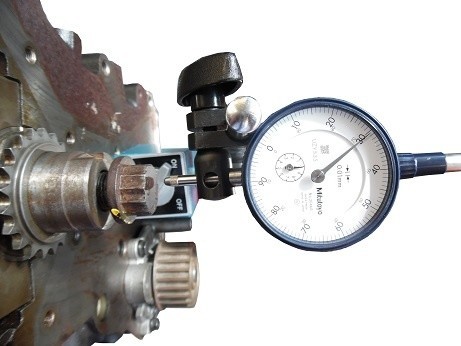
Step 1.
Mount the dial gauge on a fixed point on the engine block. In the image, the dial gauge is attached to the engine block. The plunger has not yet touched the crankshaft bolt.
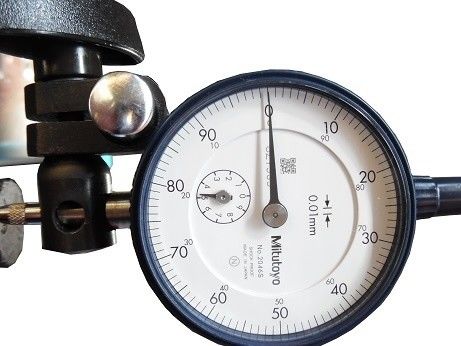
Step 2.
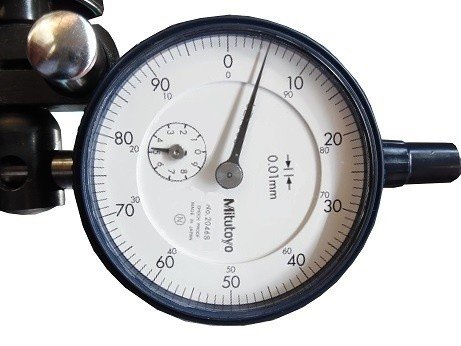
Set the dial gauge with a preload greater than 2 millimetres. That means that the measuring plunger of the dial gauge is depressed by at least 2 mm while the crankshaft is not yet being moved. If no preload is set, there is a chance that during movement of the crankshaft the plunger will no longer touch the bolt. In the image, the preload is set to 5 mm (the small pointer indicates the whole millimetres).
Push the crankshaft (in the longitudinal direction) as far as possible to one side. Then turn the outer ring so that the zero on the dial is aligned with the pointer.
Step 3.
In the previous step, the pointer was exactly at 0 with a preload of 5 mm while the crankshaft was moved to one side. With every movement that is now made, the needle will indicate more or fewer millimetres. The crankshaft must now be pushed in the axial direction to the other side. The pointer will then indicate a different value from 0.
In the image, a clearance of 0.05 mm is indicated.
Consult the factory data of the relevant engine to compare the measured value.