Measuring flatness of cylinder head and engine block:
After removing a cylinder head, its flatness must be checked. There is a chance that the cylinder head has warped after the engine has overheated. If the warped cylinder head is refitted, complaints may arise concerning leakage of the head gasket. In addition to the cylinder head, the rotating part of the engine must also be checked in the same way. If we find an excessive deviation, in most cases machining operations are possible to allow the cylinder head to be refitted without problems. The requirements for measuring flatness are:
- clean measuring surface of both the cylinder head and the engine block;
- straightedge;
- feeler gauges.
The following image shows a measurement on the surface between cylinders 2 and 3.
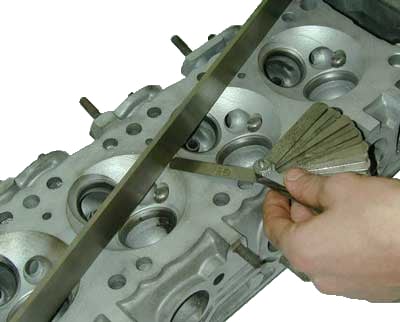
To determine the flatness, we need to perform a total of six measurements on the engine block and on the cylinder head. The two images below show the positions in which the straightedge must be held. Once we have placed the straightedge in position, we must insert the feeler gauge at approximately half the length between the engine / head and the straightedge.
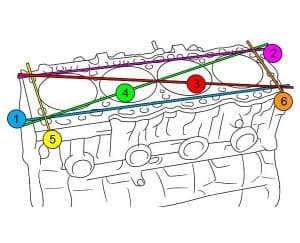
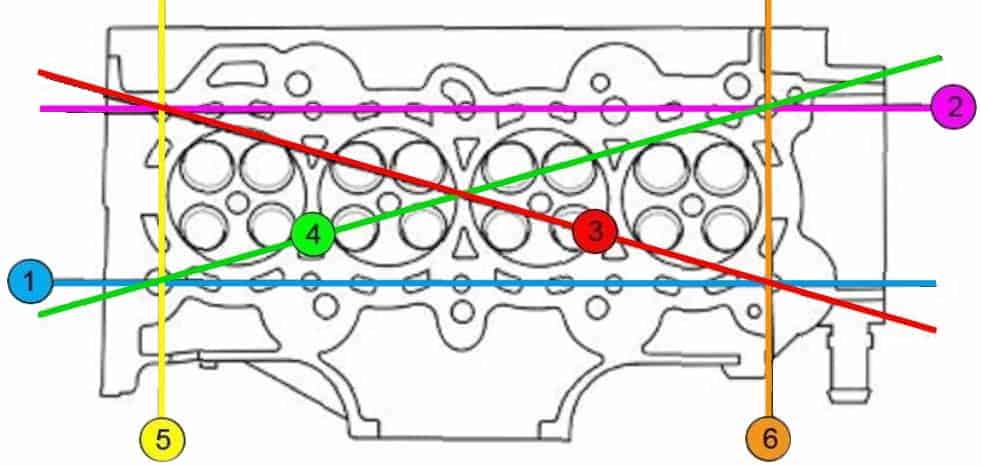
The maximum permissible gap between the engine / head and the straightedge may be 0.05 mm at most (unless the manufacturer specifies a different value). If a 0.1 mm feeler gauge can be slid between the engine or head and the straightedge, we can assume that we are dealing with deformation (a warped object).
If the deviation is very small, but just outside the tolerances, the cylinder head can be resurfaced by an engine reconditioning company. During this process, the machine removes material from the head until it is straight. In the case of large deviations and therefore coarse machining, this results in a smaller combustion chamber volume. A thicker head gasket compensates for this difference.
Related pages: