Topic:
Serpentine belt:
The serpentine belt is often confused with the timing belt. This belt is, of course, quite different. The serpentine belt is always located completely at the front or on the side of the engine block. This belt provides the drive for the alternator and, in modern cars, also for the power steering pump and air conditioning compressor. The crankshaft provides the driving force. The belt drives the other components, such as the alternator. There are several ribs (often 6 or 8) on the belt and on the pulleys (these are the wheels on the components, such as the crankshaft pulley, A/C compressor pulley, etc.) so that the belt cannot slip off these pulleys.
In the past this was still called the V-belt. Back then, cars did not have as many luxury features and in most cases the V-belt only had to drive an alternator. Now that so many other components have been added, the belt has a tougher job. That is why this (multi V-belt) has been made a lot wider and has more contact surface for a longer service life.
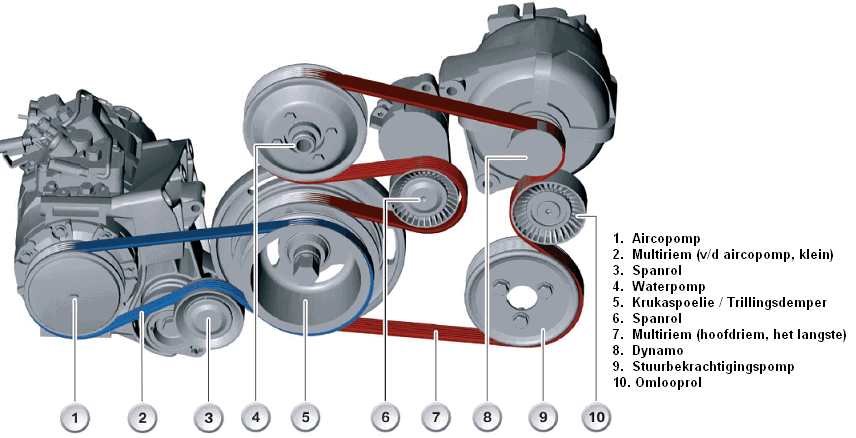
When the small belt is removed, tensioner pulley (3) must be moved against the spring force. When a Torx socket is inserted into the star-shaped recess at the bottom of the tensioner and pushed down, tensioner pulley 3 will move downwards against the spring force. As a result, the (now blue) belt gets enough room to be removed from the pulleys. By then routing a new belt around them and slowly allowing tensioner pulley 3 to spring back, it is immediately refitted at the correct tension.
In this case, 2 separate belts are installed. Sometimes the engine is fitted with one serpetine belt and one V-belt behind each other, or one multi belt that drives all components.
The idler pulleys have the function of guiding the belt over them. By using the idler pulleys, it is prevented that the belt starts flapping and therefore slipping. If you look at idler pulley 10 in the illustration above, the belt runs around it in a small bend. If the pulley were not there and the belt would run directly from the alternator to the power steering pump, it could start flapping and slipping.