Introduction:
Shock absorbers increase driving comfort and improve road handling. Their purpose is to absorb the shocks from driving over uneven surfaces.
Simple example of how they work: If a thin leaf spring is clamped at one end in a vise, the spring is bent and then released again, the spring will start to oscillate. So it repeatedly deforms at its own frequency. This is the same with a car coil spring.
When you drive a wheel over an obstacle in the road, the spring deforms and starts to vibrate. This vibration can be amplified at the next obstacle so that it continues to bounce. Since the wheel follows the movements of the spring, it will constantly jump up and down. The task of the shock absorbers is to dampen the spring vibrations as quickly as possible. They convert kinetic energy into heat.
A shock absorber has no influence on the height of the car. A worn shock absorber will cause poor driving performance, but this will not be visible when a car is standing still in the parking lot.
Inward / Outward stroke:
Inward stroke:
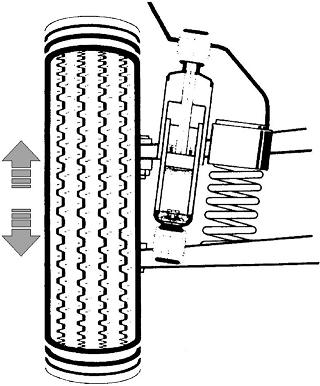
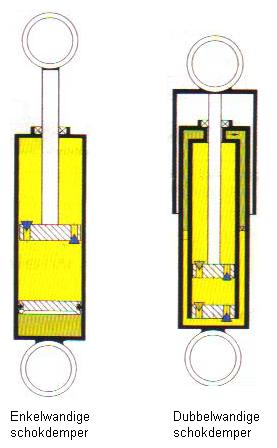
During the inward stroke of the shock absorber, the piston moves downward relative to the cylinder. The oil beneath the piston then flows through the orifices to the space above the piston. The pressure on the oil is the same above and below the piston. To compensate for the volume taken up by the piston rod, the oil under the piston flows through the base valve into the reservoir tube. The inward stroke should go smoothly; it must be prevented that the car is “lifted” at a bump in the road surface because the inward stroke would be too stiff. The damping is obtained during the outward stroke.
Outward stroke:
During the outward stroke, the piston moves upward relative to the cylinder. A certain pressure is exerted on the oil above the piston, causing this oil to flow through orifices into the space beneath the piston. The resistance the oil encounters here provides the force during the outward movement of the shock absorber. Through the base valve, oil flows from the reservoir tube into the space beneath the piston to compensate for the volume taken up by the piston rod. The force required during the outward stroke is greater than during the inward stroke.
With a detached shock absorber you will notice that it can be compressed easily, but is difficult to pull out again. If both the inward and outward movements were to go smoothly, that would mean the damper is worn out.
Consequences of bad shock absorbers:
- The braking distance becomes longer. When the wheel rebounds, contact with the road is broken, resulting in an interrupted skid mark.
- In a bend it is the friction between tire and road surface that keeps the car on the road. With bad shock absorbers a car will therefore start to skid much sooner in a corner. Even on a straight road, road holding is poorer.
- The steering is less precise.
- The carcass of the tire is excessively stressed, which can even result in a blowout.
- Worn shock absorbers also cause a characteristic tire wear pattern, where the tires have large worn patches in random spots and sufficient tread depth in others.
Checking shock absorbers:
Bounce test:
The general operation of shock absorbers can be checked as follows:
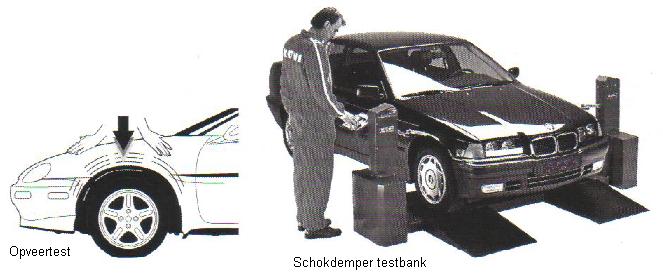
- Grab a solid part of the fender or similar (that will not dent when force is applied). Move it up and down in a smooth motion so that the car bounces firmly.
- Release the car after bouncing it up and down a few times.
- The car may bounce at most twice; down-up and once more down-up.
- If the car continues to bounce several times until the bodywork comes to a stop, the shock absorber is worn.
- If the car can be bounced so far in and out that the wheel comes off the ground, then the shock absorber provides no damping at all. What happens now is that the spring can compress and extend to the maximum without the rebound movement being damped. The maximum spring travel is reached in a short period of time, causing the bodywork to move up and down more and more. In that case, the wheel can come off the ground during the rebound movement. The latter is very dangerous. This can also happen while driving. The risk of an accident increases enormously when driving on poor road surfaces.
Shock absorber test bench:
The manual bounce test is not entirely reliable. A better way to test shock absorbers is by using a shock absorber test bench. From a certain height the driving plates are released, causing the plates to drop down a short distance (about 20 cm). Based on the results of the car’s oscillation, the computer can calculate per wheel to what extent the shock absorber is worn.