Blown fuse:
When a fuse blows immediately after being fitted in the fuse holder, there may be two possible causes:
- The fuse has too low a rating. If a 5 amp fuse is installed while the consumer needs 10 amps to operate, the fuse will blow as soon as the consumer is switched on. In this case there is no short circuit; a fuse with a higher rating must be installed.
- There is a short circuit. The fuse blows to protect the system.
This page describes how to locate a short circuit.
Short circuit in a lighting system:
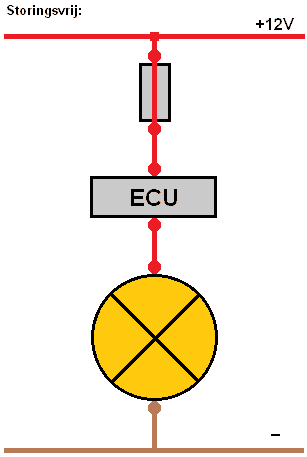
In a fault-free lighting installation, the lamp lights up as soon as the ECU (the electronic switch) switches the voltage through. There is then a closed circuit, so current can flow. In the illustration below (No fault), the positive is shown in red and the ground in brown.
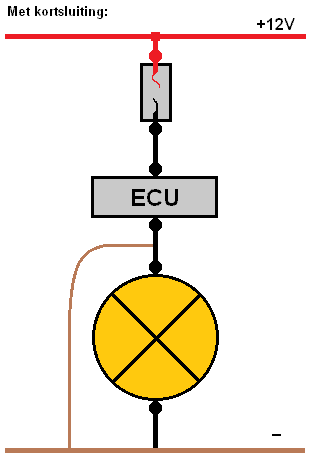
In the illustration (titled Short circuit), the positive connection of the lamp is connected directly to ground. This extra wire is shown in brown in the illustration. In reality, the wires are lying against each other, so damage to the insulation of two cables can cause them to make contact.
There must always be a consumer between the positive and negative terminals of the battery. With this brown wire in the illustration below, that is not the case. As soon as the positive terminal of the battery is connected to ground, the fuse will blow.
It can be very difficult to find a short circuit. The short circuit may be located in a wiring harness, but also in the ECU or in a consumer. As soon as a new fuse is fitted, it will blow immediately. If a short circuit is suspected, it can be traced by connecting a test light into the circuit.
Any 12-volt bulb used in the vehicle’s lighting system can be used as a test light. Special test lights are also available at auto parts stores. This test light must be connected to the terminals of the fuse (see the diagram). The consumer must be switched on. As soon as the test light illuminates, you can be sure that there is a short circuit in the circuit.
When the ECU switches on, the ground wire of the test light is connected to the battery ground, causing the test light to light up. In the fault-free situation, the ECU switches the positive through, but in this case the ground is switched through. Testing with the test light is not harmful to the system. The test light is a consumer, so the short circuit will no longer cause an overload.
Now that it is known that there is a short circuit in the system, the location of the short circuit can be found by disconnecting connector plugs. In the diagram above, the connections to the lamp can be disconnected, but the test light stays on. So the lamp connections are not the cause of the short circuit.
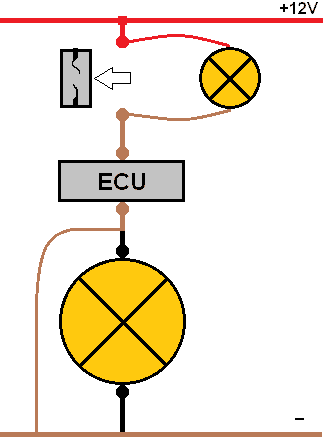
When the plug on the output of the ECU is disconnected, the connection to ground is interrupted. The test light goes out. With the help of the diagram, it can be determined that the short circuit is located in the wiring between the ECU and the lamp. Now that the location is known on the diagram, the specific wire in the vehicle can be found more easily. Repairing the damage, or replacing a section of the wiring, is often sufficient.