Introduction:
The purpose of the suspension system is to absorb the movements caused by driving over irregularities in the road surface as effectively as possible, so that driving comfort is maintained as much as possible. Road holding is also influenced by the suspension. When the suspension is very soft (think of old American cars), the road holding will be much worse than that of a car with stiff suspension. This is because a very softly sprung car loses grip during rebound after it has compressed (e.g. during hard braking or taking sharp corners). The pressure of the tires on the road surface is many times lower with a fully extended wheel than with a compressed wheel and will therefore start to slide much sooner. When taking sharp corners at high speed, the chance of the car breaking away will also be very high, because the grip of the tires on the inside of the corner is minimal.
When a very softly sprung car drives on a hilly, paved road surface, the car will bounce a lot during rebound. When the car is fully extended, the pressure on the tires is lower and braking and steering are barely, if at all, possible at that moment.
With a stiffly sprung car, especially sporty cars or lowered cars, grip on all four wheels will be as high as possible when taking sharp corners. The anti-roll bar and tire size also have a major influence here. When a lowered car drives on a hilly, paved road surface, the car will stay firmly planted on the road and will therefore not experience any problems when braking hard suddenly while the suspension is extended.
With soft and stiff suspension (on cars with coil springs) we are dealing with the spring rate. To allow a car to spring optimally (depending on the design), soft springs can be fitted for comfort (linear springs), or stiffer springs for sportiness (progressive springs). More about this in the chapter Spring rate further down this page.
McPherson:
The big advantage of the McPherson suspension is that the spring and the shock absorber are combined. This saves a lot of space and is also easy to design when developing the car. As a result, production costs are low as well.
The McPherson suspension is an evolution of the suspension with two transverse control arms (also called a double wishbone design). The upper control arm is replaced by the piston rod of the shock absorber, which now also absorbs the lateral forces. That is why in the event of an impact to the wheel (by another vehicle or when driving into a curb), there is usually immediate damage to the piston rod. It deforms very quickly and is then bent. The complete shock absorber must then be replaced.
The McPherson suspension is always used at the front of the car. Struts are sometimes also used at the rear axle, but these are not of the McPherson type. Rear suspension usually has separate coil springs and shock absorbers.
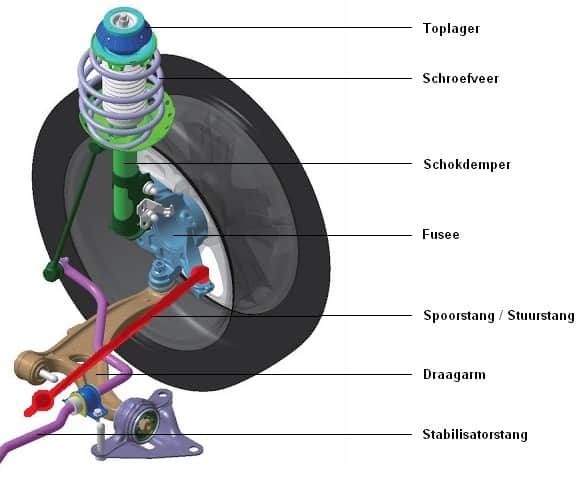
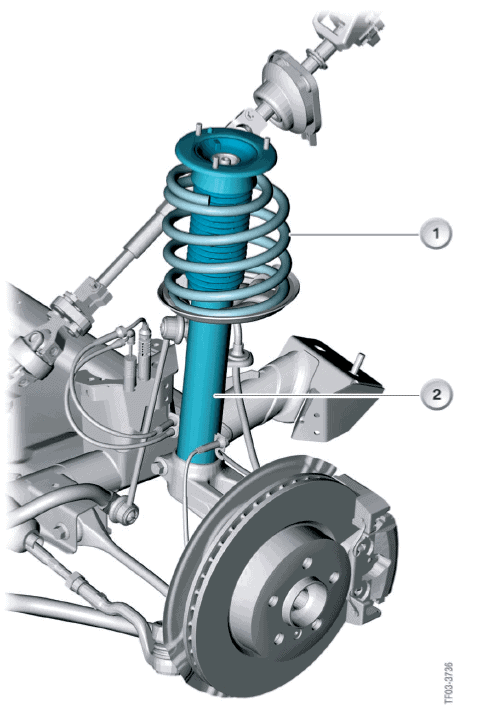
The top mount is located at the top of the strut. The top mount makes steering movements possible. The strut is usually bolted to the bodywork under the bonnet. This is a fixed point. The top mount, located underneath, ensures that the complete strut can rotate smoothly relative to the upper fixed point. This system with a load‑bearing function and a pivot point with a top mount is called the McPherson system.
Coil spring suspension:
The operation of a coil spring is not based on bending as you might first think, but on torsion (twisting). When the spring is compressed, the helical rod is twisted. The entire vehicle weight is supported by the coil springs. The coil spring is clamped between the top mount and the lower spring seat. When the vehicle compresses, the top mount pushes the coil spring down. Because it twists, a counterforce is generated. This counterforce is ultimately the spring action. The more counterforce the spring exerts, the stiffer the spring is.
Spring rate:
The softness of a spring is indicated by the spring rate. The spring rate of a linear coil spring is different from that of a progressive coil spring. With a linear spring, the distance between all coils is the same. With a progressive spring, these distances are not the same; at the top or bottom of the spring the coils are placed closer together than elsewhere. The difference between these two types of springs is shown in the image:
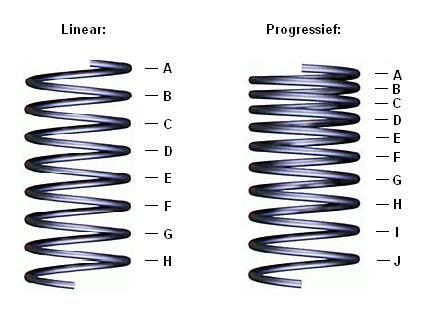
With a linear spring, the spring always compresses a certain distance for a certain weight. Below is an example of the travel of a linear spring:
- With +100 kg extra load, the car sinks 2 cm.
- With +200 kg extra load, the car sinks 4 cm.
- With +300 kg extra load, the car sinks 6 cm.
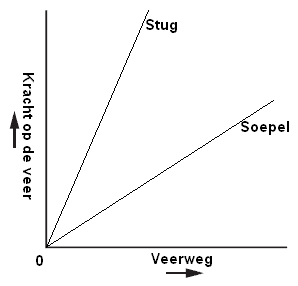
With this linear spring there is a relationship between weight and distance. Below, the compression of a linear spring is shown; the greater the force on the spring, the greater the spring travel. The lines are perfectly straight because the distance between all coils of the spring is the same.
With a progressive spring there is no linear relationship between weight and distance. This spring becomes increasingly stiffer as it compresses further. The first part compresses easily, but as the load increases, it compresses less and less. This is because at the top the coils are closer together. Below is an example of the travel of a progressive spring:
- With +100 kg extra load, the car sinks 2 cm.
- With +200 kg extra load, the car sinks 3 cm.
- With +300 kg extra load, the car sinks 3.5 cm.
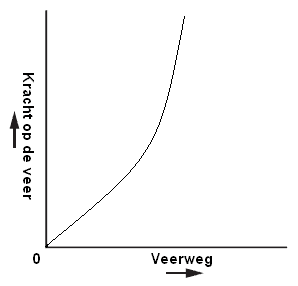
The graph of a progressive spring is shown below. At first, as the force on the spring increases, the spring travel increases. The line is not perfectly straight, but slopes upwards. This means that as the force on the spring increases further, the spring travel becomes smaller and smaller. So the car will compress less and less with an increasing force on the spring.
Car designers are always looking for the best balance between comfort and the driving characteristics of the vehicle. By adjusting the progressiveness of the spring (by placing more or fewer coils close together), the spring travel can be adjusted. The diameter of the coil itself also has a major influence on the amount of torsion that is possible. This will therefore be different for every car. Even the same model cars with different engine capacities, type of engine (petrol or diesel), sport packages, etc. all have different types of springs.
Lowering springs often compress a lot in the first part of their travel, so that the car already sits lower above the road surface in the neutral position. It must then be harder to compress the car further, so the springs are made extra progressive. Otherwise the vehicle would hit the road surface far too quickly. Because the springs compress less easily, the vehicle becomes stiffer; some people experience this as uncomfortable.
Leaf springs:
Leaf springs consist of multiple leaves mounted on top of each other. The top leaf is called the main leaf. The more leaves a spring has, the stronger and stiffer it becomes. In the past they were sometimes fitted to passenger cars. The leaf spring then consisted of only a few leaves, sometimes just the main leaf. They are still used on commercial vehicles; these are of course considerably thicker. The centre of the leaf springs is attached to the axle and the ends to the body or chassis. The spring movement is obtained by the deflection of the multiple leaves in the middle of the total length.
There are two different types of leaf springs:
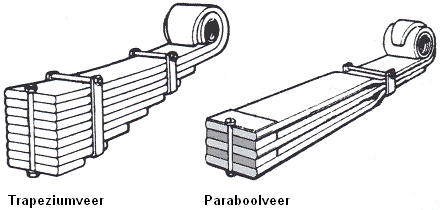
- Trapezoidal spring: The spring leaves differ in length and are equally thick everywhere.
- Parabolic spring: The spring leaves are all the same length and are thicker in the middle than at the ends. There is also space between the leaves. Parabolic springs are softer than trapezoidal springs and have a lower mass.
Air suspension:
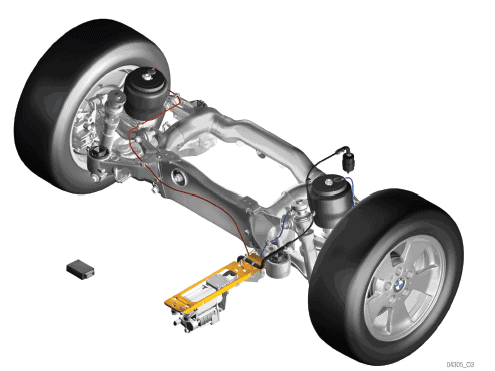
Air suspension is used less often on passenger cars than coil springs. Air suspension can, for example, be found on an Audi A8, BMW 7 Series or X5. These cars often have air suspension at all four wheels. Some cars have struts with coil springs at the front and air suspension at the rear.
The image shows a rear suspension with air bellows. Inside the car (often in the bottom of the boot) there is a pump that pumps air into the air bellows. The air bellows extend in the longitudinal direction so that the weight of the car can rest on them. There is often a sensor on a control arm that measures how far the car has compressed due to the load (people sitting in the back or a heavy trailer). Based on this data, the air pump can inflate the bellows more, so that the car does not sag at the rear.
Torsion bar suspension:
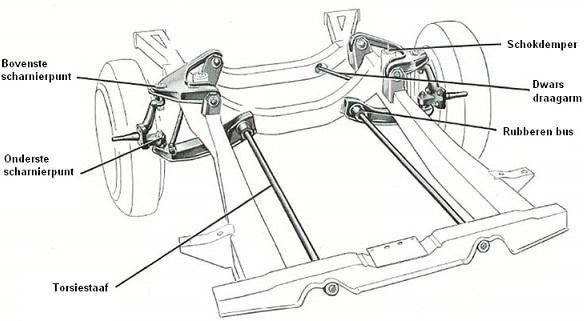
Torsion is another word for “twisting”. Torsion bar suspension used to be applied (mainly) on American cars. The lower control arm of this design is connected to the body by means of a torsion bar. When the vehicle compresses, the upper and lower pivot points will move. The control arm containing the torsion bar will want to pivot around the torsion bar. However, this is not possible because the torsion bar is fixed in the control arm. The other end of the torsion bar (in the image at the bottom) is fixed to the body.
This means that when the wheel compresses, the bar is subjected to twisting. This twisting builds up a resistance (the further the wheel compresses, the more the torsion bar is twisted). Compression therefore becomes increasingly harder as torsion increases. The entire suspension of the car’s front axle works on this principle. That is also one of the reasons why old American cars compress and rebound so easily and smoothly.
Hydropneumatic suspension:
Hydropneumatics is a combination of hydraulics and pneumatics. This system has been used by Citroën since the 1950s and can still be found in its models today.
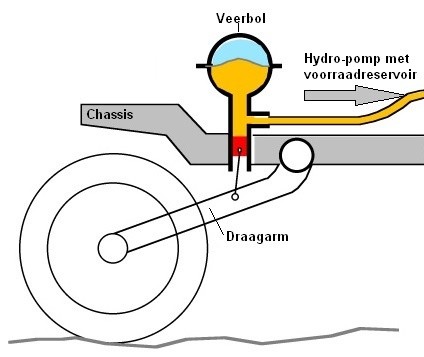
Compressed gas (blue in the image) is contained in the suspension sphere and is compressible. The hydraulic fluid (yellow) is not. During compression, the red piston is pushed upwards by the control arm and the gas volume is compressed. The blue area therefore becomes smaller. When the wheel rebounds and the piston moves downwards, the system returns to its previous state. The spring and damping action is obtained by compressing this compressed gas.
The system can be controlled by regulating the amount of oil (yellow). By adding extra oil to the system under heavy load, which happens automatically thanks to the hydraulic pump, the ride height will increase. The vehicle will then sit higher on its springs. When the load is removed (or the passengers get out), the oil in the system will flow back into the reservoir via a pressure valve. The ride height will decrease again.