Subject:
Thermostat:
The thermostat is a mechanical component that controls coolant circulation and thus the temperature. The technology is already old; namely by expanding a certain amount of wax. Due to the expansion at a higher temperature, a pin is pushed away against the spring pressure. There are also thermostats with a bimetal (bends when heated) and electronically controlled thermostats.
When the coolant flows through the radiator, it is cooler at the outlet than when it flowed into the radiator. This is because the airstream or the cooling fan has blown air through the fins of the radiator. When the engine has just been started, it must reach operating temperature (90 degrees) as quickly as possible. With a cold engine, among other things, fuel consumption and mechanical wear are greatest. The faster the 90 degrees is reached, the better. Until the engine reaches operating temperature, no or minimal flow of cooled coolant from the engine to the radiator should take place. The access to the radiator must therefore be closed. The thermostat takes care of that.
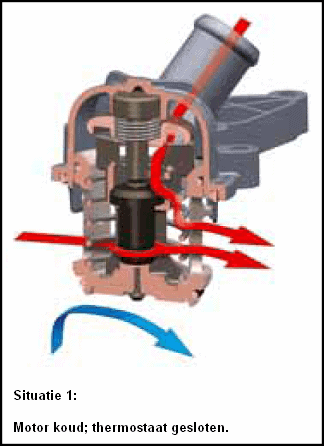
Situation 1. The engine has just been started and the temperature of the coolant is the same as the outside air temperature. There is no circulation through the radiator (the blue arrow). At this moment, the radiator is closed off from the engine cooling system. The coolant is pumped by the water pump through the entire engine, causing it to warm up very quickly.
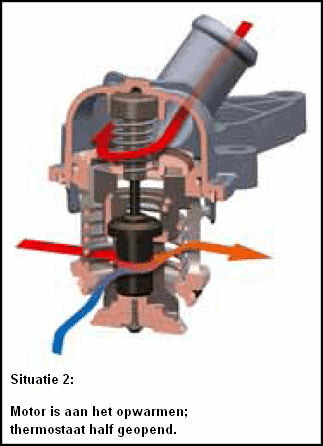
Situation 2. The engine has been running for a while and the coolant temperature is rising. The wax in the thermostat expands slightly, causing it to open a small amount. A small quantity of coolant can now flow from the engine to the radiator. This already happens at a coolant temperature of around 85 degrees Celsius.
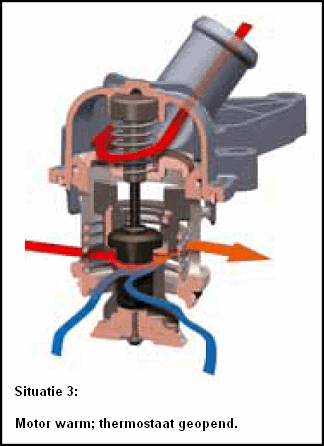
Situation 3. The engine is at operating temperature, often 90 degrees Celsius. The thermostat is now fully open. The coolant is now pumped from the engine through the radiator. The hot coolant from the engine is cooled in the radiator. From the radiator, the coolant will then flow back to the engine.
While driving, it will constantly switch between situations 2 and 3. Higher engine load or little airstream causes a higher coolant temperature. Higher engine load occurs during acceleration or driving uphill, and the situation with little airstream can occur in traffic jams or when idling.
When driving on the motorway, situation 2 will apply; due to the maximum amount of airstream through the radiator, the coolant is well cooled. Because a lot of cold fluid enters the engine, there is a chance that it cools down too quickly. The thermostat will then close slightly again.
In city traffic with a lot of stopping, situation 3 will apply; because there is little airstream flowing through the radiator, the fluid is cooled less. Therefore, a greater amount of coolant flow is needed to prevent overheating. The radiator fan will also try to cool this coolant as much as possible. In changing situations, the thermostat will therefore continually regulate the coolant circulation.
With a defective thermostat, it often remains stuck in situation 2. It then stays open. This is often clearly visible on the temperature gauge on the dashboard; when the vehicle is stationary (with the engine running) the temperature neatly rises to 90 degrees and when driving at higher speed the temperature drops again to e.g. 60 degrees or lower. While driving, the thermostat should therefore close slightly again, which does not happen (see the explanation above). The thermostat will therefore need to be replaced.