Introduction:
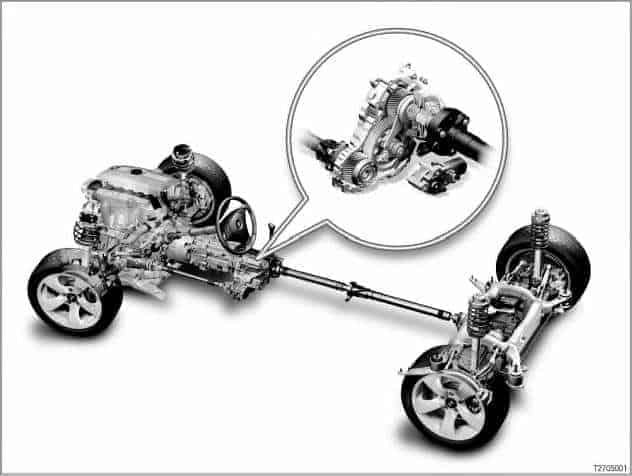
A transfer case consists of a shifting system with multi-plate clutches which can control the drive to the front wheels. The system is used by BMW in the X-drive systems (which are used, for example, on an X3, X5, X6 or 330xi). Every BMW is rear-wheel drive as standard. The X-drive versions are four-wheel drive. However, this is not permanent four-wheel drive. With permanent four-wheel drive, the front and rear wheels cannot be disconnected from each other and they always rotate together. Unfortunately, this has disadvantages, such as increased fuel consumption, increased tire wear, etc.
A transfer case ensures that the rear wheels are directly connected to the gearbox. This is a fixed connection and is not controlled by the transfer case. Depending on the engine load (sporty acceleration) and the type of road surface (with slippery, unpaved surface), the connection to the front wheels is regulated. The transfer case will, with the aid of the engaged multi-plate clutch, rotate the shaft of the front wheels at the same speed as the rear wheels.
Operation of the transfer case:
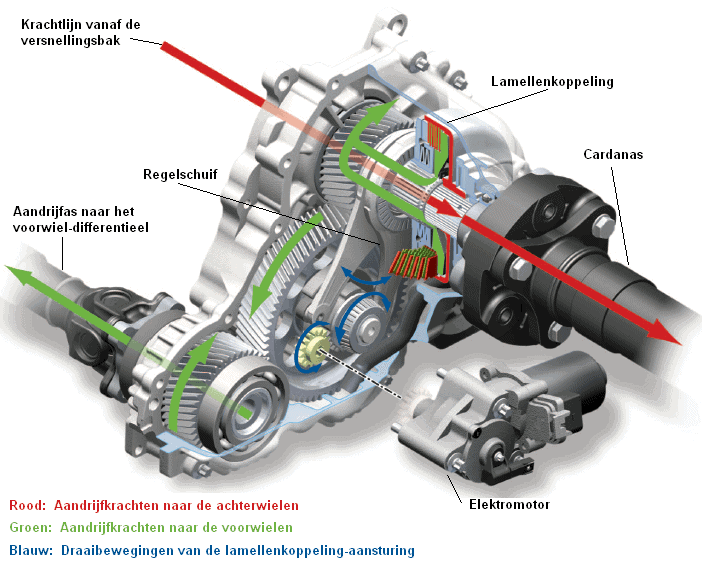
In cars with a transfer case, the gearbox is directly connected to the rear wheels. In the image below this is clearly visible by the red line. It runs from the gearbox directly to the propeller shaft of the rear wheels.
When the rear wheels are about to slip, or when a lot of power needs to be transmitted to the road surface, the electric motor is activated. The electric motor rotates a gear which then operates a control slide. The rotation of the control slide can be seen by the blue arrows. This control slide presses the multi-plate clutch, creating a connection between the gears of the rear wheels and those of the front wheels. As soon as the multi-plate clutch is engaged, the force indicated by the green arrows is created. The drive shaft to the front axle differential is now driven. The front wheels now rotate at the same speed as the rear wheels.
In vehicles from the VAG group, the 4-motion / Syncro / Quattro system is used. This works with a Haldex clutch mounted at the rear axle. Click here for information about the Haldex clutch.
Transfer case with high and low gearing:
Transfer cases of off-road vehicles, such as the Chevrolet K30 and the Jeep CJ7, are equipped with a gearbox which allows selection of high or low gearing (English: high gear and low gear). This provides a different transmission ratio between the gearbox and the wheels.
In off-road vehicles, low gearing is used when driving over terrain with sand, rocks and hills. When shifting from high to low gearing, the engine speed increases, with the advantage that the tractive force at the wheels becomes considerably higher.
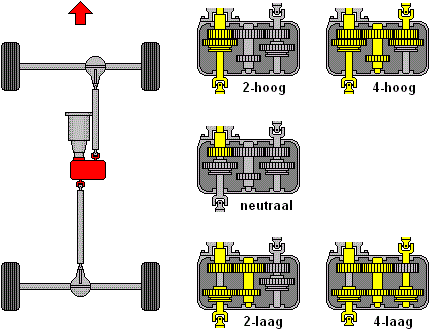
The following image shows the drivetrain of a four-wheel-drive vehicle (left) with an arrow in the driving direction, and on the right the different positions of the transfer case. The yellow color of the gears and shafts indicates that these components are engaged or driven.
- 2-high: the gearbox drives the propeller shaft for the rear wheels. In this position one generally drives on flat road surfaces;
- 4-high: four-wheel drive is engaged;
- neutral: the drive between the gearbox and the wheels is interrupted;
- 2-low: between the input shaft of the gearbox and the output shaft to the differential, an extra shaft with gears is coupled. The power flow goes from the large gear (above) to the small one. The speed of the input shaft increases, as does the torque of the output shaft;
- 4-low: again, four-wheel drive is engaged. As with 2-low, the middle shaft with gears provides the low gearing.
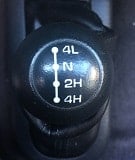
Selecting the different positions is done by operating the extra lever in the interior. In most off-road vehicles this lever is located near the “normal” gear lever of the gearbox. The image shows the shift pattern of a Dodge Ram. It can be seen that the 2L position is missing: in this vehicle, driving in low gearing is only possible in combination with four-wheel drive.
To shift to another position, the clutch must be operated so that the drivetrain is unloaded when engaging another gear set.
The principle of the transfer case in off-road vehicles is similar to a splitter gearbox of (heavy) commercial vehicles. In trucks, the extra reduction is found in the gearbox. When driving with a heavy load, the gearbox with eight gears is doubled to sixteen.