Topics:
- General
- Operation
General:
In the air conditioning system, an accumulator has the tasks of converting the last liquid droplets of refrigerant into gas form, removing moisture from the refrigerant, and adding oil. The accumulator is mounted on the low-pressure side of the system, between the evaporator and the compressor. The accumulator is only installed in air conditioning systems with a capillary tube. (The other version uses a TEV valve, but in that case there is no accumulator, but a filter / drier installed). The task of the capillary tube is to reduce the system pressure, causing the refrigerant to evaporate. Unfortunately, the capillary tube is not always able to convert all the refrigerant from liquid to vapor. There are always some liquid droplets left, which then enter the accumulator via the low-pressure side of the system. In the accumulator, these droplets evaporate. It is very important that all liquid droplets have evaporated before the refrigerant reaches the compressor. If there is too large an amount of liquid, the compressor will experience so-called “liquid slugging” and can be damaged as a result. After all, liquid cannot be compressed. The accumulator is often mounted near hot engine components. As a result, the accumulator is heated internally, so the evaporation of the liquid droplets occurs more quickly.
Operation:
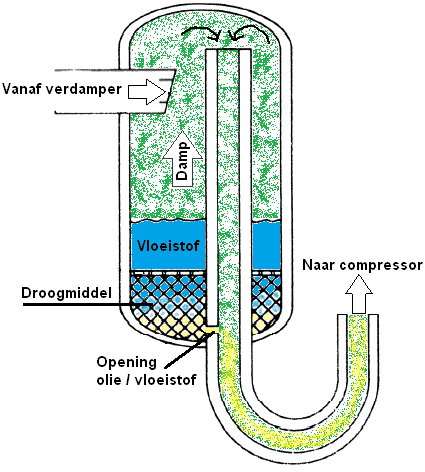
The refrigerant enters the top of the accumulator from the evaporator. The present droplets and the oil fall down and end up in the liquid reservoir. The vapor remains at the top and is then drawn through the central tube by the compressor (due to vacuum). At the bottom of the accumulator there is a desiccant, which has the same function as that of a filter / drier in a TEV system. The present moisture is absorbed by the desiccant. The present oil (the lubricating oil for the compressor) gradually sinks through the desiccant and collects at the opening at the bottom of the tube. The oil is gradually drawn in by the venturi effect, because the gases in the tube move outward (and thereby create a vacuum at the opening). In this way, oil is gradually supplied to the refrigerant, because too much oil can also cause damage to the compressor.
Click here to go to the air conditioning page.