Introduction:
The air conditioning system is responsible for cooling and dehumidifying incoming air, which helps create a comfortable environment for vehicle occupants. In addition to increasing comfort, a pleasant climate also affects the driver’s alertness. Air conditioning is part of the so‑called HVAC, which stands for: Heating Ventilation Air Conditioning. A vehicle with HVAC can therefore heat, ventilate and cool the climate system. In the literature, the term HVAC is appearing more and more often.
The extent to which an air conditioning system can reduce the temperature may vary depending on several factors, such as the ambient temperature, the efficiency of the system and the desired temperature setting. In general, it is common for a properly functioning air conditioning system in a passenger car to cool the temperature by approximately 10 to 20 degrees Celsius compared to the outside temperature. To quickly bring the air outlet temperature to the desired level, it is recommended to activate the recirculation mode. This function ensures that the already cooled air in the interior is passed through the evaporator again for additional cooling.
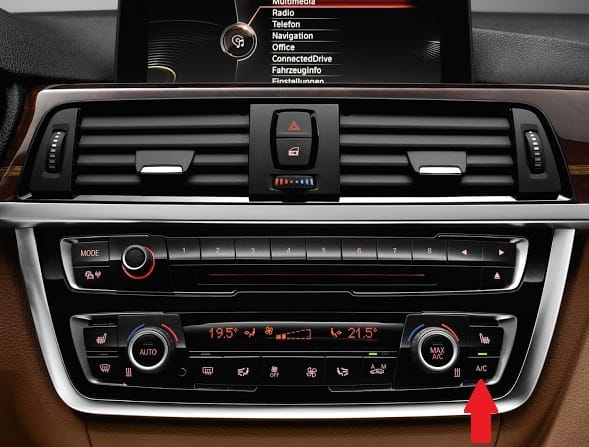
The following image shows the control panel of a BMW 3‑series. The air conditioning (A/C) button is indicated by a red arrow. The air conditioning is switched on.
This page provides a brief overview of the operation of the air conditioning system. Each section can be clicked to go to the page where more detailed information is given about the respective subject.
Operation of the air conditioning system:
In the activated air conditioning system, refrigerant circulates through the various components of the system. This refrigerant undergoes two state changes:
- condensation: heat is released to the surroundings. During condensation, the refrigerant changes from a gaseous state to a liquid;
- evaporation: heat is extracted from the surroundings. Evaporation takes place in the evaporator, which cools the air flowing into the interior.
The image below shows an overview of the components of a modern air conditioning installation. The refrigerant circuit can be divided into two pressure regions: high pressure and low pressure. In the image below, the red line is the high‑pressure line and the blue one is the low‑pressure line.
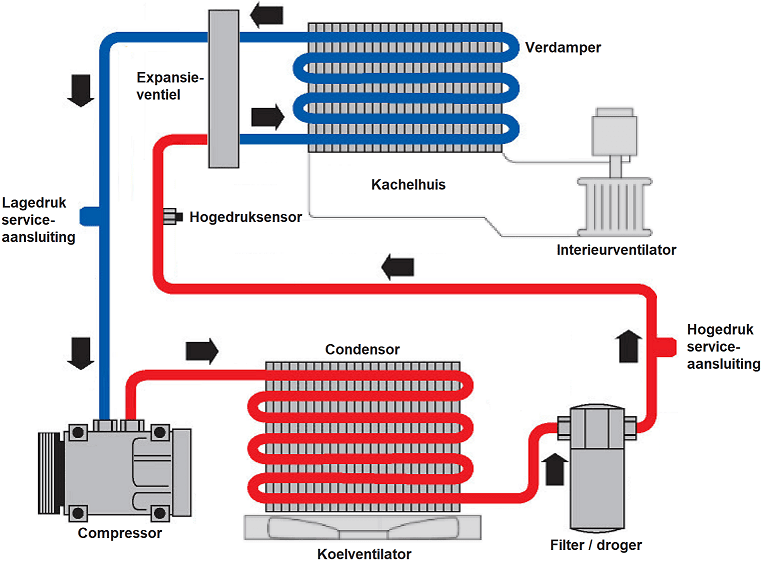
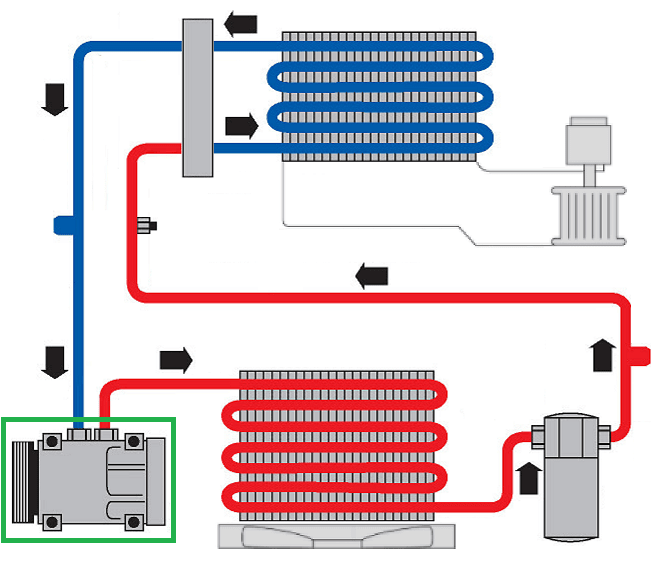
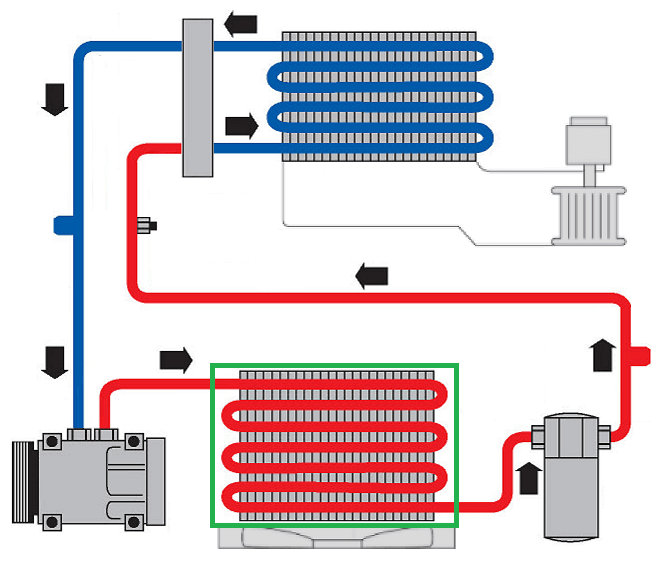
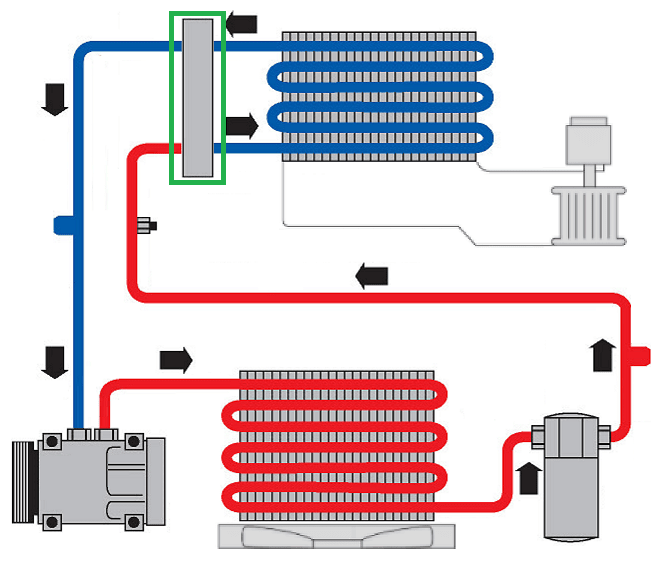
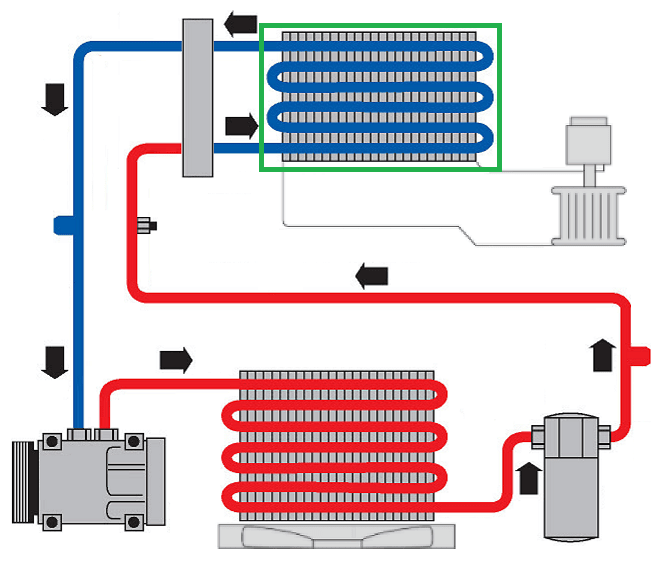
In the following sections, the above diagram is shown again, with each component individually highlighted with a green frame. For each component, detailed explanations are given about the operation, the location in the vehicle and the interaction with other components. First, the components that are directly responsible for the circulation process are described. Each component has its own subpage that goes into the operation in more depth. Click on the blue‑coloured text for that.
Compressor:
The air conditioning compressor draws in the gaseous / vapour‑form refrigerant via the blue line and increases its pressure. When the pressure is increased, the boiling point also rises. The vapour is then routed to the condenser via the red line. The vapour remains superheated. On the air conditioning compressor there is a pulley that is driven by the multi‑rib belt. The compressor can be switched on and off by means of a magnetic clutch. In electric or hybrid vehicles, the drive can be provided by an electric motor in the HV system instead of the multi‑rib belt.
In cars with combustion engines, the air conditioning compressor is located in the engine compartment on the side of the multi‑rib belt and is driven by this belt together with the alternator and, if present, the power steering pump. In the case of electric vehicles, the compressor may be located in the interior and an electric motor drives the (electric) air conditioning compressor.
Condenser:
After the refrigerant leaves the compressor, both the pressure and the temperature have risen significantly. The condenser has the task of condensing the superheated vapour from the compressor into a subcooled liquid. When the temperature has dropped below the boiling point, the refrigerant becomes liquid. In the condenser, heat is dissipated to the outside air. While driving, the ram air flows through the condenser. If the airflow and cooling are insufficient, the fan switches on to increase the air flow. The outside air flowing through the condenser is then heated.
We find the condenser in the front section of the car, in front of the radiator of the cooling system.
Expansion valve:
The liquid refrigerant arrives at the expansion valve under high pressure. The expansion valve causes a sudden pressure drop, which lowers the pressure, temperature and boiling point. The liquid changes into saturated vapour. This is a mixture of vapour and liquid particles. In the expansion valve the high and low pressures are separated from each other.
The expansion valve is available in different versions: with fixed restriction (capillary tube) or variable restriction (thermostatic expansion valve).
Evaporator:
The task of the evaporator is to cool the air flowing into the interior of the car. The interior fan blows outside air or recirculated interior air through the evaporator fins. Heat is extracted from the passing air. The cooled air is then blown into the interior.
From the expansion valve, the vapour‑form refrigerant flows to the evaporator. The temperature, pressure and boiling point are low when it flows in. The airflow through the evaporator heats the refrigerant, causing it to begin boiling immediately. When leaving the evaporator, the refrigerant is in a superheated state. After the refrigerant has evaporated as it leaves the evaporator, the cycle starts again. The compressor draws in the gaseous refrigerant again to compress it once more.
The evaporator is built into the heater/ventilation housing behind the dashboard.
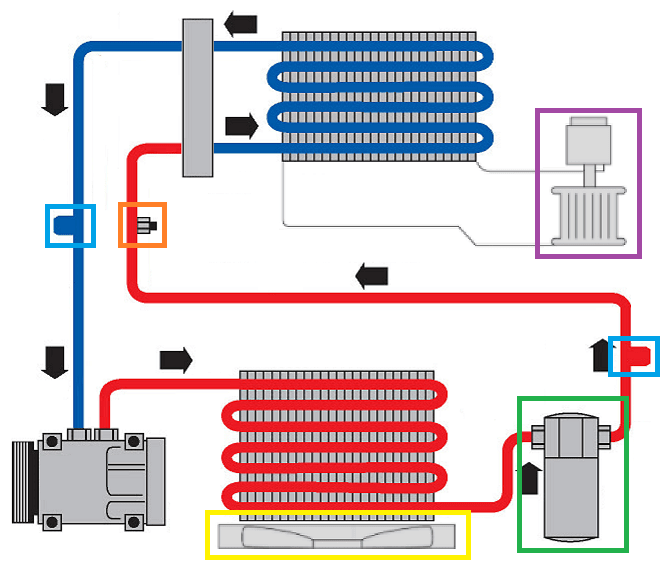
In the last image, the components that were not mentioned above are shown.
- Service connections: these are outlined in blue. They are used to check the pressures with a pressure gauge, and to evacuate or fill the system;
- High‑pressure sensor: the sensor outlined in orange measures the pressure in the high‑pressure line. The engine ECU can use this to control, among other things, the output of the compressor;
- Interior fan: the fan outlined in purple, the interior fan, blows air into the heater housing and therefore also through the evaporator;
- Cooling fan: the fan outlined in yellow, the cooling fan, blows outside air through the condenser. Some cars have a separate fan for the condenser, while others use the cooling fan that also cools the radiator;
- Filter / dryer: the filtering of dirt particles and the drying (dehumidifying) takes place in the component outlined in green. The filter / dryer element may be mounted directly next to the condenser, but it can also be located inside the condenser.
Pressures and temperatures:
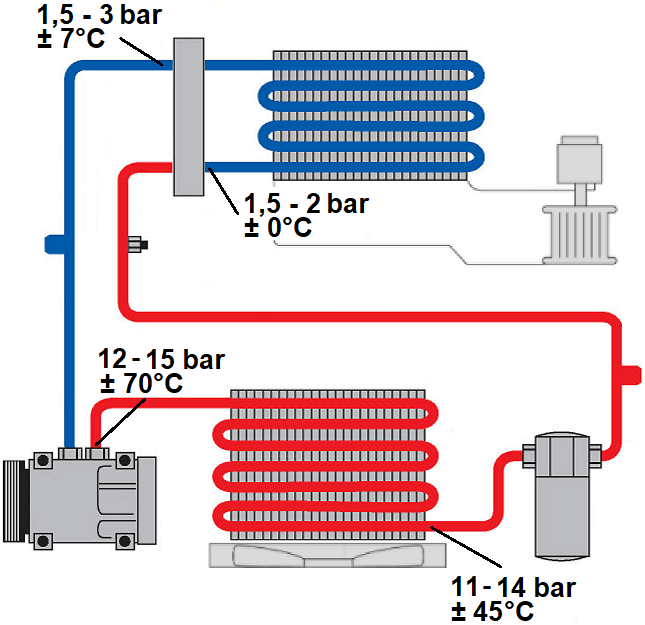
By measuring the pressures and temperatures at various points in the system, we can determine whether the system is functioning correctly. Because the pressure and temperature of the refrigerant depend on the outside air temperature, we take as a reference value a temperature between 25 and 30 °C and an increased engine speed so that the air conditioning compressor has sufficient capacity.
Due to compression, the temperature of the refrigerant at the outlet of the compressor rises to around 70 °C, while the pressure varies between 12 and 15 bar. The refrigerant reaches the expansion valve via the dryer/filter, where a pressure drop occurs and the temperature falls to just above freezing point. When the refrigerant leaves the evaporator, it has been warmed up a few degrees by the air that has passed by.
On the page: Diagnosing air conditioning based on pressure and temperature, the most common faults, causes and solutions are described.