Topics:
Calculating piston speed:
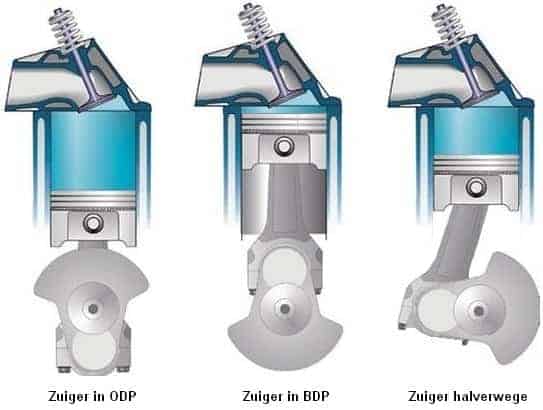
The speed at which the piston moves in the cylinder is called the piston speed. The piston moves from top to bottom (the top dead center TDC) to the bottom (bottom dead center BDC) and back up again. Each time the piston reaches TDC or BDC, it comes to a standstill because the direction of movement changes. This is illustrated in the image below:
The piston speed is highest when it is halfway along the cylinder. This is also related to the secondary piston motion. From the middle, the movement will slow down again until TDC is reached. When the crankshaft makes one full revolution, the piston moves down and up once. The distance between TDC and BDC is called the stroke. If the actual crankshaft speed is also known, the average piston movement can be calculated.
V = 2 x s x n
V = average piston speed [meters per second]
2 = twice the piston movement
s = stroke; the distance the piston travels [meters]
n = crankshaft speed [Hertz]
Example:
An engine has a stroke of 90 mm. The stroke can be found in the engine’s factory data. The engine speed is 3000 revolutions per minute (read from the tachometer). With this data, the average piston speed can be calculated.
To begin with, the stroke given in millimeters must be converted to meters (divide by 1000). That is 0.09 meters. The crankshaft speed in revolutions per minute must also be converted to revolutions per second (divide by 60). That is 50 Hertz.
The calculated data can be entered into the formula:
V = 2 x 0.09 x 50 = 9 m/s