Clutch and pressure plate:
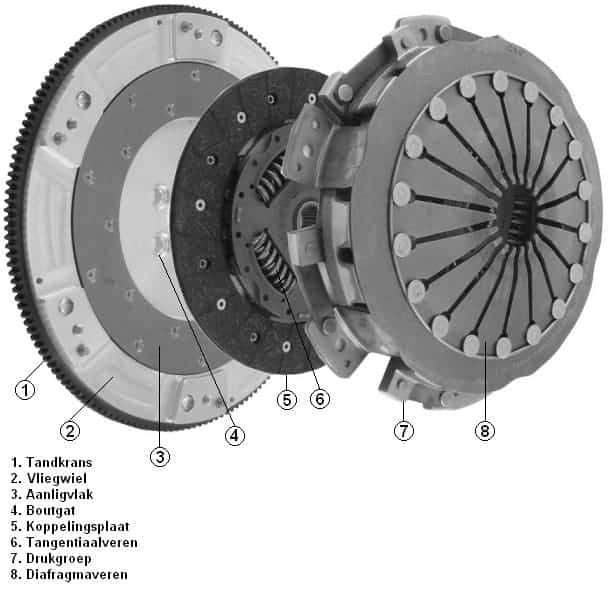
The purpose of the clutch is to connect and disconnect the engine from the manual gearbox and driven wheels at the desired moment. The clutch consists of a clutch disc and a pressure plate (see image below). These are mounted to the engine’s flywheel. In its rest position, the pressure plate clamps the clutch disc against the flywheel. The lining of the clutch disc (5) is then clamped against the contact surface (3) of the flywheel.
When the clutch pedal is depressed, the release bearing presses against the diaphragm springs of the pressure plate. This happens on the inner side of the diaphragm springs. Due to the diaphragm action, the outer side of the pressure plate flexes outward. The clutch is then “disengaged”. When the clutch pedal is released again, the release bearing exerts less and less force on the diaphragm springs. These springs return to their neutral position, causing the outer side of the diaphragm to move back toward the clutch disc. The clutch is again clamped between the pressure plate and the flywheel. By doing this very gradually and allowing the clutch to slip between the flywheel and the pressure plate, the car starts to move. If this position is held too long, or if it is done at too high an engine speed, the lining of the clutch disc will wear out more quickly or may even get damaged.
The clutch disc is a wear item. The characteristics of this wear are described at the bottom of this page. When replacing the clutch, in 99% of cars the gearbox will need to be removed. For most cars this is a lot of work. Sometimes the subframe also has to be removed. In a few cases it is even practical to remove the complete engine block together with the gearbox as one unit.
When a clutch disc is replaced, it is customary to replace the pressure plate and the release bearing as well. Leaving these in place is unwise, because the pressure plate is also subject to wear; think of the flexing of the diaphragm springs and the contact surface on the back of the pressure plate where the clutch disc is pressed against.
Never apply too much grease to the input shaft or other parts of the clutch. Some manufacturers even forbid the use of grease altogether! There will all too quickly be too much grease on it, and dust from the clutch lining will soon start to stick to it.
After disassembly, clean everything very thoroughly and degrease it. That is more important than applying grease. If one still wants to apply some, only a very thin layer should be applied to the splines of the input shaft. So minimal that it is barely visible.
Release bearing:
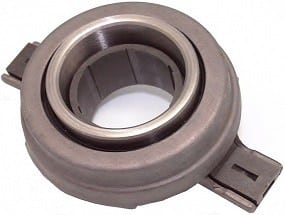
The release bearing is mounted with springs to the inside of the gearbox housing and slides along the splines of the input shaft. On one side of the release bearing there is the lever, and on the other side are the diaphragm springs of the pressure plate. When the engine is running, the pressure plate with the diaphragm springs will rotate at the same speed. The crankshaft drives the flywheel and thus directly the clutch. The lever does not rotate. It only makes a back-and-forth movement when the clutch pedal is pressed or released. The release bearing makes it possible for the “stationary” lever to press on the rotating diaphragm springs. Between the two parts of the release bearing there are ball bearings, allowing these parts to move relative to each other.
The illustrated release bearing is a thrust bearing, which is described on the bearings page.
Mechanically operated clutch system:
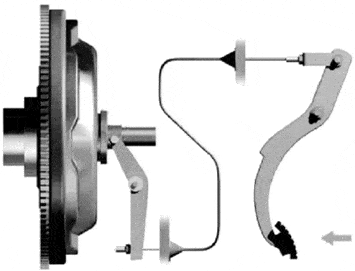
In the mechanical control system, Bowden cables are used. Rod linkages were also used in the past, but because there were too many drawbacks, such as the reaction forces that are strongly transmitted to the clutch pedal and the play that develops over time at the hinge points, this is no longer used nowadays. We will therefore not go into that here. A Bowden cable does not have these drawbacks. The disadvantages of this cable are that over time it stretches, which makes adjustment necessary. In addition, with age and due to dirt and moisture, the cable will become increasingly heavy to operate.
Operation: When the clutch pedal is depressed, the pivoting movement at the hinge point above the pedal pulls the inner cable in the Bowden cable. As a result, the clutch lever will pivot around its pivot point (which is a fixed point in the gearbox housing), causing the release bearing to be pushed inward. The release bearing presses against the diaphragm springs of the pressure plate, releasing the clutch disc. The clutch is then disengaged.
The cable can often be adjusted. Sometimes the cable is equipped with a self-adjusting mechanism. As it ages, the cable can become heavy to operate or start to creak. It can sometimes help to lubricate the cable. This can be done by letting a little lubricant run into an opening of the Bowden cable and operating the cable repeatedly. However, the best solution is to replace the cable.
Hydraulically operated clutch system:
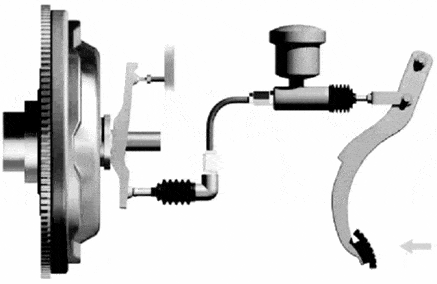
In the hydraulic clutch system, the force from the clutch pedal is transmitted to the pressure plate by means of fluid (usually brake fluid). The big advantage is that the clutch can be operated more smoothly than with the mechanical system using a clutch cable. Because brake fluid is used, the circuit is connected to the braking system. Due to the presence of a special flow-through valve, a leaking clutch system will never cause the braking system to run dry. When changing the brake fluid of the braking system, the clutch fluid can also be changed at the same time by opening the bleed nipple on the clutch cylinder on the gearbox.
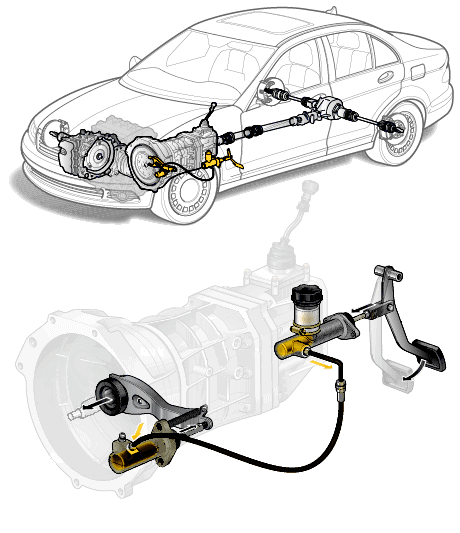
Operation: When the clutch pedal is pressed, fluid pressure is built up in the clutch cylinder behind the pedal (the master cylinder). This fluid pressure is transmitted via the hose to the clutch cylinder on the gearbox housing (also called the slave or operating cylinder). The piston of this slave cylinder pushes against the underside of the lever. Because the top side is mounted to a fixed point of the gearbox housing, the middle part will move to the left. The release bearing is mounted in the middle part and will press the diaphragm springs when operated. Just as with the diaphragm springs of a mechanically operated system, the clutch disc will be released when operated.
At the moment the clutch pedal is released again, the diaphragm spring will push the release bearing back outward and the clutch disc will again be clamped between the pressure plate and the flywheel. In that case, the transmission is coupled to the engine again and the vehicle can be driven.
In the image below, a vehicle can be seen with the engine and gearbox mounted in longitudinal direction. The gear lever is located directly above the gearbox, because the gearbox is positioned under the center console in the interior.
Clutch faults:
A clutch is a wear item. With proper driving style the clutch can easily last 300,000 km. For people who allow the clutch to slip a lot and drive mainly in city traffic, the clutch can become bad after just a few tens of thousands of kilometres. As a clutch wears, this can be noticed by the following points:
- Clutch pedal is very high; with a hydraulic clutch this does not immediately have to mean that the clutch is worn. If it also tends to slip, then it is wearing out. With a mechanical system, it can also mean that it is incorrectly adjusted. However, when only a small force is applied to the pedal and the clutch already starts to slip, the clutch is worn.
- Clutch slips; under full acceleration, the engine speed rises faster than the car accelerates. This is usually accompanied by a burnt clutch smell. This clutch is badly worn and will soon become unusable.
- When accelerating in 4th (or higher gear) and lightly touching the clutch pedal, the clutch already starts to slip; the clutch is becoming worn.
- If you accelerate in a higher gear (4th or higher) and the clutch is briefly depressed and released while the accelerator pedal remains pressed, the clutch should re-engage quickly. If the clutch continues to slip for a longer time, it is wearing out.
- Clutch is heavy to operate, the pedal has to be pressed with a lot of force; the pressure plate is often the cause of this. This is often a combination of a worn clutch and pressure plate and they will have to be replaced.
- Clutch does not release when the clutch pedal is fully depressed; probably a problem in the clutch cylinder or in the pressure plate. A diaphragm spring in the pressure plate may be broken.
- Clutch shudders / judders when engaging; this can be dirt on the clutch disc, a glazed clutch, or a dual-mass flywheel with excessive play.
If the clutch slips very little (so with good driving style) the discs can become contaminated. By allowing the clutch to slip briefly and firmly, the discs are cleaned again. While driving, put the car in a high gear (4 or 5), depress the clutch halfway and accelerate. Do not do this for too long, because then the disc may burn. If this is done carefully, the dirt will burn off the clutch disc and the juddering can disappear permanently. - If a scraping noise is audible when the car is in neutral and the clutch is not being operated; if the clutch is depressed, the noise disappears. This is then probably the release bearing making noise. The release bearing is located between the lever and the pressure plate. When it is unloaded, it can rattle. Replacing this part is the only solution.