Compression ratio:
The compression ratio has a major influence on engine performance. The higher it is, the higher the final compression pressure will be, so the more energy the engine can extract from the fuel and the more power it will produce. However, there are limitations. More on this later.
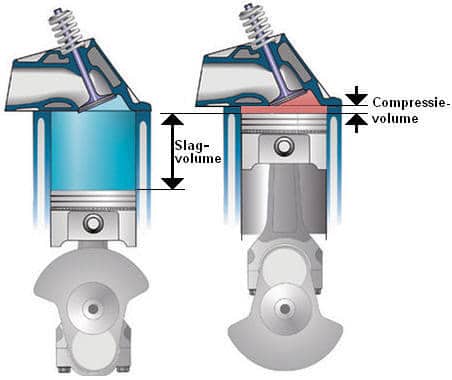
The compression ratio is a fixed ratio between the volume above the piston at TDC and the volume above the piston at BDC. The compression space is the volume of the combustion chamber in which the air is compressed by the piston. The compression space also depends on the thickness of the head gasket, the angle at which the valves are installed in the cylinder head, and the space taken up by the spark plug and injector. This makes it difficult to calculate. Therefore, the compression space is measured by pouring a specific amount of liquid into the head with the valves closed and measuring this amount.
Calculating the compression ratio:
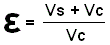
The swept volume is indicated by Vs and the compression volume by Vc. Both are in cubic centimeters (cm³). With these two data points, the compression ratio can be calculated. The compression ratio is denoted by the Greek letter ε (Epsilon).
The engine data are as follows:
Vs = 460 cm³
Vc = 50 cm³
Filling this in gives:
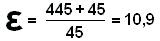
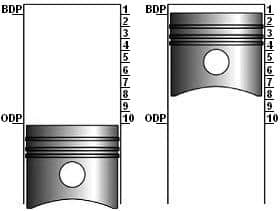
Calculating this formula yields the answer 10. That means this engine has a compression ratio of 10:1. In the image below, the ratio between the volume above the piston at TDC (10) and the volume above the piston at BDC (1) can clearly be seen. The swept volume + compression space are 10 times larger than the compression space.
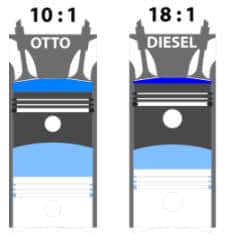
An indirectly injected petrol engine often has a compression ratio between 7:1 and 11:1. A directly injected petrol engine between 14:1 and 20:1.
The compression ratio of a diesel engine is often between 18:1 and 24:1.
As explained earlier, the compression volume (Vc) is measured because calculating it is very difficult. The swept volume can be calculated, however. The formula is shown on the right-hand side.
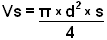
π (pi) = rounded 3.14
d² = the diameter of the cylinder squared
s = the stroke in millimetres
In the standard formula for the compression ratio, Vs is replaced by the formula used to calculate Vs. The brackets to the left and right of the Vs formula indicate that this calculation must be done first. The result must then be added to Vc and subsequently divided by Vc.
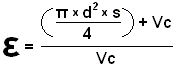
As an example, we take an engine with a bore x stroke of 81.0 x 86.4 mm. The bore is the diameter of the cylinder that must be squared, and the stroke is the distance the piston travels from TDC to BDC. The compression volume of this engine is given: 45 cm³.
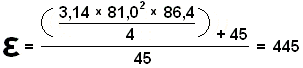
Of course, the formula can also be worked out step by step. Filling in this data in the formula gives:

The swept volume of this engine can now be entered into the formula for the compression ratio:
Limitations:
With a higher compression ratio, more power can be achieved. More energy can be extracted from the fuel (a higher efficiency). The compression ratio cannot simply be increased; due to the higher final compression pressure, there is a risk of knocking. The fuel ignites earlier than intended due to the higher pressure and temperature. An engine equipped with a turbo has a higher final compression pressure due to the boost pressure. With the same compression ratio, that would mean there is a risk of knocking. That is why the compression ratio in turbo engines is lower than in naturally aspirated engines.
Car manufacturers also apply techniques to increase the compression ratio without creating a risk of knocking. Examples include a knock sensor to advance the ignition (which is present on virtually every modern engine), water injection to cool the combustion chamber, and other fuels such as methanol and ethanol (used in racing).
Related page: