Introduction:
The first concept of the CVT principle was already designed in the year 1490 by Leonardo da Vinci.
In the 1950s these gearboxes were used in the popular DAF passenger cars (under the name Variomatic). These cars could drive just as fast forwards as backwards.
Today, the CVT principle is still widely used. Certain car brands; Audi and Seat with the Multitronic, Nissan, Toyota, Ford, Fiat, Suzuki, Subaru, Rover, Mini (BMW group), Doge, Jeep, Mitsubishi, Saturn (and possibly other manufacturers) use or used a CVT gearbox in certain models.
CVT is not only used in cars, but also in karts, snowmobiles, scooters and certain ATVs.
Operation of the CVT:
CVT stands for Continu Variabele Transmissie (Continuously Variable Transmission). That means that the transmission ratios are constantly changing. In manual, automatic and DSG gearboxes, each gear has its own gear ratio. This gear ratio is determined by the number of teeth on the gears on the shafts (in the manual gearbox) and the transmission ratio of the planetary gear set (in the automatic gearbox).
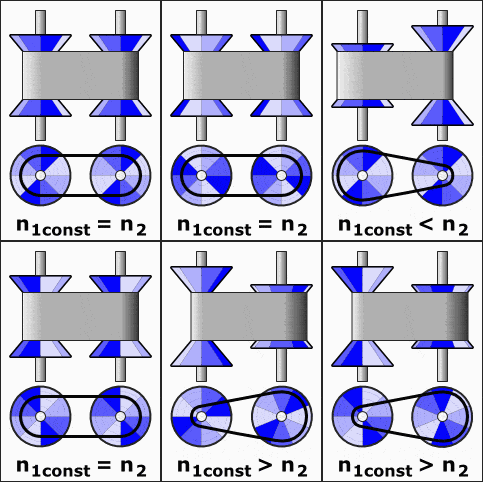
In a CVT gearbox there are no fixed gear ratios. It is not gears that provide the drive, but a rubber or metal push belt that moves over pulleys that vary in width. The change in the diameter of the pulleys results in a different transmission ratio. Because the pulleys change diameter steplessly, i.e. in a smooth movement, there are no shift shocks as is the case with a conventional gearbox.
The illustration shows how it works. However, the pulleys vary in one motion here from neutral, to small, to large. In reality this happens gradually.
Stepless acceleration:
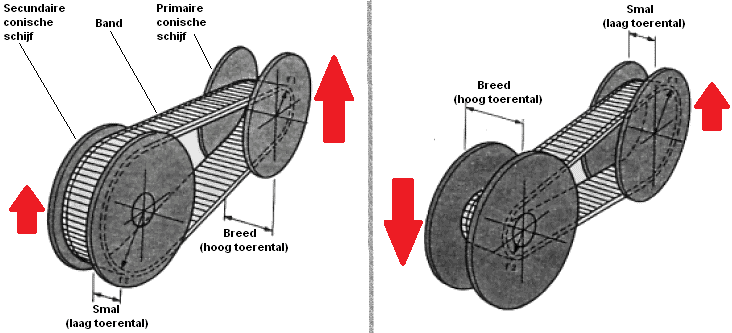
The primary conical pulley is driven by the engine (crankshaft) and the secondary conical pulley is connected to the differential and the drive shafts of the car. At low speed, the primary pulley is wide and the secondary pulley is narrow (see image below). Now you can accelerate with a high engine speed and a low road speed. In this situation a lot of engine torque can be transferred to the wheels for pulling away. As the speed increases, the primary pulley changes from wide to narrow and the secondary pulley from narrow to wide. During this change, the engine speed remains the same, but the vehicle speed becomes increasingly higher.
Accelerating in different stages:
With a CVT transmission you can usually also choose to shift in different stages. This can be done e.g. by putting the gear lever in position S (Sport) or in Manual.
With the Manual selection, just like with the conventional automatic transmission, you can select the programs 1 (high engine speed at low road speed) up to and including 3 (low engine speed at high road speed). Or you can shift manually between 1st and 6th gear.
When manually engaging, for example, 2nd gear (2nd stage), the gearbox behaves the same as a normal automatic gearbox. This is not because there is some extra mechanism inside the gearbox that makes this possible, but because the primary and secondary pulleys assume a certain position. The transmission electronics has a specific width of the pulleys stored in memory for each stage. Because the width between both pulleys does not vary, the engine remains at e.g. 3000 rpm at a speed of 60 km/h.
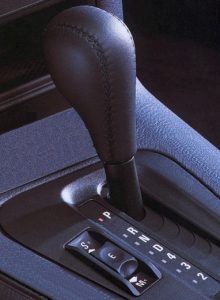
This function can be used when towing a caravan, or before the driver wants to make an overtaking manoeuvre. By selecting a certain stage so that the engine runs around the torque band, it becomes easier to start accelerating. In D (drive) mode the engine speed automatically drops back to around 1500 rpm. When pressing the accelerator pedal (kickdown), the pulleys first have to move to a different position, which takes time. The Sport and Manual modes prevent this problem.
Planetary gear set:
A single planetary gear set is also coupled to the primary pulley, which is also a component of a conventional automatic gearbox. This planetary gear set makes it possible to engage reverse gear.
More information about this can be found on the page automatic transmission. (Its operation is after all the same, and not really relevant on this page).
Push belt:
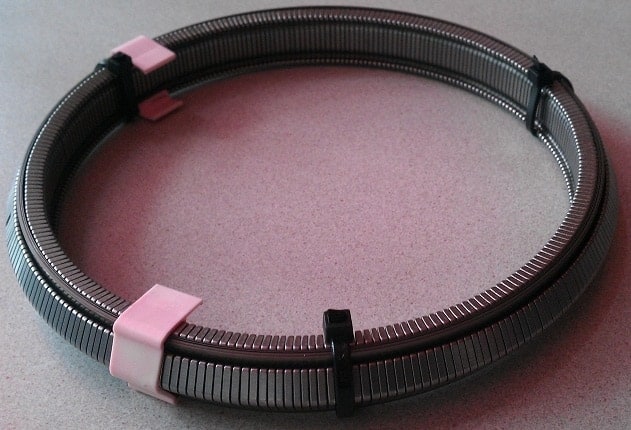
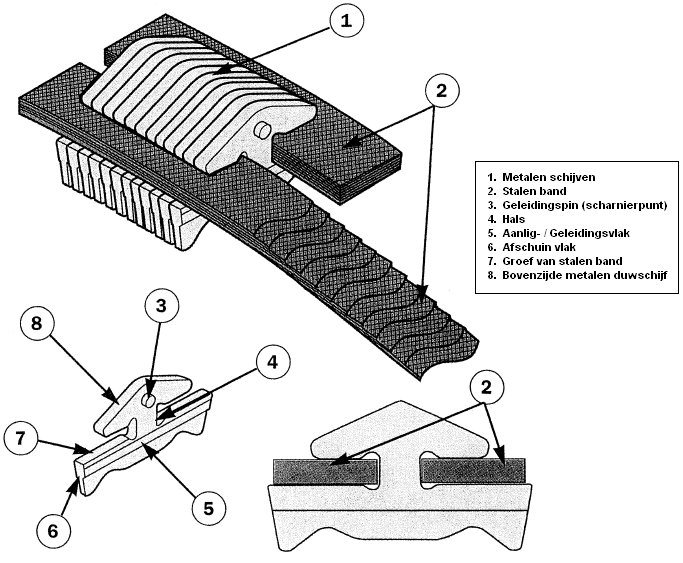
The push belt in passenger cars is constructed as shown in the image below. The steel belt is basically a ring, with lots of metal segments clamped around it. Thanks to the guide pins the metal segments can pivot relative to each other, so that a variation in diameter is possible by allowing the moving pulleys to become wider or narrower.
Because the metal segments are all in contact with each other, large compressive forces can be transmitted. The angle at which the metal segments are positioned can be small when the pulley takes a small diameter.
Variable pulleys:
The control of the pulley diameters is determined by the ECU (engine management). The engine management receives information from sensors, based on which the position will be determined and the transmission ratio will be changed. The following information is important for the ECU:
- Engine speed
- Road speed
- Position of the throttle valve
- Position of the selector lever (shifter)
- Position of the planetary set
- Driving resistances
Video of the instrument panel during acceleration:
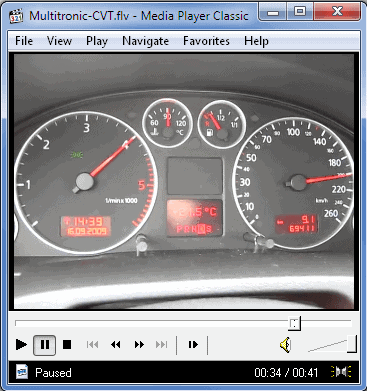
Below is a video of an Audi A4 with a Multitronic gearbox. This also works according to the CVT principle. This video gives a good impression of how this gearbox works and how it is experienced by the driver. This Audi driver floors the accelerator pedal. During gentler acceleration, the engine speed also remains the same at increasing speed, only then at, for example, 2000 rpm.
Graph:
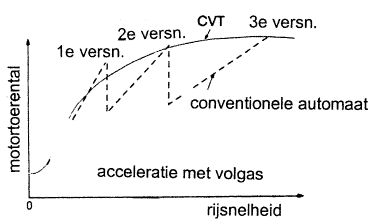
As can be seen in the video above, the engine speed remains constant during acceleration. This is also visible in the graph below. A conventional automatic shifts up several times, which causes repeated peaks in the vehicle speed. The CVT has a linear line without peaks. The advantage of this is that the engine is optimally loaded in the most favourable torque band.