Introduction:
A cooling system is always equipped with an expansion tank. A certain amount of coolant is stored in this tank. This tank also ensures that the coolant can expand. Due to temperature fluctuations and pressure increase, the coolant level will rise and fall. This can also be noticed when the cap of the tank is unscrewed with a warm engine; a hissing sound can then be heard. At that moment, the system pressure is reduced and the coolant level rises (it may even flow out of the tank). Under pressure, the temperature of the coolant can easily reach 120°C without boiling, but as soon as the pressure is reduced (e.g. by loosening the cap) the coolant will start to boil and expand.
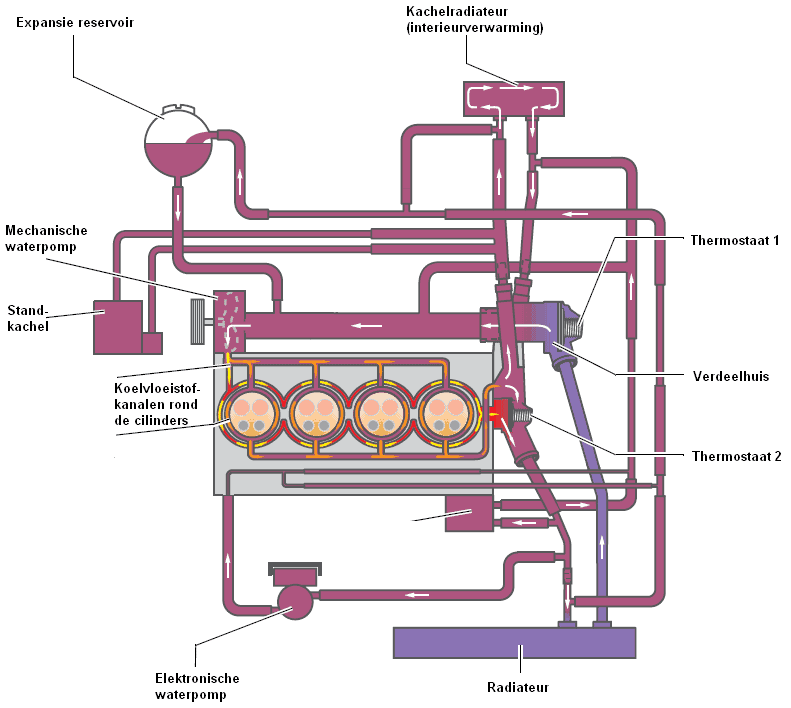
The image below shows what a car’s cooling system looks like. More information about this can be found on the cooling system page.
Different types of expansion tanks:
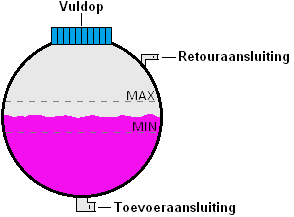
Car manufacturers can use different types of expansion tanks. Sometimes a transparent tank is chosen, and other times an opaque tank with a plastic float element. The image shows a transparent tank with a minimum and maximum marking. The coolant level must remain between the markings, preferably at maximum. The advantage of this type of tank is that the cap does not need to be removed to check the fluid level. This type of tank is often used on, among others, V.A.G. vehicles.
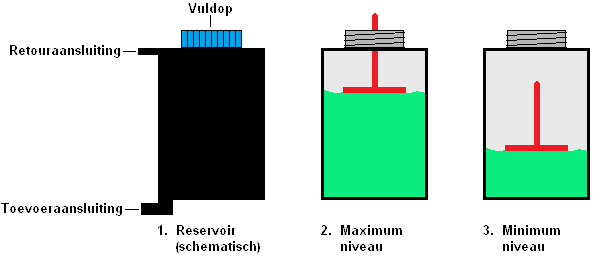
Another option is an opaque tank with a float element (see image).
- The tank is usually made of black, opaque plastic. The cap must be removed to check the level.
- At the maximum fluid level, the float element (which floats on the coolant) will protrude at the top of the tank.
- At a minimum fluid level, the float element will lie deep in the tank. This is a sign that it needs to be topped up.
The disadvantage of this tank is that the cap must be removed to check the fluid level. This is not possible with a warm engine. When the engine is too hot, the fluid will flow out of the tank because the boiling point is lowered and the coolant will expand and may start to boil. If this is not the case, but a hissing sound is audible, the level will rise due to the pressure drop. At that moment it looks as if the fluid level is at maximum, but if, for example, an hour is then waited until the engine has cooled down, the fluid level may only be halfway. This can give a distorted picture of the fluid level. It is therefore always important to check the level with a cold engine.