Introduction:
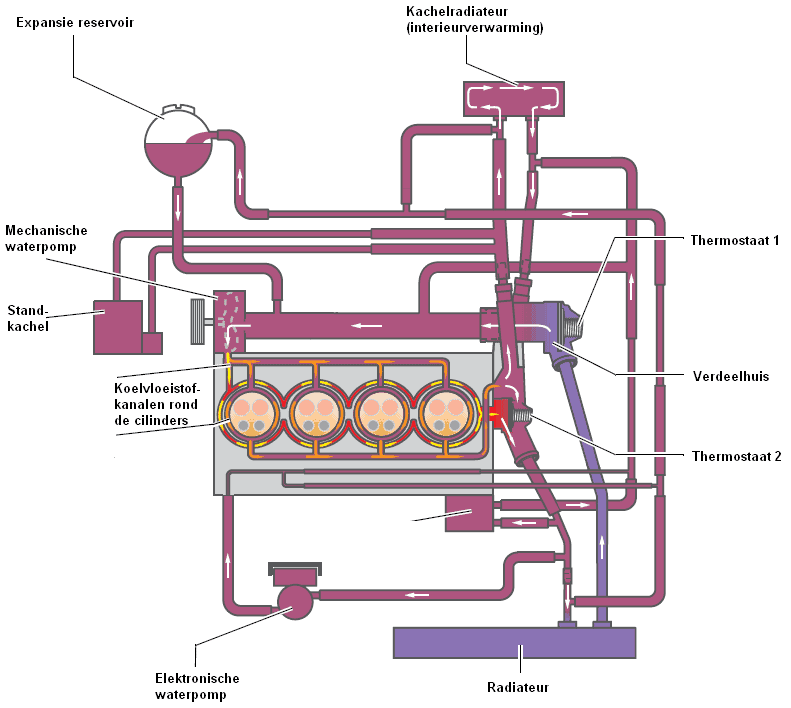
It is important to cool the engine, because the engine can overheat, lubrication can be compromised, and the risk of knocking (uncontrolled combustion) is highest. The thermal load on the engine also has a major impact on its service life. Both the engine oil and the coolant have the task of cooling the engine internally. The cooling system of an engine contains a number of very important components, which are listed below:
- Expansion tank; this contains a supply of coolant
- Heater matrix; for interior heating
- Thermostat; 2 units, divided over 2 cooling circuits
- Radiator; the coolant is cooled here by the passing air (ram air)
- Water pump; ensures circulation of the coolant. The water pump is usually driven by the timing belt or auxiliary belt. Nowadays the water pump is also increasingly driven electronically.
- Parking heater; preheats the coolant before the engine is started. This is often an option. Most cars are not equipped with a parking heater.
The cooling fan protects the cooling system from overheating.
Consequences of too much or too little cooling:
A lack of cooling can occur when the coolant cannot circulate properly. This can be caused by too little coolant being present (leakage), a blockage in the cooling system (e.g. the radiator), a defective water pump causing poor circulation of the coolant, or when the cooling fan / viscous fan does not switch on. As a result of insufficient cooling, the following things can happen:
- Overheating;
- Seizure of engine components;
- Piston rings breaking;
- Thickening of the engine oil (lighter components in the oil evaporate, causing it to become more viscous);
- Knocking.
Knocking can also be caused by petrol with too low an octane rating, an overly lean air/fuel mixture, an ignition timing that is set too far advanced, or carbon deposits in the combustion chambers. More information about this can be found on the knocking page.
- High fuel consumption (the engine does not reach operating temperature).
- Internal contamination (at low temperatures, more combustion residues and dirt particles remain behind in the engine).
- Condensation of fuel droplets (poorer combustion).
- Interior heater does not get warm.
Different cooling methods:
- Indirect cooling: The warm air is absorbed by the coolant and then released in the radiator to the ram air. That is why liquid cooling is called “indirect cooling”. Nowadays all passenger cars have indirect cooling.
- Direct cooling: The heat is ultimately removed by the ram air. Because with air cooling the heat is transferred directly to the ambient air, we speak of direct cooling. Older cars were often air-cooled (e.g. the first VW Transporters and Beetles). By using cooling fins on the engine block, the components were cooled by the ram air. Ram-air cooling is a simple and inexpensive cooling method. The airflow passes along the cylinder and directly absorbs the heat.
- Forced-air cooling: A fan blows cool air along the cylinders and cylinder heads. Cylinders and cylinder heads are also fitted with cooling fins. By using ducting around the fan and the components to be cooled, the cooling air is distributed in such a way that uniform cooling is achieved.
The advantages of air cooling include the fact that less maintenance is required. No leakage can occur as with liquid cooling, the coolant level does not need to be checked or replaced, etc. There is also a shorter warm-up period. At start-up, the coolant does not first need to be warmed up, so an air-cooled engine reaches operating temperature more quickly. Wear during the warm-up period is therefore also lower.
Pressure test:
When the coolant level in the reservoir keeps dropping, there is probably a leak. Sometimes the leak is so small that it is not visible when shining a flashlight on the engine block and the surrounding components. The small amount of coolant that ends up on a hot part of the engine block can evaporate, leaving no traces of leakage.
Because the cooling system is not pressurized when the engine is switched off (cold), no coolant will leak while the car is standing still. In such cases, the car’s cooling system can be pressurized. The coolant can then leak away at locations where a gasket has dried out or cracked.
An example of the pressure test can be seen in the image.
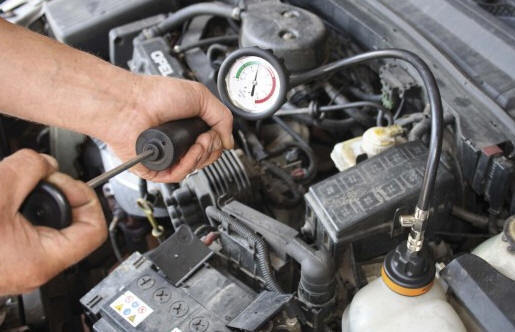
A pressure tester (often a hand pump with a gauge indicating the pressure) is supplied with a number of different mounting caps. Not every connection of coolant reservoir or radiator cap is the same. After mounting the correct pressure cap, the pressure tester can be connected to the cap using a quick coupling. By moving the piston rod of the pressure tester back and forth several times, overpressure is applied to the cooling system. The radiator hoses and coolant hoses on the engine will become firm. It is sometimes necessary to keep the cooling system pressurized for at least an hour before a leak becomes visible. Droplets may then appear at the ends of hoses, at gaskets of the thermostat housing, or at other coolant cover plates.
The image shows leakage at the lower radiator hose:
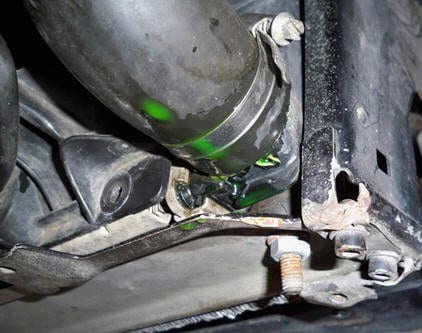
When a leak has been detected, it must be repaired using new parts. Sometimes a new gasket or O-ring costing only a few euros is sufficient. Under no circumstances should you pour a sealant into the radiator. This so-called “radiator stop leak” can cause blockages in the cooling system. Not only the opening where the leak is located will be sealed, but possibly also the cooling channels in the radiator or heater matrix.
Related page: