Introduction rain / light sensor:
Nowadays, more and more light sensors are being used in cars. These sensors measure the amount of (sun)light that shines on the car’s windscreen. Based on this, the sensor switches the vehicle’s lighting on or off.
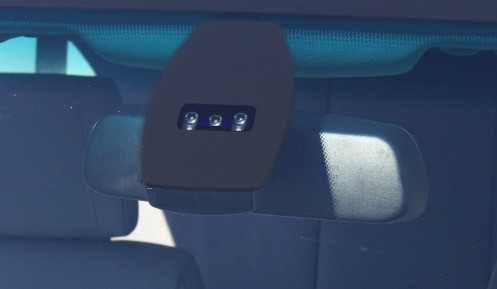
The light sensor is mounted behind the interior mirror. Most cars with a light sensor also have a rain sensor. These are then located next to each other in a single housing. That is why both sensors are discussed on this page. The rain sensor measures the light transmittance of the windscreen, which changes due to reflections when water droplets are on the windscreen.
Operation of the rain sensor:
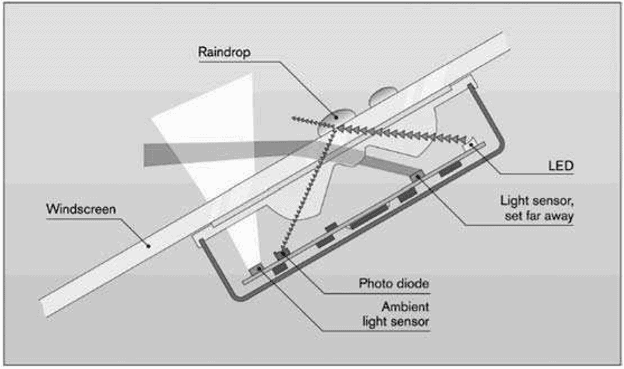
The rain sensor detects whether there is moisture on the windscreen. As soon as moisture or droplets are detected, the rain sensor activates the windscreen wipers.
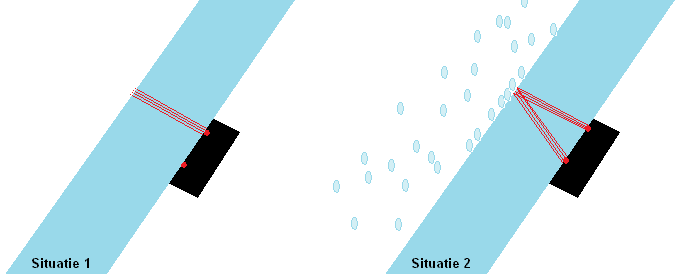
The image shows two situations:
Situation 1: It is dry. The rain sensor emits infrared light through the windscreen to the outside. It is not reflected back, so the rain sensor does not activate anything.
Situation 2: It is raining. The raindrops land on the windscreen and the direction of the infrared light beams is disturbed. The raindrops act as a kind of mirror / magnifying glass, causing the infrared light to be reflected back through the windscreen to the rain sensor. The rain sensor detects this and activates the windscreen wipers.
The rain sensor is also able to measure the intensity of the moisture level; during a heavy rain shower the 2nd or 3rd speed of the wiper motor is switched on. However, there is also a disadvantage. As soon as the wiper blades are slightly worn, a moisture trail may remain on the windscreen after wiping. As a result, the rain sensor continues to detect moisture on the windscreen and keeps activating the windscreen wipers, even though it has not been raining for quite some time.
Operation of the light sensor:
The light sensor is mounted together with the rain sensor behind the interior mirror. The light sensor is also called an LDR; Light Dependent Resistor. The LDR is an electrical sensor whose internal resistance changes when the light intensity changes.
The resistance becomes lower with a lot of light and higher with little light.
As discussed in the chapter Ohm’s Law, the resistance changes the current in the electrical circuit. This means that when the resistance becomes lower, the current will increase. The LDR is connected to a control unit, which measures the amount of current coming from the LDR.
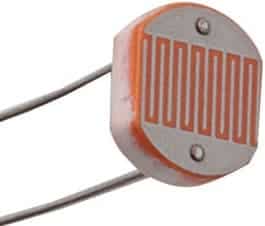
During the day with a lot of sunlight, the resistance will be high, so the current will be low. The control unit keeps the vehicle’s lighting switched off. As soon as it starts to get dusk, or when the car enters a dark space (a tunnel or a parking garage), the resistance value of the sensor changes. It drops, the current increases, and the control unit determines on the basis of this data whether the lights need to be switched on.
When exiting the tunnel, the control unit deliberately keeps the lights switched on for between 5 and 10 seconds, otherwise the lighting would constantly switch on and off with changing light conditions. That would not only be annoying for the driver and other road users, but it would also shorten the lifespan of the bulbs.