Introduction:
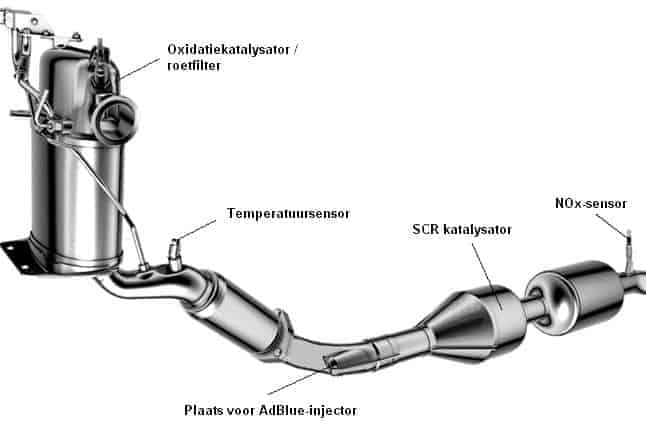
The NOx sensor is mounted in the exhaust directly after the Selective Catalytic Reduction (SCR catalyst). The NOx sensor checks whether there is still any NOx present in the exhaust gases. If that is the case, the harmful substances in NOx have not been sufficiently converted into the harmless substances nitrogen (N2) and water (H2O). In that case, more AdBlue will be injected.
The NOx sensor is used not only in systems with an SCR catalyst and AdBlue, but also in systems with only a NOx storage catalyst. In the latter system, the storage catalyst will be regenerated by temporarily applying a richer mixture; additional fuel is then injected.
Operation of the NOx sensor:
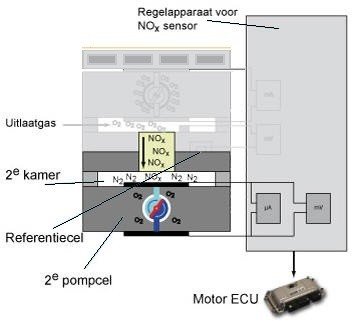
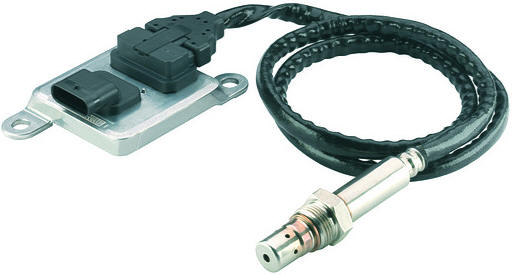
In the image the components of the NOx sensor and the control unit can be seen. The NOx sensor consists of two chambers, two pump cells and a heating element. The sensor element is made of zirconium dioxide; this material has the property that when an electrical voltage is applied, the negative oxygen ions flow from the negative electrode to the positive electrode.
In the first chamber a portion of the exhaust gas is collected. There the oxygen concentration is reduced so that the nitrogen oxide content in the exhaust gas can be measured. Based on the different oxygen levels in the exhaust gas and the reference cell, an electrical voltage can be measured at the electrodes. The control unit of the NOx sensor regulates this voltage at a constant value. The value corresponds to an air/fuel ratio of lambda = 1. To achieve this, oxygen is pumped into or out of the first chamber by the pump cell, and the oxygen concentration in the first chamber can be regulated to a specific value.
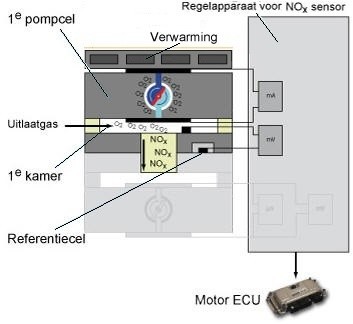
The exhaust gas flows from the first to the second chamber (see image). The NOx molecules in the exhaust gas are split into N2 and O2 at a special electrode. Because the voltage at both the inner and outer electrodes is constantly 450mV, the oxygen ions move from the inner to the outer electrode. Here, the current flowing through the oxygen pump is indicative of the nitrogen content in the second chamber. Because the current through the oxygen pump is equal to the nitrogen oxide content in the exhaust gas, the amount of nitrogen oxides can be determined on this basis.
The NOx sensor can only operate once the temperature of the exhaust gases is high enough. At that point there will no longer be any condensed water present and the measurement will not be affected by it. The measured signal is sent by the NOx sensor control unit to the engine control unit.